
Order Online
- Straight to your door!
Straight to your door


Think of your home's plumbing like its veins and arteries; the 32mm waste pipe is one of the most common vessels, quietly getting on with the job of carrying away wastewater from your bathroom. This specific size is the go-to standard for most bathroom basins and small sinks across the UK, making it a staple for any plumbing job, big or small. Getting to grips with its role is the first step to a successful installation or a quick repair.
A 32mm waste pipe is a cornerstone of modern plumbing, designed for fixtures that don't shift huge volumes of water. Its main job is to drain greywater—the used water from sinks, basins, and bidets—and get it safely into the larger soil pipe system, which carries everything away from your property. It sounds simple, but the dimensions are spot-on for a reason.
Imagine trying to drink a glass of water with a massive fire hose versus a normal straw. The straw gives you the right amount of control and flow. In the same way, a 32mm pipe provides the perfect balance for a bathroom sink. It lets water drain fast enough to avoid backing up but keeps the flow strong enough to be self-cleaning.
This pipe size isn't just a random choice; it’s the standard in the UK for good reason. It’s all about performance and meeting regulations. If you use a pipe that's too big for a small basin, you’ll run into trouble. The trickle of water won't have enough force to push soap scum and other gunk along, leading to build-up and, eventually, a blockage.
On the flip side, a pipe that’s too small would drain painfully slowly, leaving you with a sink full of water every time you use it. The 32mm diameter hits that sweet spot, giving you the best performance for the most common jobs around the house.
For both the trade and the keen DIYer, knowing when and why to reach for a 32mm waste pipe is fundamental. It’s not just about connecting point A to point B; it’s about building a reliable and efficient drainage system that’s made to last.
This guide will walk you through everything you need to know about this plumbing essential. We'll cover:
When you pick up a piece of plumbing pipe, the number printed on the side tells a crucial story. For a 32mm waste pipe, that figure refers to its external diameter—the distance across the outside of the pipe. This is the standard measurement in UK plumbing, and it’s the key to making sure every fitting, from a simple connector to a complex trap, lines up perfectly.
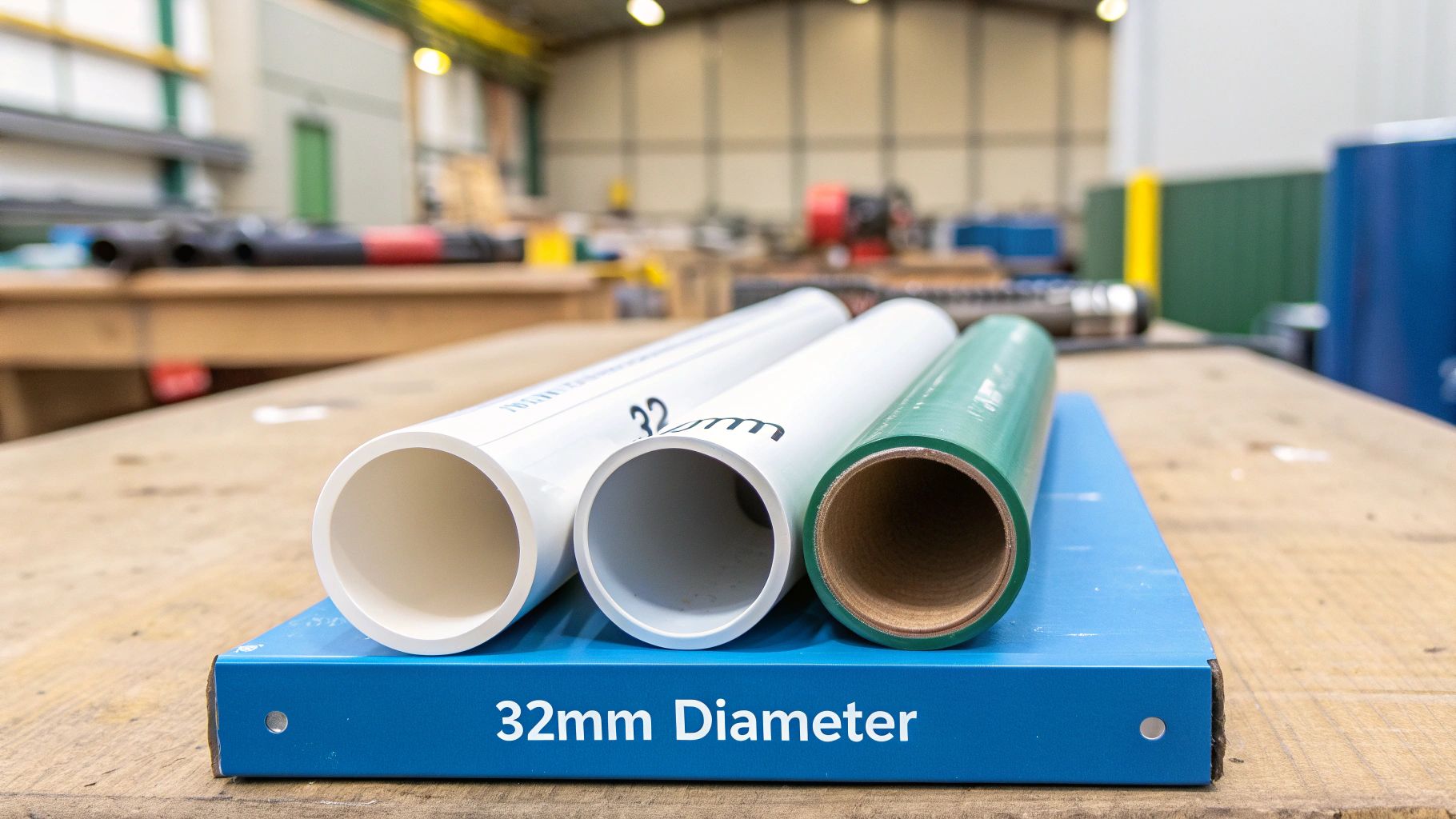
Getting this simple fact right is the first step towards a leak-free job. While the external diameter is fixed at 32mm, the internal diameter can vary slightly depending on the pipe wall's thickness. But for all practical purposes, that outside measurement is your golden rule for compatibility.
Not too long ago, domestic waste systems relied on heavy materials like copper or lead. While they were tough, these metal pipes were a pain to work with—they were cumbersome, prone to corrosion, and required skilled techniques like soldering to join them. The move to modern plastics was a huge leap forward, a bit like swapping heavy, rusting armour for lightweight, high-performance protective gear.
Today’s plumbing world is dominated by advanced polymers, mainly unplasticised polyvinyl chloride (PVC-U) and Acrylonitrile Butadiene Styrene (ABS). These materials have completely changed the game, making plumbing work faster, more reliable, and much more accessible for both the pros and the weekend DIY warrior. Their natural properties just make them a better choice over old-school metal pipes for modern drainage.
The widespread switch to plastic for the 32mm waste pipe is no accident. These materials bring a whole host of practical benefits to any plumbing project, big or small.
This blend of strength, convenience, and value is exactly why plastic has become the industry standard. It’s a dependable solution that stands up to the demands of daily use while making the whole installation process a lot simpler.
When you're deciding on the right pipe for your project, it's helpful to see how the most common materials stack up against each other. Each has its own strengths that make it better suited for certain jobs.
| Material | Key Advantages | Best Use Cases | Considerations |
|---|---|---|---|
| PVC-U | Highly durable, UV resistant, and very affordable. Solvent weld joints create a strong, permanent bond. | General domestic waste from basins, sinks, and utility rooms. Great for both exposed and concealed pipework. | Can become brittle in very cold temperatures. Solvent cement requires good ventilation during application. |
| ABS | Tougher and more impact-resistant than PVC-U, with better performance at low temperatures. | High-traffic areas like commercial kitchens or utility rooms where pipes might get knocked about. | Slightly more expensive than PVC-U. Also requires a specific type of solvent cement for joining. |
| Push-Fit Plastic | Incredibly easy and fast to install with no special tools or solvents needed. Joints can be demounted. | Quick repairs, temporary setups, or projects where you might need to make adjustments later. Ideal for DIYers. | Can be bulkier than solvent weld fittings and more expensive per connection. May not be suitable for concealed pipework. |
Ultimately, PVC-U is the go-to for most standard domestic jobs thanks to its excellent balance of cost and performance. However, if you're working in a high-impact area or need the flexibility of a quick-fit system, ABS or push-fit options are well worth considering.
The standardisation of waste pipe diameters is a cornerstone of modern domestic plumbing. This ensures efficient, reliable drainage and helps prevent the common blockages that can disrupt a household.
In the UK, the 32mm waste pipe is a key part of domestic plumbing systems, officially recognised in Building Regulations Part H since a major update in 2004. These regulations specify that 32mm pipes are ideal for sink and basin waste, as they can handle flows up to 1.5 litres per second without backing up—a critical detail, given that blockages are behind over 70% of reported domestic drainage issues. You can dive deeper into wastewater infrastructure trends on transparencymarketresearch.com.
This regulatory framework doesn't just make systems work better; it makes them consistent, allowing for predictable performance and easier maintenance down the line. Choosing the right material within this framework is your next crucial step.
Alright, we’ve covered the technical bits. Now let's get practical. Knowing exactly where a 32mm waste pipe fits into your home's plumbing is key to getting any job right. Think of it like this: you wouldn't use a delicate screwdriver to break up concrete, and you definitely wouldn't install a massive pipe for a tiny hand basin.
This specific diameter is the undisputed champion for fixtures with a lower water flow. It’s sized just right to handle the volume of water from smaller sinks, creating a flow that's strong enough to carry away soap scum and debris. That little detail helps keep the pipework clear down the line.
In pretty much every UK home, the 32mm waste pipe is the go-to choice for small-scale drainage. It strikes the perfect balance, allowing for swift drainage without being overkill for the job.
Here’s where you'll almost always find it:
Choosing the right pipe size isn't just a friendly recommendation; it's a core principle of good plumbing. Using a 32mm pipe in these specific spots ensures your drainage system works exactly as intended, preventing future headaches with slow flow and blockages.
Getting this right from the start helps you plan your plumbing layout with confidence, ensuring every fixture is hooked up with the proper pipework.
Just as important as knowing where to use this pipe is knowing where not to. Fitting a pipe that's too small for the job is one of the most common DIY plumbing mistakes, and trust us, it leads to frustrating and costly problems. An undersized pipe simply can’t cope with high volumes of water or solid waste.
Avoid using a 32mm waste pipe for these fixtures at all costs:
A 32mm waste pipe is only ever the starting point of a plumbing job. It’s the fittings and traps that bring the whole system together, creating a reliable, leak-proof network that you can trust. Getting your head around how these parts work is crucial, whether you're a seasoned pro or an ambitious DIYer, as they're the real backbone of any successful installation.
These vital connectors are what let you join pipes, navigate tricky corners, and hook up fixtures securely. The choice you make between the two main methods—solvent weld and push-fit—really comes down to the demands of the job at hand.
Think of it like choosing between welding a steel frame or bolting it together. One gives you permanent, unshakeable strength, while the other offers flexibility and the chance to make adjustments down the line.
Solvent Weld Fittings: This method creates a permanent, chemical bond between the pipe and the fitting. You apply a special solvent cement to both surfaces, which momentarily melts the plastic. When you push them together, the two pieces fuse into a single, seamless unit. The result is an incredibly strong and reliable joint, perfect for pipework that’s going to be hidden away behind walls or under floorboards.
Push-Fit (Compression) Fittings: These are the last word in convenience. Each fitting has a rubber ring, or 'O' ring, inside that creates a watertight seal when the pipe is pushed home. A screw-on cap then tightens everything down, compressing the ring around the pipe. The big advantage here is speed and simplicity. There's no messy cement, and the joints can be taken apart and reassembled if you need to make changes.
For the tradespeople sourcing from Neasden Hardware, this means you get reliable access to robust stock levels of 32mm compression waste pipes, complete with solvent weld joints that boast a 99.5% leak-free installation rate when fitted correctly, a figure validated by British Standards Institution testing back in 2020. Historically, their adoption shot up after the 1990 Building Regulations, helping to cut wastewater leaks by a massive 42% in urban areas like London. You can learn more about the evolution of plastic pipe usage over on ceresana.com.
Once your pipes are connected, the trap is the next essential piece of the puzzle. A trap is that U-shaped or bottle-shaped bit of pipework you see directly under a basin's plughole. Its design is simple but genius: it holds a small amount of water at all times, creating a barrier that stops unpleasant sewer gases from creeping up the drain and into your home.
Without a trap, your bathroom would quickly start to smell of the main drainage system. It's a non-negotiable component required by UK building regulations for every single fixture.
A correctly installed waste trap is your first line of defence against drain odours and is fundamental to a hygienic plumbing system. It’s a simple component that does an incredibly important job.
There are a few different types of traps out there, but for a 32mm waste pipe connected to a bathroom basin, you’ll typically come across three main designs.
Choosing the right trap often comes down to the space you've got to work with and the look you want to achieve, especially if the pipework is going to be on show.
P-Trap: Named for its distinct shape, the P-trap is the most common type you'll see. It has a U-bend followed by a horizontal arm that connects directly to the waste pipe in the wall. It offers excellent flow and is very good at self-cleaning, making it a solid, reliable choice for most setups.
S-Trap: Similar to a P-trap, the S-trap has a deeper bend that directs the waste pipe down into the floor instead of into the wall. You'll often find them in older properties, but they're less favoured in new installations because they can be more prone to siphoning the water seal away.
Bottle Trap: This trap has a sleek, cylindrical design, which makes it the perfect choice for modern bathrooms where the pipework is exposed, like under a wall-mounted basin. The bottom of the 'bottle' can be unscrewed for easy cleaning, which is a fantastic practical touch.
This infographic gives a simple overview of where a 32mm pipe is a suitable choice and where a larger diameter is needed.
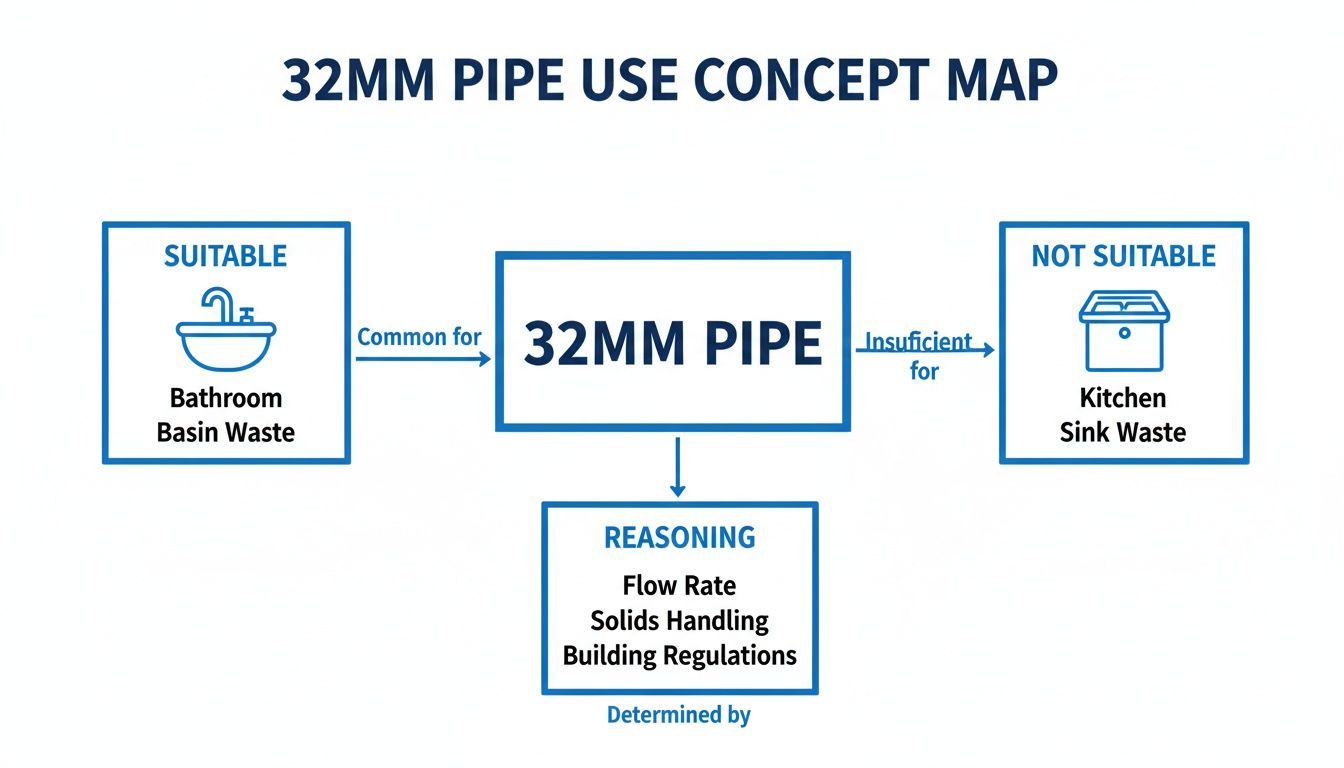
As the diagram shows, while 32mm pipes are ideal for low-flow bathroom basins, they just aren't cut out for high-volume fixtures like kitchen sinks. Picking the correct trap and fittings for the job is the final step in building a drainage system that’s both robust and efficient.
A professional, leak-free job isn’t about luck; it’s about technique. Getting the fundamentals right when fitting a 32mm waste pipe is what separates a quick, successful job from one that causes endless headaches down the line. From the first measurement to the final connection, every single step plays a vital role.
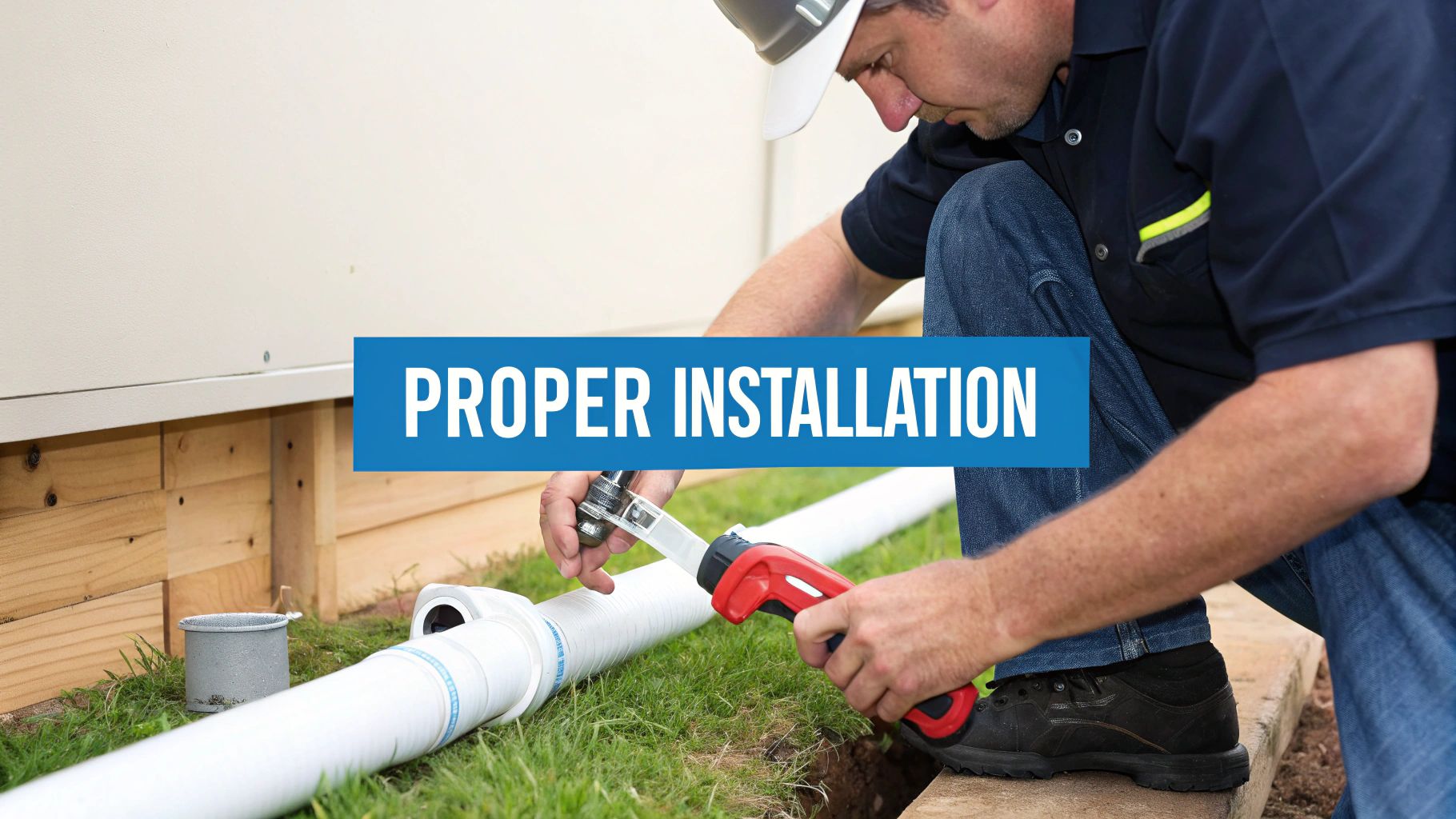
Here, we'll cover the essential steps, common pitfalls, and the one crucial element that ensures your pipework looks after itself for years to come. Let's get it right the first time.
The old saying "measure twice, cut once" has never been more relevant. Inaccurate measurements are the root cause of poorly fitting joints, which create stress on the pipework and lead to leaks. Always measure the exact length you need between the centre points of your fittings.
Once you have your measurement, a clean, square cut is non-negotiable. Using a dedicated plastic pipe cutter is the best way to get a perfect 90-degree angle. A hacksaw can work in a pinch, but you have to use a mitre box to guide the blade. An angled cut will prevent the pipe from sitting flush inside the fitting, compromising the seal.
For larger jobs that involve cutting through materials to route your pipe, a versatile tool like the Bosch Hex-Shank Hole Saw is invaluable for creating clean entry and exit points.
After cutting, every edge must be deburred. This just means removing the rough plastic shavings from both the inside and outside of the pipe end. A simple deburring tool or even a file will do the job. Skipping this is a classic mistake; those tiny shavings can catch waste, snag the rubber seal in a push-fit fitting, or stop solvent cement from creating a complete bond.
Gravity is your best friend in plumbing. To work properly, a horizontal 32mm waste pipe must have a steady downward slope, known as the 'fall'. This ensures water and waste are carried away efficiently, preventing gunk from settling and creating blockages.
According to UK Building Regulations, the ideal gradient for a 32mm waste pipe is between 18mm and 90mm for every metre of horizontal pipe run. This specific range is the secret to a self-cleaning system.
A slope within this range creates a flow that's fast enough to move solids along but not so fast that the water outruns the waste, leaving it behind. It's a delicate balance, and getting it wrong is one of the most common causes of drainage problems.
Avoiding common pitfalls is just as important as following the right steps. Here’s a quick-reference guide to help you steer clear of the most frequent installation errors we see.
Do This, Not That
| Do This | Not That |
|---|---|
| Achieve a steady fall. Use a spirit level to ensure a consistent gradient of 18-90mm per metre. | Create a shallow or level run. A slope less than 18mm per metre is just asking for blockages as solids will settle. |
| Deburr every single cut. Smooth the inside and outside edges of the pipe for a perfect, debris-free seal. | Leave rough edges. These will damage seals in push-fit fittings and create points for waste to snag on. |
| Hand-tighten then give a quarter-turn. For compression fittings, this prevents cracking the plastic nut. | Over-tighten fittings. Applying too much force with a wrench will crack the fitting or strip the threads. |
| Apply solvent cement evenly. Use a light, even coat on both the pipe and the inside of the fitting socket. | Use excessive solvent cement. Too much can bead up inside the pipe, creating a ridge that causes future blockages. |
| Support the pipe run. Use pipe clips every 500mm (0.5m) horizontally to stop the pipe from sagging over time. | Leave long runs unsupported. Sagging creates low spots where water and sludge will pool, leading to nasty blockages. |
By focusing on these core principles—accurate measurement, clean cuts, correct fall, and proper jointing—you're setting your project up for success. This approach ensures your 32mm waste pipe installation is not only leak-free but also built for long-term, trouble-free performance.
A properly fitted 32mm waste pipe system should give you years of trouble-free service. But 'low-maintenance' isn't the same as 'no-maintenance'. With just a few good habits, you can head off the slow drains and gurgling sounds that signal a blockage is on its way, keeping everything flowing as it should.
Think of it like changing the oil in your car—a little preventative care now saves a world of hassle later on. Stopping the build-up of soap scum, hair, and other gunk is always easier than clearing out a stubborn clog.
The best way to fix a blockage is to make sure it never happens in the first place. These simple habits take just a few seconds but can save you hours of frustration down the line.
Even with the best care, drains can sometimes slow down. When it happens, don't panic. The trick is to start with the gentlest methods and only move on to stronger solutions if needed. For a bit of extra help, this guide to unblocking waste pipes offers some great DIY tips.
By following a logical process, you can tackle most common drainage issues yourself. The key is to start with simple, non-invasive fixes before moving on to more direct methods. It could save you the time and expense of calling in a pro for what might be a minor fix.
We get asked a lot of questions about plumbing, and 32mm waste pipe is a frequent topic for both seasoned pros and weekend DIYers. Here are some straight-talking answers to the most common queries we hear, helping you get the job done right the first time.
Yes, and it's a very common job in plumbing. To do it properly, you'll need a specific fitting called a ‘reducer’. This little connector is designed to create a perfect, watertight seal between the two different pipe sizes.
You can find reducers in both solvent weld and push-fit styles. Just make sure you grab the right 40mm to 32mm reducer that matches the system you're working with.
According to UK Building Regulations, the ideal gradient—or ‘fall’—for a 32mm waste pipe is between 18mm and 90mm for every metre of horizontal pipe. This gentle slope is the secret to good drainage.
This gradient is all about using gravity to let water and waste flow away smoothly. It's single-handedly the most important factor in stopping gunge from building up and causing blockages down the line.
Get this right, and you’ve essentially created a self-cleaning system that won't give you much trouble.
No, a 32mm pipe is definitely not the right choice for a main kitchen sink. While it’s perfect for a small hand basin in a cloakroom, a kitchen sink in the UK needs a 40mm waste pipe as standard.
Think about it: a kitchen sink has to deal with a much higher volume of water, not to mention grease and bits of food. The larger diameter of a 40mm pipe is built to handle that heavy load without complaining. Using an undersized pipe here is a recipe for frequent and frustrating blockages. If you do notice smells starting to build up, using a good drain odour remover can help keep things fresh.
For all your plumbing essentials, from pipes and fittings to tools and accessories, trust Neasden Hardware to deliver quality products for your next project. Explore our full range at https://neasdenhardware.co.uk.