
Order Online
- Straight to your door!
Straight to your door


A rim lock is one of those classic pieces of hardware you instantly recognise, even if you don't know the name. It’s a surface-mounted lock, meaning the entire mechanism sits in a neat metal box right on the face of the door, rather than being hidden away inside it. This makes the lock itself a visible, and often very decorative, part of the door furniture.
If you've ever found yourself admiring the charming, slightly rustic hardware on a door in a period property or a cosy country cottage, chances are you were looking at a rim lock. Unlike a modern mortice lock, which needs a deep pocket chiselled into the edge of the door, a rim lock is simply fitted onto the interior surface. It’s this design simplicity that’s a huge part of its enduring appeal.
This approach makes it a go-to choice for older or thinner doors, where cutting a large recess for a mortice lock would be either impractical or downright damaging. Its visible presence also adds a genuine touch of character and history to a space, connecting it to a long and proud tradition of British ironmongery.
The rim lock is no recent invention. It’s the oldest type of lock still commonly used across the United Kingdom and Ireland, with a history stretching all the way back to the early 17th century. These mechanisms were developed when doors needed practical locking systems, long before the days of modern precision engineering. You can learn more about the historical significance of the rim lock's development.
This rich heritage is precisely why rim locks are so often specified for restoration projects and homes where keeping a traditional aesthetic is the top priority.
To get a quick handle on what makes a rim lock unique, this table breaks down its core features. It's a simple way to see its defining attributes, from how it's mounted to where you'll most often find it.
| Feature | Description |
|---|---|
| Mounting Style | Surface-mounted directly onto the face of the door. The entire lock body is visible. |
| Aesthetic | Offers a traditional, often rustic or Victorian appearance. Available in many finishes. |
| Installation | Simpler to install than a mortice lock as it does not require a deep recess. |
| Common Uses | Ideal for internal doors in period properties, cottages, sheds, and garden gates. |
| Security Level | Provides a basic level of security; often paired with a stronger lock on external doors. |
In short, these characteristics highlight why the rim lock remains a popular choice for specific applications where style and simplicity are key.
At first glance, a rim lock is just a simple box on a door, but its mechanism is a clever bit of engineering that’s proven its worth over centuries. Getting to grips with how it works takes the mystery out of it, giving you a clear picture of what’s happening every time you turn the key or twist the knob. The whole show is run by a few key parts working together inside the lock's case.
Think of the main casing as the 'control centre'. Inside, you’ll find a system of levers and springs just waiting for you to give the command. The main players here are the latch bolt and the deadbolt – the two components responsible for keeping the door shut and securely locked.
The latch bolt is that angled, spring-loaded bit that shoots back when you turn the doorknob. This is what clicks into the frame as you close the door, holding it shut without actually locking it. Its angled edge is what allows the door to close smoothly, so you don't have to turn the handle every single time.
The deadbolt, on the other hand, is the solid, square-ended bolt that provides the real security. It isn’t spring-loaded and can only be moved with the key. When you lock the door, the key slides the deadbolt into the frame, securing it firmly in place.
A simple way to remember the difference is that the latch bolt catches the door, while the deadbolt locks it. This two-part system is fundamental to how a rim lock provides both convenience and security.
So, how does the key make all this happen? A traditional rim lock key, often what we’d call a skeleton key, is cut to navigate past a series of internal obstructions (known as wards) to engage with the lock's levers. When the right key is turned, it lifts these levers to the perfect height, clearing the way for the deadbolt to slide across.
Of course, all these moving parts would be useless without the final piece of the puzzle: the keep.
This straightforward, purely mechanical process is exactly what makes the rim lock so reliable. There are no complex electronics to fail, just well-designed ironmongery working in harmony to keep your space secure.
Choosing the right lock often comes down to a classic hardware dilemma: the visible charm of a rim lock versus the concealed strength of a mortice lock. It's a choice that pits tradition against modern minimalism. Understanding the fundamental differences between these two, along with their popular cousin, the cylinder nightlatch, is the key to getting the right balance of security and style for your door.
This isn't just about looks; it's about how they're installed, how they function, and what job they're best suited for.
A rim lock, as we've seen, is essentially a self-contained box. Its entire mechanism is fitted proudly onto the face of the door. This makes it an ideal solution for older, thinner, or more delicate doors where cutting a large cavity into the wood would be damaging or just plain impractical.
In stark contrast, a mortice lock is designed to be hidden. It requires a deep pocket, or 'mortice', to be chiselled into the edge of the door. The body of the lock is tucked away, leaving only a discreet keyhole and faceplate visible. This creates a much cleaner, more seamless look that suits a lot of modern homes. To get the full story, check out our guide on what mortice locks are and how they work.
The most obvious difference between the two is how they look and how you fit them. A rim lock is all about character—its visible form becomes part of the door's personality, which is perfect for period properties aiming for an authentic feel. Installation is also relatively straightforward, usually just requiring screws to fix the lock body and the keep in place.
A mortice lock, however, is all about that integrated, seamless appearance. Fitting one is a more involved job, demanding precise woodworking skills to create the internal pocket. The payoff is a lock that's felt but not seen, offering solid security without interrupting the door's design.
This flowchart shows the simple, surface-mounted components that make up a traditional rim lock.
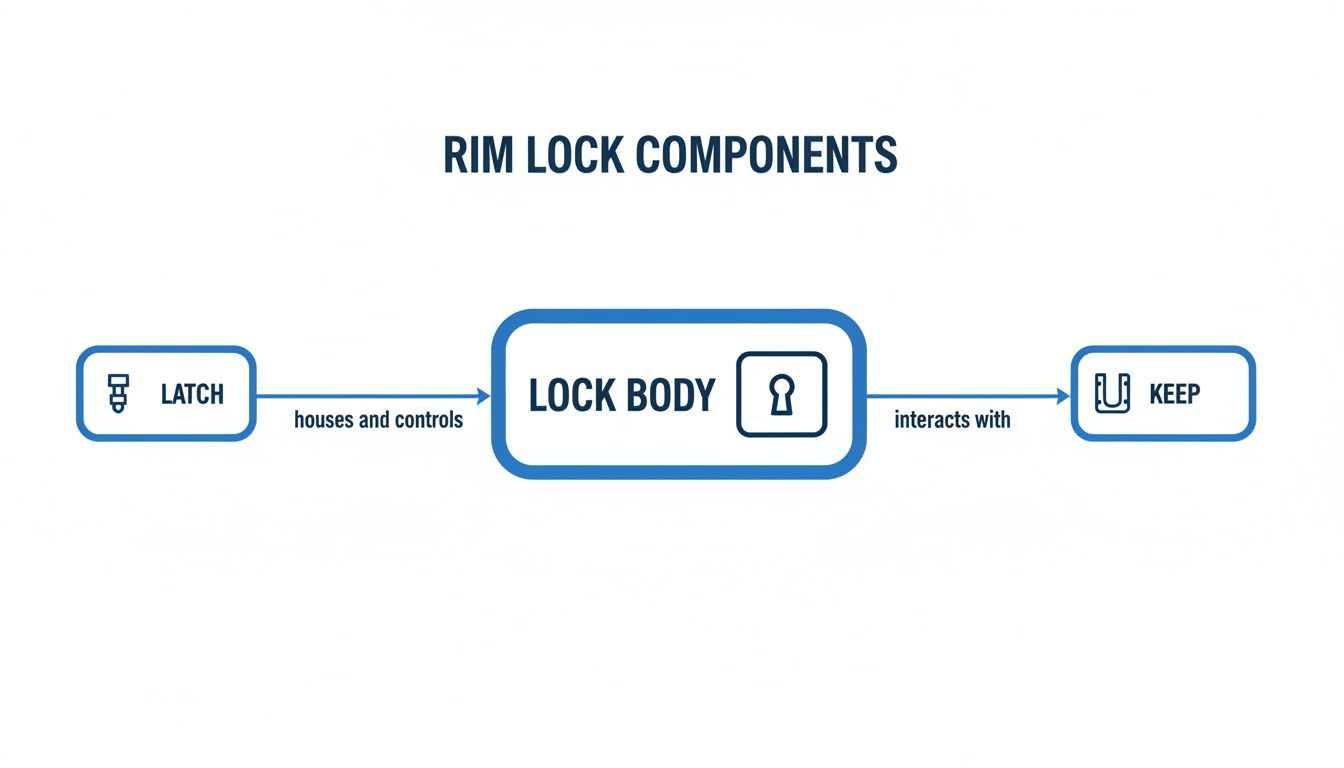 You can see how the lock body, latch, and keep all work together on the outside of the door—a world away from the concealed mechanism of a mortice lock.
When it comes to pure security, the mortice lock generally has the upper hand, especially for external doors. Because its body is embedded deep within the door's structure, it offers far greater resistance to brute force attacks. It's no surprise that a 5-lever mortice deadlock is often an insurance requirement here in the UK.
Rim locks are perfectly secure for most internal doors, but for external doors, they're usually considered secondary security. Many modern 'nightlatches' are technically a type of rim lock, but for a front door, they are almost always paired with a mortice lock to provide proper protection.
In essence, think of it this way: a rim lock adds character and provides convenient latching, while a mortice lock provides deep, structural security.
To help make sense of it all, we've put together a simple table comparing the three main lock types side-by-side. It breaks down the key differences in installation, security, and aesthetics.
| Attribute | Rim Lock | Mortice Lock | Cylinder Nightlatch |
|---|---|---|---|
| Installation | Surface-mounted; easier DIY fit. | Recessed into door edge; requires precision. | Surface-mounted body, cylinder through door. |
| Best For | Internal doors, period properties, sheds. | External and internal doors needing high security. | Front doors (with a mortice lock). |
| Security | Basic to moderate. | High; often BS 3621 compliant. | Moderate; offers convenience. |
| Aesthetic | Traditional, visible, and decorative. | Concealed, minimalist, and discreet. | Functional and modern. |
Ultimately, the right choice really does depend on your specific needs. It's all about balancing the authentic look of a rim lock with the formidable security that a mortice lock brings to the table.
There's something uniquely charming about a rim lock that modern hardware just can't match. It’s more than a mechanism for keeping a door shut; it's a tangible piece of architectural history. Every turn of the handle tells a story of traditional craftsmanship, blending sturdy function with a decorative character that has graced British homes for centuries.
From grand Georgian townhouses to cosy countryside cottages, the honest, visible design of a rim lock adds an authenticity that concealed locks simply can't replicate. It's a testament to a design perfected long ago that still resonates with homeowners, restorers, and designers today.
The story of the rim lock is woven into the very fabric of Britain's industrial past. While locks were made all over the country, one small town became the undisputed heart of the industry. Willenhall, tucked away in the West Midlands, earned itself the title of the 'Lock Capital of England', dominating production with an incredible focus.
This town was the epicentre of Britain's lock-making world, hitting its stride during the massive industrial boom of the Victorian era. It's estimated that by 1860, a staggering 90% of all locks made in England came from Willenhall and the surrounding area—a phenomenal concentration of specialised skill. You can learn more about this fascinating industrial heritage and the legacy of Britain's lock capital.
It's this history that cements the rim lock as a signature feature of Victorian design, a time when mass production met time-honoured craftsmanship.
If you're taking on an authentic period property restoration, a rim lock isn't just an option—it's practically a necessity. Fitting modern, concealed hardware onto a centuries-old door can feel jarring and out of place, breaking the historical flow of the space.
A rim lock, however, respects the property's original character. It works with the original construction methods and aesthetic, ensuring any renovation enhances, rather than diminishes, the building's historic soul.
But the appeal of the rim lock isn't stuck in the past. These versatile locks have found a firm footing in contemporary homes, offering both practical solutions and a dash of stylistic flair.
This ability to bridge the gap between historical authenticity and modern style is exactly why the rim lock remains such a cherished and relevant piece of British ironmongery.

Picking out the perfect rim lock for your door involves more than just finding a style you like. To make sure it fits perfectly and works without a hitch, you need to think about a few practical details – from which way your door swings to the specific measurements of the lock itself. Getting this right is the difference between a frustrating installation and a flawless finish.
One of the first things you used to have to worry about was the door's 'handing'—whether it opens to the left or right. In the past, this was a huge headache, as locks were often made specifically for one side. Everything changed after 1865, when clever manufacturers came up with the reversible rim lock, a design that pretty much did away with these limitations.
Thankfully, most modern rim locks you'll find today are reversible. This means you can easily flip the latch to suit either a left or right-handed door, making the buying process so much simpler. It's always worth double-checking the product description though, especially if you're buying reclaimed antique hardware.
Of course, a big part of the appeal is how it looks. Your rim lock should feel like a natural part of your home's character, tying in nicely with other door furniture like hinges and handles. The material and finish you choose will completely define its look.
Take a look at the other ironmongery in the room. Matching the finish of your rim lock to your window latches or light fittings helps create a cohesive and really well-thought-out design.
For a rim lock to fit and work properly, two measurements are absolutely critical: the case size and the backset. Taking a moment to measure your door will save you a world of potential headaches down the line. If you need a bit of guidance on the fitting process itself, our in-depth article has a great overview of how to install door locks correctly.
The backset is the most crucial measurement of all. It’s the distance from the edge of the door to the centre of the keyhole or the doorknob spindle. Getting the backset right means the knob will be positioned comfortably, not jammed up too close to the door frame.
If you're dealing with specific security needs or a tricky installation, it can be really helpful to get some expert advice by consulting with locksmith professionals. By just checking these simple details—handing, material, and measurements—you can confidently choose a high-quality rim lock that looks beautiful and works perfectly for years to come.
To wrap things up, let's tackle some of the most common questions that pop up when people are considering a rim lock. Think of this as a quick-fire round to clear up any lingering doubts and give you the practical advice you need.
This is the big one, and it’s a crucial question. While a traditional rim lock offers a basic level of security, it's not typically recommended as the sole lock for an external door in a modern home. Its surface-mounted design can be more vulnerable to a brute-force attack compared to a mortice deadlock, which is set deep inside the door itself.
For front or back doors, the UK standard is to pair a rim lock (often a modern 'nightlatch' style) with a BS 3621 (British Standard) compliant 5-lever mortice deadlock. This combination gives you the best of both worlds: the day-to-day convenience of the latch and the high security demanded by most home insurance policies. For sheds, garden gates, or internal doors where high security isn't the priority, a traditional rim lock is often more than enough.
Absolutely. For a competent DIYer, fitting a rim lock is a very achievable weekend project. Because the whole mechanism sits on the surface of the door, you get to skip the tricky chiselling and cutting needed for a mortice lock. The secret to success is just careful measurement and alignment.
Here’s the basic process:
That said, if you’re working with a precious period door or just aren't feeling confident, calling in a professional carpenter or locksmith is always a smart move. They'll get it done neatly and securely.
Rim locks are famously low-maintenance and built to last. A quick annual check-up is usually all it takes to keep one working smoothly for decades.
A puff of graphite-based lock lubricant directly into the keyhole and around the moving latch bolt will do the trick. It’s best to steer clear of wet oils like WD-40 inside the lock itself, as they tend to attract dust and gunk up the internal levers over time. It’s also a good idea to check that the screws on the lock body and keep are nice and tight, as the vibrations from opening and closing the door can sometimes loosen them. If you ever need a spare key, it's worth using professional key duplication services to guarantee an accurate copy.
This used to be a real headache, but thankfully, most modern rim locks you'll buy today are 'reversible'. This clever design means the latch can be easily flipped to work on both left-handed and right-handed doors, making life much simpler. When you're looking at different lock types, it helps to know the parts; for a deeper dive, check out our guide on what is a sash lock.
Quick Tip: To figure out your door's 'handing', stand on the side where you pull it towards you. If the hinges are on your left, it’s a left-handed door. If they're on your right, it’s right-handed.
Always double-check the product description, but you'll find that nearly all new locks are reversible. The only time you really need to worry about handing is if you’re sourcing a genuine antique or reclaimed lock for a restoration project – in that case, you'll need to match it perfectly.
For all your ironmongery needs, from classic rim locks to high-security mortice deadlocks, explore the extensive collection at Neasden Hardware. With expert advice and fast, nationwide delivery, we have everything you need for your next project. Visit our online store today!