
Order Online
- Straight to your door!
Straight to your door


You're at the trade counter with a coastal handrail job on the van, and the box of “stainless” bolts looks perfectly suitable. The label says stainless steel, the finish is bright, and the price is lower than the marine-grade option beside it. Then someone asks the question that matters: is it A2 or A4?
That small detail separates a general-purpose stainless fixing from one intended for harsher exposure. It also separates the alloy's corrosion class from its strength class, two points that are often confused even by experienced buyers. A4 stainless steel isn't a guarantee against every form of corrosion, but it can be the sensible choice for coastal, damp and chemically exposed work when the environment and load are matched properly.
The contractor points at the box. “Stainless bolts. They'll be fine on the seafront.”
The counter assistant checks the marking and turns the packet over. They're stainless, yes, but they're A2, not A4. That difference may not be obvious in the hand, and both grades can look identical on the shelf. In a salt-laden environment, however, the choice can affect staining, pitting and the life of the joint.
The word stainless causes trouble. Stainless steel is a family of alloys, not one universal material with one guaranteed performance level. A fixing suitable for an indoor cabinet, sheltered gate or dry workshop may be a poor choice for a balustrade exposed to sea air, trapped moisture or road salt.
The saving at the till can disappear quickly if a failed fixing means a return visit, replacement ironmongery and an unhappy client. Trade buyers often deal with this wider category of hardware alongside hinges, locks and architectural fittings, so a useful introduction to the wider subject is the ironmongery guide.
Counter rule: “Stainless” tells you the material family. The A-number tells you more about the alloy group, and the suffix tells you about mechanical strength.
The marking A4-70 gives you both clues. A4 identifies a molybdenum-bearing austenitic stainless group associated with 316-type stainless steel, while 70 identifies a minimum tensile strength of 700 MPa. A4-80 uses the same broad corrosion-grade designation but reaches a minimum tensile strength of 800 MPa through cold working.
There's a further boundary that matters. A4 is preferred for marine and chemical environments, but it isn't suitable for hydrochloric acid and chlorides in every condition, particularly where heat, evaporation or immersion concentrates the attack. The rest of the buying decision comes down to reading that code properly and understanding where A4 performs well, and where it doesn't.
The code makes more sense when you read it from left to right.
The A identifies an austenitic stainless steel family used for common stainless fasteners. The number distinguishes the composition group. In the UK fastener system, A4 is the group associated with 316-type stainless steel, a molybdenum-bearing alloy selected for stronger resistance to many chloride and chemical environments than A2.
BS EN ISO 3506 provides the fastener framework. The British Stainless Steel Association identifies A4 as a molybdenum-bearing austenitic family and records the latest edition of the fastener standard as issued in 2020. UK stainless-steel references also connect the material framework with BS EN 10088 and the mechanical requirements for fasteners under BS EN ISO 3506, as described by the British Stainless Steel Association's standards guidance.
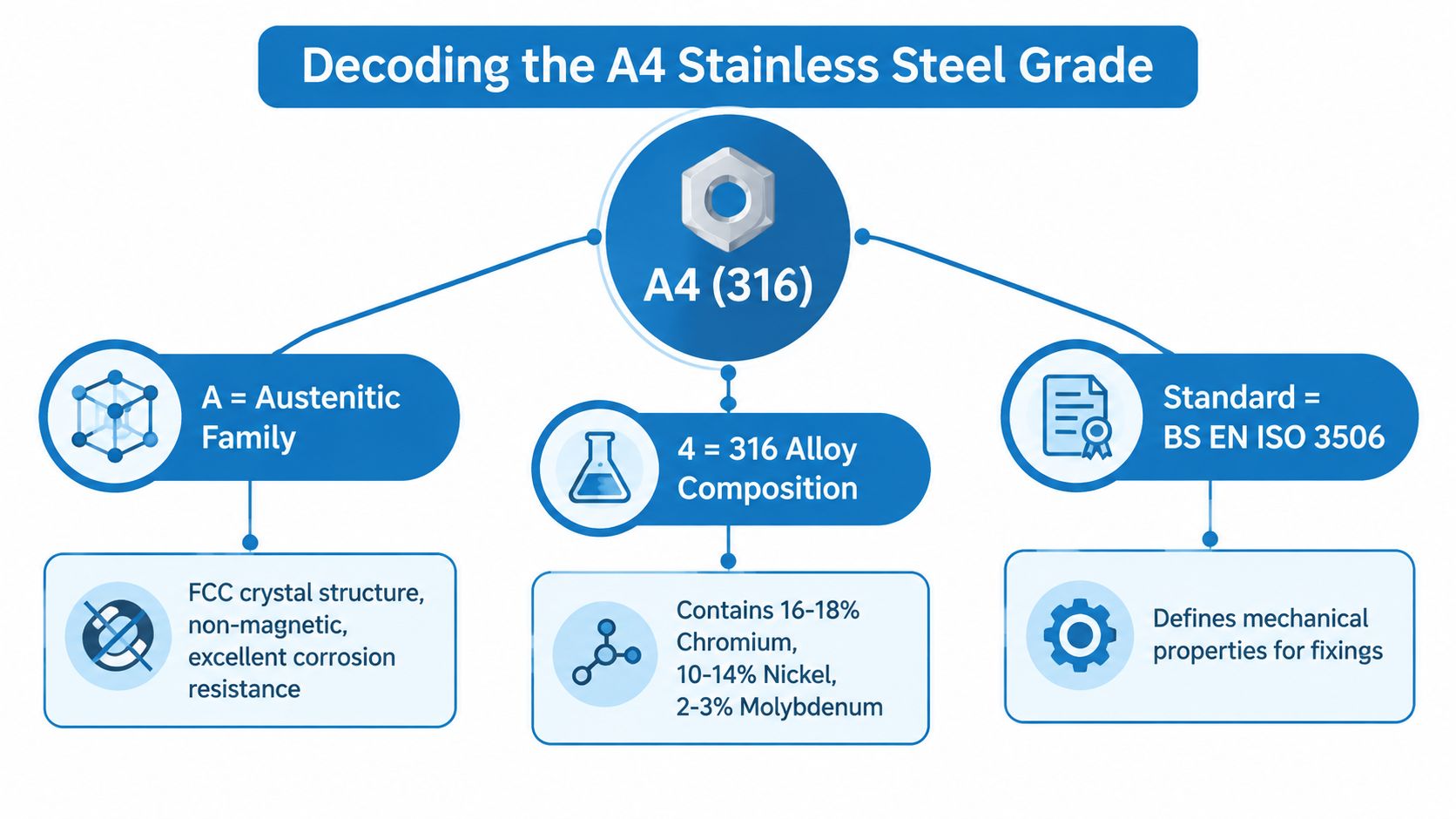
The number after the hyphen is the property class, not a second corrosion rating.
The same UK guidance identifies A4-70 with a minimum tensile strength of 700 MPa and a minimum 0.2% proof strength of 450 MPa. That helps explain why a property class matters when a bolt must maintain clamp load, but it doesn't tell you whether the alloy will survive a particular chemical exposure.
A plain-English translation is therefore:
A4-70 means austenitic stainless, grade group 4, with a minimum tensile strength of 700 MPa.
A4-80 isn't automatically “more corrosion resistant” than A4-70. The A4 part carries the principal alloy and corrosion meaning. The 70 or 80 part describes mechanical performance, so choose it alongside thread engagement, preload, service temperature and joint design.
A4's performance comes from its composition, but buyers don't need a chemistry lecture to use the information. They need to know why the alloy behaves differently from A2 and what the figures mean at the shelf.
The British Stainless Steel Association gives a typical A4 composition with carbon at 0.08% maximum, silicon at 1.0% maximum, manganese at 2.0% maximum, phosphorus at 0.03% maximum, sulphur at 0.045% maximum, chromium at 16.0% to 18.5%, molybdenum at 2.0% to 3.0%, and nickel at 10.0% to 15.0%. The balance is principally iron. These are typical limits and ranges for the grade family, not a promise that every individual product will have the same laboratory result.
| Element | Typical % | What It Does |
|---|---|---|
| Chromium | 16.0% to 18.5% | Forms the passive surface layer that gives stainless steel its resistance to atmospheric corrosion. |
| Nickel | 10.0% to 15.0% | Helps stabilise the austenitic structure and supports formability and toughness. |
| Molybdenum | 2.0% to 3.0% | Improves resistance to localised pitting and crevice corrosion, especially where chlorides are present. |
| Carbon | 0.08% maximum | A controlled limit for the standard grade. Lower-carbon variants are better suited to welded fabrications. |
| Manganese | 2.0% maximum | Supports the alloy structure and manufacturing process. |
| Silicon | 1.0% maximum | Helps during production and contributes to the alloy's composition control. |
| Phosphorus | 0.03% maximum | Kept controlled as part of the grade chemistry. |
| Sulphur | 0.045% maximum | Kept controlled because excess sulphur can affect corrosion behaviour and fabrication. |
The practical headline is molybdenum. It doesn't make A4 immune to chlorides, but it gives A4 an advantage over A2 where salt, dampness and chemical residues encourage localised attack.
Carbon limits matter most when fabrication includes welding. A low-carbon L variant, such as 316L within the wider alloy family, reduces the risk of sensitisation around welded areas. That makes the low-carbon designation relevant to welded assemblies, not automatically to every ordinary bolt or screw bought for a bolted joint.
A2 and A4 are often placed beside each other in the same tray, but they answer different environmental questions. A2, associated with the 304 family, is generally the economical choice for dry indoor work, sheltered locations and many ordinary inland applications. A4, associated with the 316 family, becomes more attractive when chlorides or chemical exposure enter the job.
Cost still matters at the counter. A2 is commonly the sensible specification where the environment is mild, while A4 earns its place when replacement would be awkward or exposure is difficult to control. On a sheltered internal cabinet, A4 may add capability that the joint doesn't need. On a coastal gate, using A2 just because it looks the same can create an avoidable maintenance problem.
For product selection, start with the stainless steel screws range, then check both parts of the marking rather than ordering by the word stainless alone.
A4-70 and A4-80 both belong to the A4 corrosion group. The suffix changes the minimum tensile strength, not the basic chloride-resistance category. A4-80 can be appropriate where the joint needs greater mechanical capacity, but it won't solve a chemical compatibility problem that A4 itself cannot handle.
| Criterion | A2 (304) | A4 (316) | A4-70 | A4-80 |
|---|---|---|---|---|
| Main role | General stainless corrosion grade | Higher corrosion resistance in many chloride and chemical environments | A4 alloy with 700 MPa minimum tensile strength | A4 alloy with 800 MPa minimum tensile strength |
| Typical setting | Indoor, sheltered and milder inland exposure | Coastal, marine above-waterline and selected chemical exposure | General A4 ironmongery and fastening | Higher-loaded A4 joints where the design requires it |
| Corrosion meaning | A2 composition group | A4 composition group | Same A4 corrosion group | Same A4 corrosion group |
| Mechanical meaning | Depends on its own suffix | Depends on its own suffix | Minimum tensile strength 700 MPa | Minimum tensile strength 800 MPa |
| Buyer's check | Is the environment mild enough? | Are chlorides or chemicals present? | Is this load class sufficient? | Does the joint need the higher class? |
A quick trade-counter decision is simple. Choose the A-number for the environment, then choose the suffix for the load. Don't choose A4-80 merely because the number looks stronger, and don't choose A4-70 for a high-load joint without checking the design requirement.
A4 starts to justify its place when the fixing sees moisture that stays put, salt carried in the air, or cleaning residues that repeatedly wet the joint.
A seafront handrail is an obvious example. The fixing may be an A4 deck screw, a through-bolt, a stainless hinge or a gate-eye latch. The same logic applies to boat-trailer fittings, signage near the coast and external furniture where salt air settles into threads and gaps. A4 coach screws can also make sense in exposed timber work, provided the timber detail doesn't trap water around the head or shank.
The exact environment still controls the decision. A4 is suitable for many marine and chemical applications, but “marine” doesn't automatically mean submerged seawater service. For design inspiration involving hospitality spaces and fitted hardware, a project portfolio from Simply Hospitality can help show how functional fittings sit within a wider finished installation.
A4-70 may suit general exposed ironmongery, while A4-80 is the stronger option where the specification calls for 800 MPa minimum tensile strength. The part must also be installed correctly. A stainless bolt that is over-tightened, cross-threaded or left with swarf under the washer can fail through installation or joint-detail problems rather than through a lack of alloy quality.
A4 is not rustproof in every environment. UK technical guidance describes A4 as preferred for marine and chemical exposure, while also warning that it remains unsuitable for hydrochloric acid and chloride conditions where evaporation and high temperature intensify the attack. Another UK-facing technical boundary describes A4 as suitable for stainless fastenings in marine conditions, but not when immersed in seawater, as set out in the technical guidance on stainless fastener use.
Warm seawater immersion, tidal splash zones and poorly washed salt deposits can create conditions that are much harsher than ordinary coastal air. De-icing salt around bridges, piers and exposed access routes can also concentrate in crevices beneath washers, inside threads or where a fixing enters damp timber.
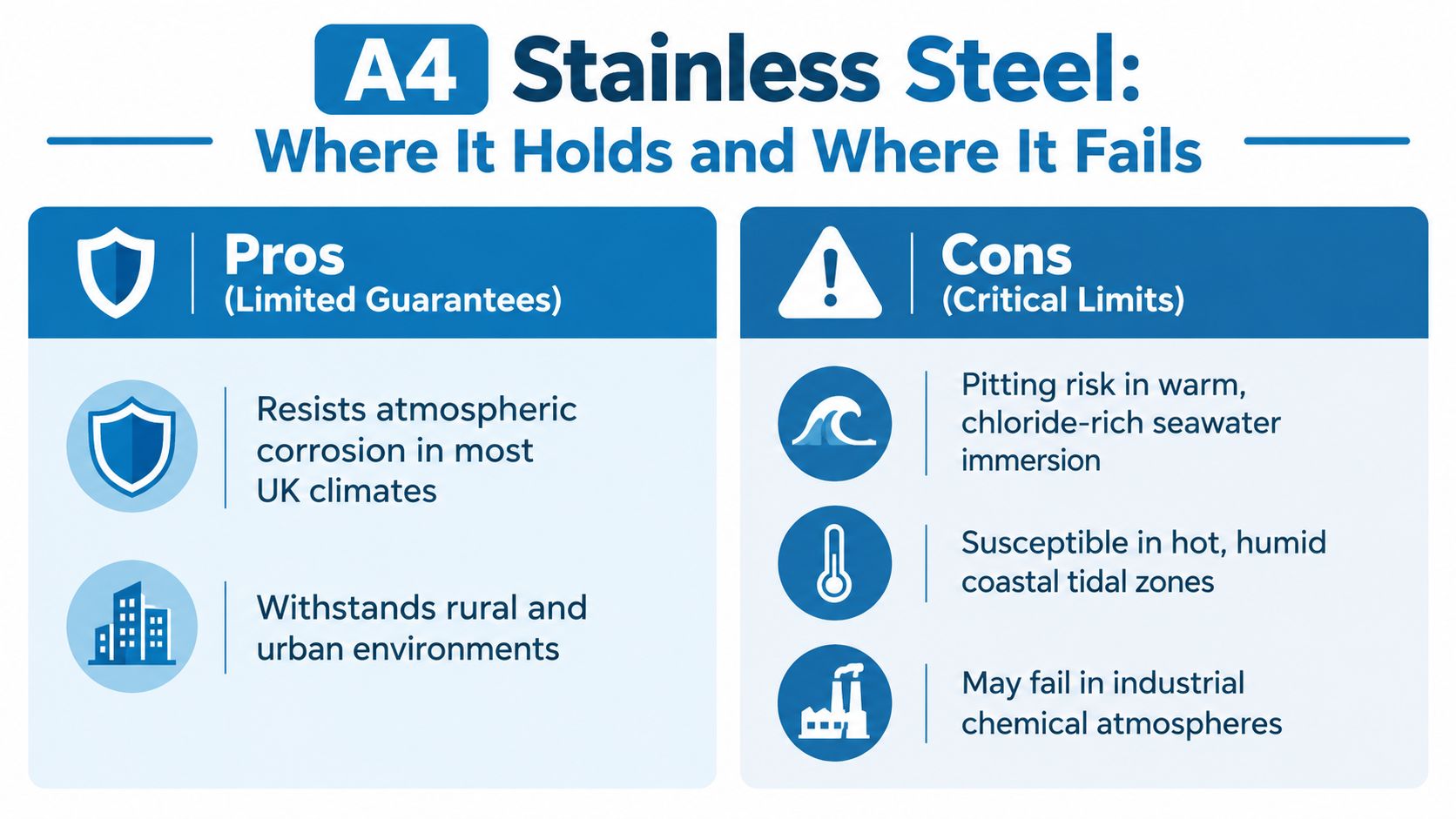
Strong acids, including hydrochloric acid, can attack the passive surface. Industrial cleaning chemistry must be assessed by its specific substance, concentration, temperature and contact time. A4 may resist atmospheric staining and pitting in many industrial and urban areas, and it performs better than A2 in several chemical environments, but that doesn't make it suitable for every process line.
Material pairing creates another trap. A4 connected directly to carbon steel or zinc in wet conditions can contribute to galvanic corrosion of the less noble metal. Aluminium frameworks and zinc-plated brackets need particular care. Isolation, compatible washers and sleeves, and a design that prevents standing water can reduce the risk.
Practical limit: If the fixing is immersed, repeatedly heated while wet, exposed to concentrated chlorides or handling a known industrial chemical, don't specify A4 from the label alone.
Where standard A4 isn't enough, the next step may be a higher alloy such as a super-austenitic 6Mo grade or a duplex stainless grade. That decision belongs with the engineer or corrosion specialist because the right material depends on the complete service condition, not just the product name.
Good A4 material can still suffer from poor site practice. Drilling swarf, carbon-steel dust and chloride-laden dirt can sit on the surface and create staining or localised corrosion, particularly when moisture remains trapped around a washer or thread.
Before handover, wipe exposed fixings with a clean cloth and remove swarf from the joint. Use tools that haven't been contaminated with ordinary carbon steel where surface appearance matters. Stainless threads can also gall, so start nuts by hand, avoid forcing resistance and use a suitable lubricant where the joint specification allows it.
Routine cleaning should use a mild detergent followed by a clean, non-chloride rinse. Avoid brick-cleaning acids, muriatic descalers and chloride bleaches. Tea-staining, dark marks around crevices or small pits are signs to investigate early, especially on a safety-related bracket or a fixing that is difficult to replace.
For a seized or corroded fastener during maintenance, a product such as Faren Rust Off rust loosening aerosol spray may help with removal, but freeing an old fixing doesn't replace checking why corrosion started. Clean the mating surfaces and correct the material pairing before fitting the replacement.
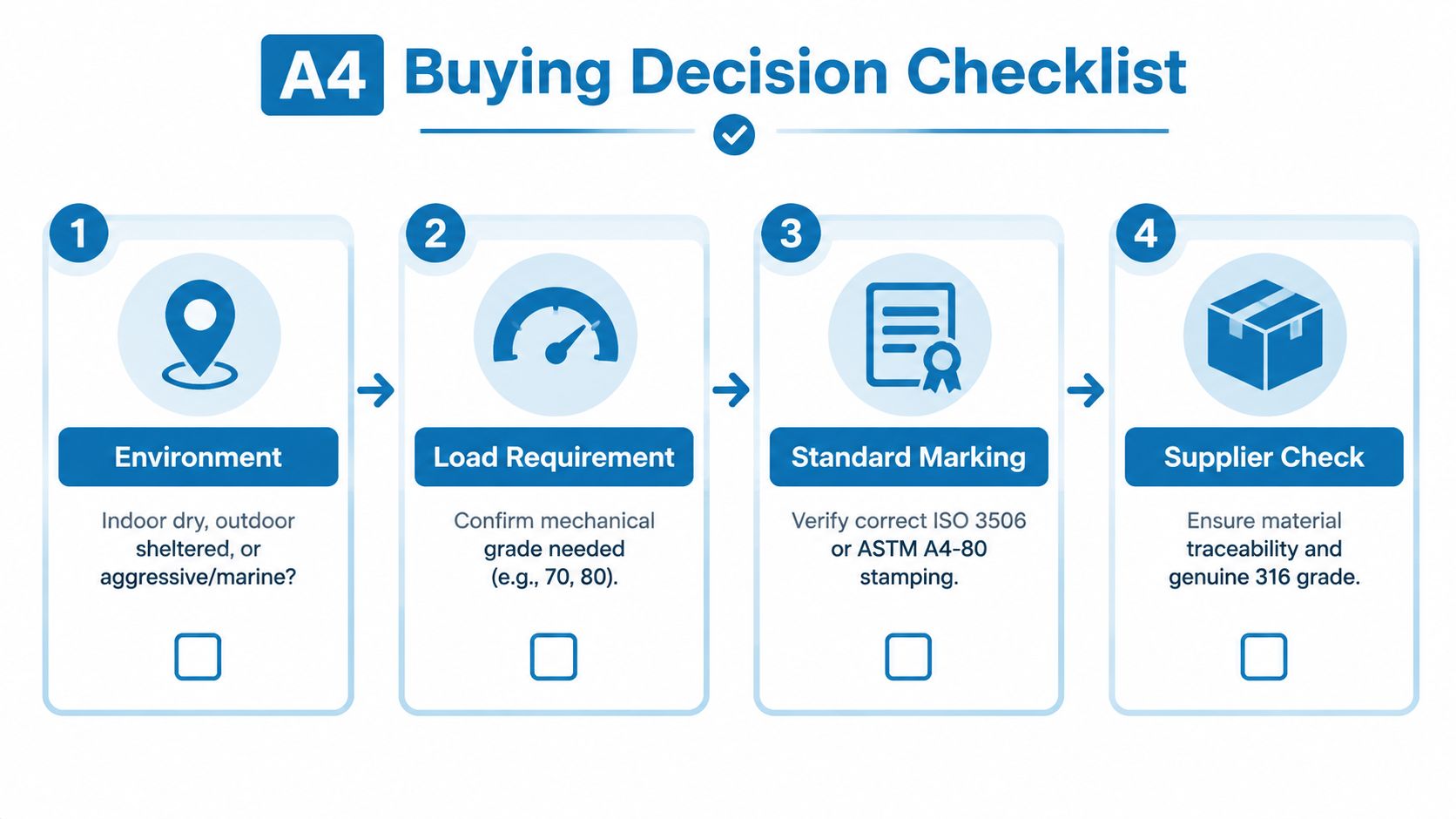
A reliable purchase starts with the site, not the screw bin. Take the job through four checks and you'll avoid treating A4 as either unnecessary everywhere or suitable for everything.
Ask whether the fixing will be indoors and dry, outdoors but sheltered, exposed to rain, close to the coast, or regularly affected by de-icing salt. A2 may suit a sheltered or mild setting. A4 is the more appropriate starting point for exposed coastal and chloride-prone work. Immersion or aggressive chemical service needs a higher-level materials review.
A4 identifies the alloy group, not an unlimited guarantee. Check whether water can drain away, whether salt can be washed off, and whether the joint contains crevices. If the answer involves seawater immersion, hot chloride exposure or a named industrial chemical, ask for a specialist recommendation rather than assuming A4 is enough.
Choose A4-70 for general A4 fastening where the design allows that property class. Choose A4-80 where the joint needs the higher minimum tensile strength. Match the suffix to preload, thread engagement, temperature and the joint designer's requirements.
Look for the relevant BS EN ISO 3506 designation on the packaging and, where applicable, the fastener head. Confirm that the supplier can identify the material and property class, particularly for structural or safety-critical work. If the box only says “stainless” and gives no usable grade information, pause before installing it in an exposed or loaded joint.
A useful comparison outside construction is the barista milk jug buying guide, which shows why stainless selection still depends on the working environment and the job's practical demands, even when the item is a small piece of hardware.
A4 often costs more than A2, but the sensible comparison is the complete job cost, including access, labour and the consequences of a failed external fixing. For an unconfirmed external application, asking for A4 and then checking whether A4-70 or A4-80 is appropriate is usually safer than buying an unmarked “stainless” box and hoping the environment stays kind.
Neasden Hardware supplies stainless fixings and related ironmongery for trade, maintenance and home-improvement projects, including A4 stainless screws for damp or coastal applications. Visit Neasden Hardware with your required environment, fixing type and load requirement, and the team can help you narrow the choice before you buy.