
Order Online
- Straight to your door!
Straight to your door


A homeowner calls after removing a cupboard door and finding an ageing plastic consumer unit behind it. The electrician has suggested a metal replacement, but the question isn't just whether steel looks more modern. The primary issue is whether the complete installation, including cable entries, seals, fixings and the surrounding cabinet, will satisfy the relevant requirements.
A metal consumer unit is now the normal choice for new domestic consumer-unit installations in Great Britain. Its enclosure helps contain heat and fire within the board, while the protective devices inside manage faults on individual circuits. Yet a metal shell alone doesn't guarantee compliance. The details around it matter just as much.
The change began with Amendment 3 to BS 7671:2008, introduced in 2015, with the domestic requirement taking effect from January 2016. From then, consumer units and similar switchgear assemblies installed in domestic premises had to use a non-combustible enclosure, which in practice means a metal or metal-enclosed cabinet. The requirement was carried forward into the 18th Edition wiring regulations, making metal enclosures the standard for new domestic installations. Elec-Mate's overview of consumer-unit regulations explains this regulatory milestone and its effect on replacement boards.
That doesn't mean every older plastic board is automatically illegal. An existing pre-2016 unit may remain in service if it's safe and suitable, but a replacement installation must use a metal enclosure or another compliant non-combustible housing. The important trigger is the installation or replacement event, not simply the age of the property. UK guidance on when metal consumer units became required sets out this distinction for landlords and property managers.
The safety benefit is practical. A correctly installed enclosure helps contain a fault inside the board, gives inspectors a durable surface to examine and provides a more solid foundation for modern protective devices. This guide focuses on the points that are easy to miss, especially grommets, intumescent seals, cabinet arrangements, cable entries and circuit layout.
A consumer unit is the control centre for a property's final circuits. Incoming electricity passes through the main switch, then feeds protective devices assigned to lighting, sockets, cookers, showers and other loads. Each device has a specific job, so replacing a board isn't a matter of moving cables into a larger box.
Think of the enclosure as a fire door protecting a corridor. A fire door doesn't prevent every fault from occurring, but it helps stop heat and flames moving rapidly into the rest of the building. In the same way, a non-combustible enclosure is intended to contain a fire that starts inside the consumer unit and reduce its spread to nearby building fabric. Industry guidance links this purpose to fires associated with faulty connections inside plastic consumer units and explains that metal is designed to limit fire spread. This practical explanation of metal consumer units and fire containment provides useful context.
The main switch provides a means of isolating the installation. It doesn't replace circuit protection, and it shouldn't be treated as though it detects every type of fault.
These devices work as a coordinated system. The protective device responds to the electrical fault, while the enclosure helps control what happens physically inside the board. Removing one part from the design, or fitting an unsuitable accessory around it, weakens the overall safety arrangement.
Practical rule: Treat the enclosure as a safety component, not as a decorative cover. A compliant device installed in an unsuitable or poorly sealed enclosure still leaves a problem to resolve.
The installation also needs sound terminations, correct torque, suitable cable support and clear labelling. A metal case can contain a fault more effectively than a combustible one, but it can't compensate for loose conductors, damaged insulation or poorly protected cable entries.
Choosing a board starts with the supply and the available space. A compact single-phase domestic installation has different requirements from a larger property or light commercial setting, and a surface-mounted board behaves differently during retrofit work from a flush-mounted enclosure.
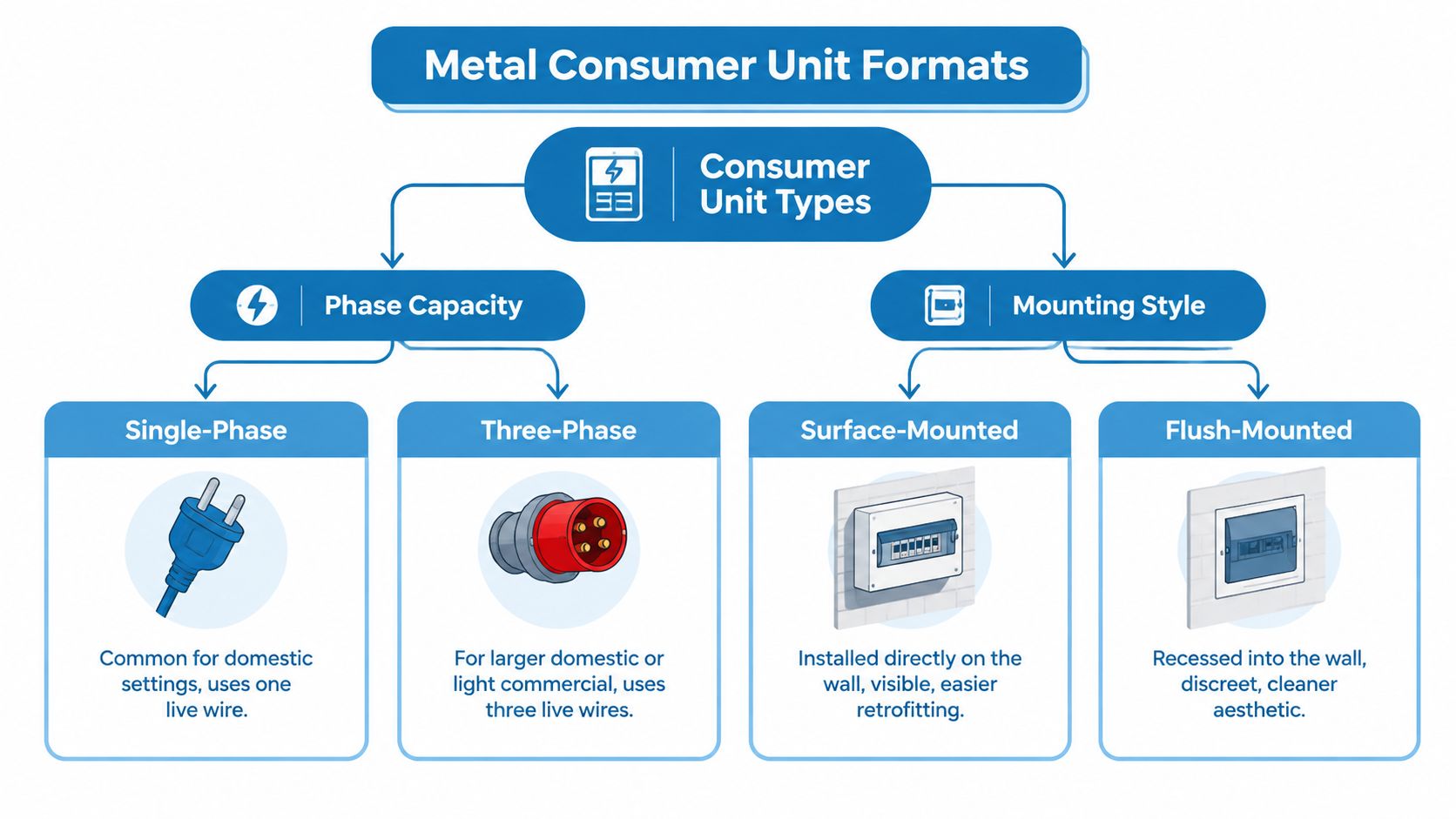
Single-phase boards are common in domestic settings. They suit the typical household arrangement, but the installer still needs to check the incoming supply, tails, protective devices and the expected circuit load before selecting the enclosure.
Three-phase boards are used where the installation has a three-phase supply, such as larger domestic properties, workshops or light commercial premises. The board and its protective devices must match the supply arrangement, and load distribution becomes more significant because circuits may need to be balanced across phases.
Don't choose by enclosure size alone. Count the outgoing circuits, identify high-demand equipment and allow room for the devices the design requires. A board with insufficient ways can force awkward compromises, while a board that's unnecessarily large may be difficult to position and terminate neatly.
A surface-mounted enclosure sits directly on the wall. It's often practical during a replacement because cable routes remain accessible and the installer doesn't need to recess the surrounding masonry or lining. The trade-off is that the board projects into the room.
A flush-mounted unit sits within a prepared recess. It gives a cleaner appearance, but the wall cavity, cable routes and surrounding construction need careful planning. For a clear explanation of what flush mounting involves, Axis Meter Solutions' guide to flush mounting is a useful reference.
Main-switch arrangements also vary. A double-pole isolator can disconnect line and neutral together, subject to the design and equipment specification. The manufacturer's instructions should determine the compatible devices, busbar arrangement and permitted accessories.
For retrofit work, use fixings suited to the substrate and the enclosure's mounting points. If you're selecting screws for cabinet or metalwork tasks, this guide to self-tapping screws can help distinguish thread-forming options from fixings intended for other materials.
Within domestic premises in Great Britain, the assembly must comply with BS EN 61439-3 and use a non-combustible enclosure, or sit inside a non-combustible cabinet or enclosure. Ferrous metal such as steel is identified as an example, and the implementation date was 1 January 2016. Electrical Safety First's consumer-unit mythbuster summarises these requirements.
A metal enclosure must be suitable for its environment as well as non-combustible. The datasheet should be read as part of the installation design, not filed away after the product is ordered.
The IP rating addresses protection against ingress from solids and water. The first digit relates to solid or dust ingress, while the second relates to water. The correct level depends on the position and exposure of the unit. A dry hallway and a utility area don't present identical conditions, so don't assume one rating suits every location.
The IK rating concerns resistance to mechanical impact. It matters where the board could be struck by tools, stored items or activity in a garage, workshop or service area. A higher impact resistance can be useful, but it doesn't replace correct mounting or protection from foreseeable damage.
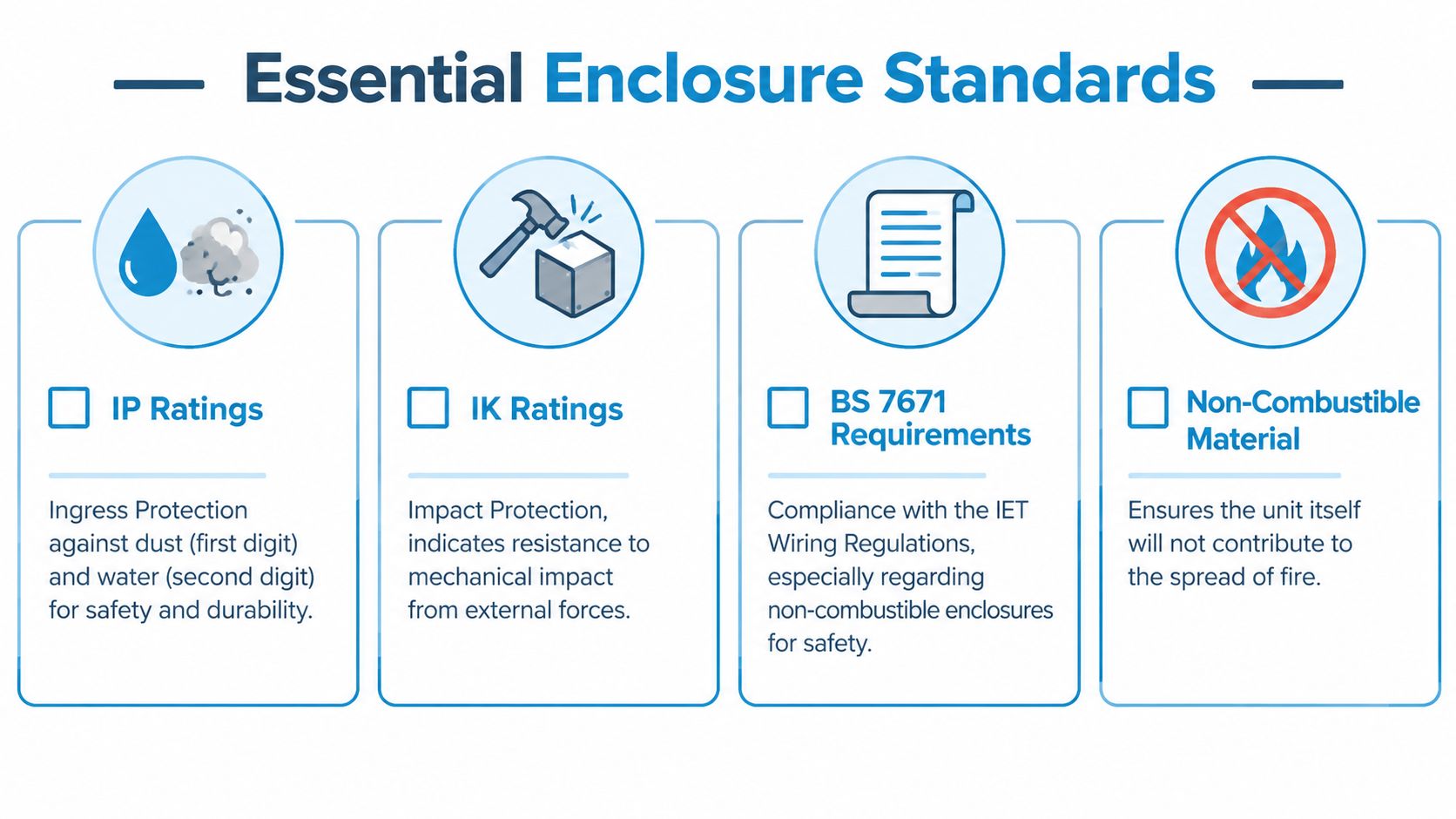
Regulation 421.1.201 of BS 7671 requires consumer units and similar switchgear assemblies in UK domestic installations to have an enclosure made from non-combustible material, or to be installed inside a non-combustible cabinet. BEAMA identifies ferrous metal, including steel, as an accepted example. BEAMA's guidance on consumer-unit enclosures sets out the technical basis for this approach.
The part that catches people out is the cable entry. Cutting an oversized opening and leaving a sharp edge, open gap or unprotected route can undermine the intended performance of the enclosure. Use the manufacturer's approved entry arrangements, suitable grommets and, where required, fire-rated grommets or intumescent seals.
A non-combustible cabinet can also be acceptable. That gives an installer more flexibility in a retrofit, but the cabinet must provide the required protection and the consumer unit must be installed according to its instructions. A metal box placed inside a combustible cupboard isn't automatically equivalent to a tested non-combustible cabinet arrangement.
Inspection point: Check the enclosure, entry method, seals, fixings and cabinet together. Inspectors assess the installation they can see, not only the product label.
Before certification, verify the assembly standard, enclosure material, mounting instructions, IP and IK information, cable-entry accessories, earthing arrangements and device compatibility. If the manufacturer's instructions require a particular grommet or seal, substituting an untested accessory creates an avoidable inspection risk.
A well-planned board lets the next electrician understand the installation without dismantling it. Arrange circuits so the labelling, protective devices and physical cable routes tell the same story.
Lighting circuits should be easy to identify, as should socket circuits and dedicated high-load circuits. A schedule inside the board should match the labels on the protective devices. Don't rely on assumptions such as “the left-hand group is upstairs”, especially after alterations by several contractors.
High-demand circuits need deliberate placement and protective-device selection. In a three-phase installation, the designer balances loads across phases. In a single-phase domestic board, the focus shifts to suitable circuit grouping, RCD or RCBO selection, conductor capacity and avoiding unnecessary shared protection.
RCBO layouts can isolate faults to the affected circuit. A shared RCD arrangement may protect several circuits together, but leakage from multiple appliances can make fault-finding more difficult. The appropriate choice depends on the design, product compatibility and the requirements applying to the installation.
Surge protection may form part of the specification, particularly where the assessment identifies a need to protect sensitive equipment. Arc fault detection devices may also be considered for specific circuits or higher-risk situations. Don't add modules merely because spare space exists. Confirm the device type, connection method, manufacturer compatibility and required enclosure width.
Keep high-current circuits clearly identified, maintain tidy separation and avoid forcing conductors across unrelated devices. Leave spare ways where the enclosure and design allow it, but protect unused openings with the correct blanks.
When preparing or maintaining conductors, use accessories that suit the conductor type and manufacturer's instructions. This practical guide to push-wire connectors can help when reviewing connector types, although it doesn't replace the consumer-unit manufacturer's requirements or the wiring regulations.
A simple final check should confirm:
The right metal consumer unit is the one that matches the installation, not the one with the largest number of ways or the lowest purchase price. Begin with the supply type, then count existing circuits, identify planned additions and check the physical wall space.
Review the manufacturer's datasheet for enclosure dimensions, device compatibility, IP and IK information, cable-entry options and the permitted mounting arrangement. Check whether the board accepts the intended MCBs, RCBOs, surge protection module and main switch. A board can look physically suitable and still be wrong for its busbar or accessory system.
Cable entries deserve their own inspection. The installer may need suitable grommets, fire-rated grommets or intumescent seals, depending on the enclosure and the route. The unit might also be installed inside a compliant non-combustible cabinet rather than used as an exposed metal box. Voltimum's guidance on installing metal consumer units highlights these surrounding construction details, which many basic product guides leave out.
For trade work, estimate the whole installation rather than the board alone. A costing tool such as Exayard electrical estimating software can help organise materials, labour and project allowances before the quotation goes out. For maintenance preparation, this guide to electrical contact cleaner may be useful when assessing suitable cleaning products, but never use a chemical around live equipment or as a substitute for correcting a defective connection.
Call a qualified electrician for a consumer-unit replacement, new circuit, complex earthing issue or three-phase installation. The work involves isolation, inspection, testing and certification, and a professional can identify problems with tails, bonding, enclosure position or existing circuits before the board is ordered.
If you're a landlord or advanced DIYer, prepare the useful information first. Photograph the existing arrangement without exposing live parts, list the circuits and planned additions, record the available wall space and ask the electrician which enclosure, protective devices, seals and cabinet arrangements are acceptable.
A metal consumer unit is more than a steel cover. In a domestic replacement, the enclosure must be non-combustible or sit within a compliant non-combustible cabinet, and the installation must preserve that protection through suitable cable entries, grommets, seals, fixings and blanking arrangements.
Before ordering, confirm the supply phase, circuit count, available ways, protective-device compatibility, enclosure ratings and mounting method. Then check the manufacturer's instructions and the relevant BS 7671 requirements. Older plastic boards installed before 1 January 2016 aren't automatically illegal, but a new domestic replacement must follow the current non-combustible-enclosure approach.
If you're unsure, ask a qualified electrician to survey the installation, specify the board and complete the testing and certification. That process is safer than trying to make an unsuitable enclosure compliant after installation.
Neasden Hardware supplies fixings, tools and related hardware for trade and retrofit work, including components useful when preparing wall-mounted installations and metalwork. Visit Neasden Hardware to source suitable project materials and review the available delivery options for your next consumer-unit installation.