
Order Online
- Straight to your door!
Straight to your door


You've chosen the tap, handles and worktop for the kitchen, yet the double sockets are still an afterthought. Then, just before the electrician arrives, you find yourself comparing brushed steel faceplates online and wondering whether the attractive option will fit the existing wall.
That's the right question, but it needs widening. A brushed steel double socket isn't only a decorative upgrade. Its metal faceplate brings earthing, back-box depth, fixing compatibility and circuit protection into the buying decision. The finish can look identical across two product pages while the installation requirements differ considerably.
A kitchen renovation often starts with visible decisions. You spend time comparing tap shapes, cabinet handles and appliance finishes, then order the sockets when the plasterer is already booked. That approach works until the new metal plate meets an older, shallow back box or wiring that leaves no practical room for the earth connections.
A plastic faceplate can conceal some untidy conditions behind it. A metal plate is less forgiving. The faceplate needs a reliable earth path, the mounting arrangement must be sound, and the box must provide enough space for the conductors and terminals without forcing the accessory against the wall.
Practical rule: choose the accessory and inspect the wiring behind it as one job, not as separate style and installation decisions.
The same-looking double socket may be suitable for a modern 35 mm box but awkward on a shallow older installation. A replacement may also offer different terminal capacity, fixing arrangements or an earth terminal for the plate. Those details matter more than whether the brushed grain matches the tap.
Before ordering, establish what's already in the wall. Check the back-box material and depth, the fixing centres, the condition of the cable insulation and the arrangement of the circuit conductors. If you're using push-in connectors during preparation, understand their limitations and application through this guide to push-wire connectors, rather than treating every connector as interchangeable.
The finish still matters. Brushed steel can reduce the appearance of fingerprints and sits comfortably beside stainless appliances, but it doesn't compensate for poor earthing or inadequate circuit protection. A compliant installation remains compliant because of its design and testing, not because the faceplate looks premium.
That distinction becomes particularly important in kitchens, flats, HMOs and rented properties. In those settings, the socket forms part of a wider electrical installation that may require inspection, documentation and additional protective measures.
A brushed steel double socket is more than a smart-looking replacement for a white accessory. In UK terms, it is usually a two-gang BS 1363 accessory, with a satin-textured metal faceplate and two 13 A socket outlets. The BS 1363 system is rated for up to 250 V and 13 A, uses shutters over the live and neutral apertures, and relies on a fuse in the plug. The standard most directly covering current switched and unswitched outlets is BS 1363-2:2023, which applies to shuttered socket-outlets for household, commercial and light industrial use. (BSI's BS 1363-2:2023 specification)
The familiar double-gang faceplate is usually 146 x 86 mm, according to UK guidance on socket faceplates. (UK socket faceplate dimensions and guidance) That describes the visible plate, not every detail behind it. Fixing centres, plate depth, terminal layout and the manufacturer's back-box requirements still need checking, particularly when replacing an accessory on an older installation.
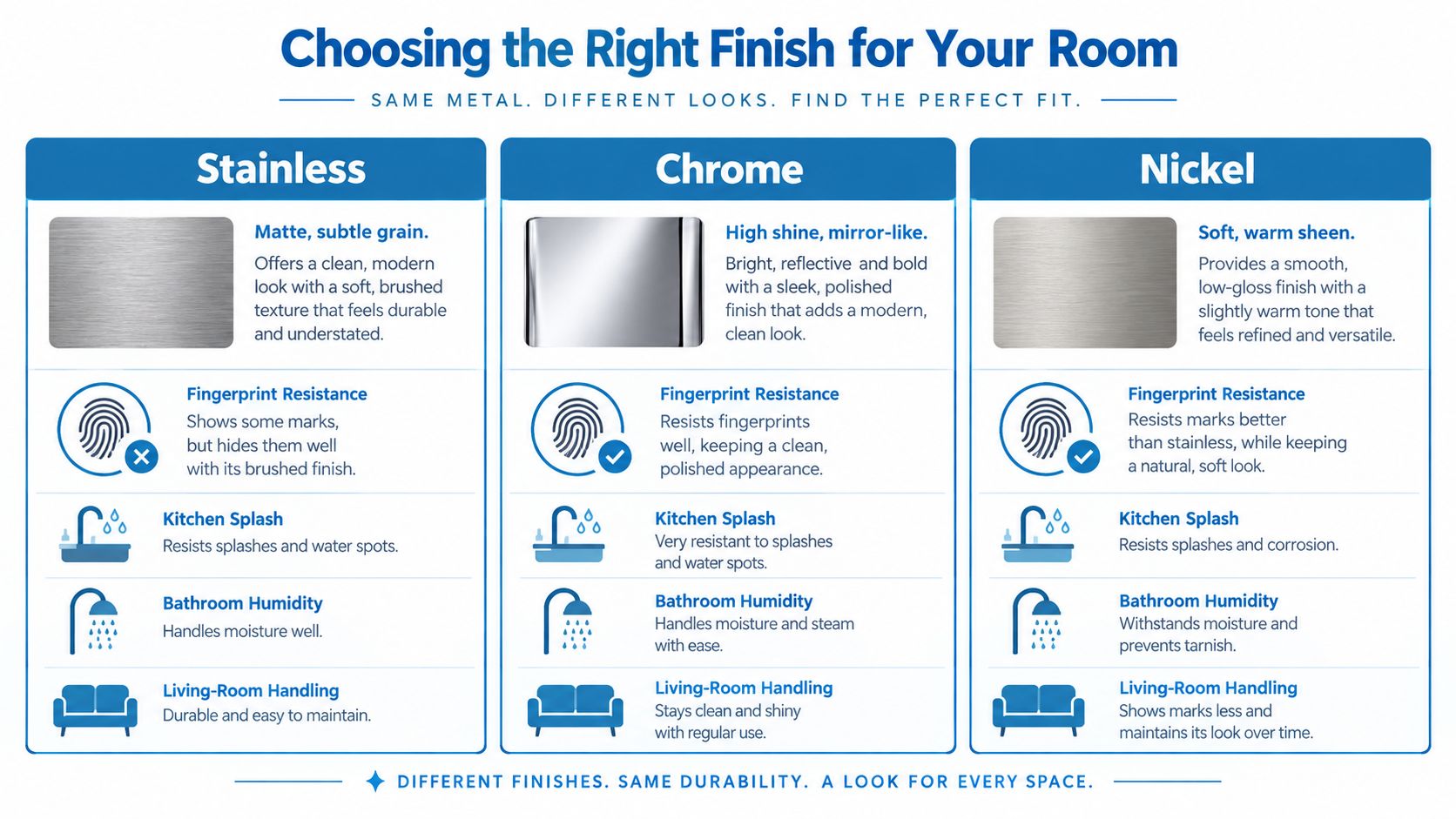
“Brushed” describes the surface appearance. It does not identify the underlying metal. A product may use stainless steel, or another metal carrying a chrome or nickel finish. Those constructions can differ in colour, sheen, edge treatment, resistance to marks and cleaning requirements.
The faceplate is also part of the electrical installation. Under BS 7671 principles, exposed conductive metalwork needs a suitable earth connection. The decorative finish does not change that requirement, so the plate must be assessed as an electrical component rather than treated as a simple cover.
Terminal capacity can affect whether the chosen accessory suits the existing conductors. BG Electrical product information for brushed-steel insert variants commonly lists 3 x 2.5 mm², 3 x 4.0 mm² and 2 x 6.0 mm² arrangements. (BG Electrical catalogue and brushed-steel finish information) These capacities can accommodate typical UK ring-final and radial terminations, but the actual cable arrangement must be compared with the product instructions.
| Feature | Standard value |
|---|---|
| Product type | Two-gang BS 1363 socket accessory |
| Faceplate size | 146 x 86 mm |
| Plug and socket system | 13 A UK system |
| Rated system | Up to 250 V and 13 A |
| Common terminal capacities | 3 x 2.5 mm², 3 x 4.0 mm² and 2 x 6.0 mm² |
| Safety feature | Shutters on live and neutral apertures |
| Faceplate material | Stainless steel or plated metal, depending on product |
Two outlets on one plate do not automatically represent two separate circuits. The accessory may share a feed from a ring final or radial circuit, subject to the circuit design and the rules governing spurs. Follow the supplied wiring diagram, and check the terminals rather than assuming that a familiar layout makes every replacement suitable.
Metal finishes behave differently in daily use. Brushed stainless steel usually has a lower-sheen appearance with a visible grain, so it works well beside appliances and worktops without looking overly bright. The texture tends to make light smears less conspicuous, although grease and cooking residue still need prompt cleaning.
Chrome is more reflective. It can sharpen a modern bathroom or polished kitchen scheme, but its bright surface can show water marks and fingerprints clearly. Nickel generally has a warmer, softer tone, making it a useful match for heritage kitchens, traditional joinery and interiors where a cooler steel colour would look out of place.
A useful comparison is not "which looks most expensive?" Ask how the room is handled. A kitchen socket may face splashes, flour, cooking oils and frequent wiping. A living-room socket may receive less contamination but more contact from furniture, cables and regular cleaning. Bathroom-adjacent locations need particular care because finish preference never overrides the restrictions applying near baths and showers.
A screwed faceplate exposes its fixing screws on the front. That interrupts the clean metal surface, but it gives direct access to the mounting screws and is familiar to most installers. A good screwed plate can remain secure for many years, provided the box threads and screws are in sound condition.
A screwless faceplate hides the fixings beneath a clip-on cover. The front looks more continuous, which suits minimalist kitchens and contemporary living rooms. The surround needs careful removal during maintenance, though, because levering it against painted plaster or tile can leave marks. A loose clip-on frame can also become irritating if the underlying plate hasn't been mounted firmly.
For a broader renovation comparison, tapware selection for renovators offers useful context on coordinating visible metal fittings. The same design principle applies to sockets, but electrical suitability must remain the deciding filter.
Think in combinations:
Colour consistency can vary between manufacturers, even where the labels sound similar. If you're matching several accessories, compare samples or buy from one range. For an example of how decorative faceplate design changes across a collection, see the antique brass double socket range, while remembering that finish families aren't automatically interchangeable.
A brushed steel socket can look like a simple finish change, yet the installation behind it decides whether the upgrade is suitable. A competent DIYer should begin at the consumer unit, identify and isolate the correct circuit, and prevent anyone restoring the supply. Prove it dead with a suitable two-pole voltage tester. A non-contact detector can help find live conductors, but it cannot prove a circuit is dead.
Before loosening any terminal, photograph the existing wiring. Use the image as a record of the starting arrangement, not as permission to reproduce work that may already be unsafe. Stop if conductors are damaged, overheated, brittle or unfamiliar, and arrange an electrician's inspection.
Use a deliberate sequence:
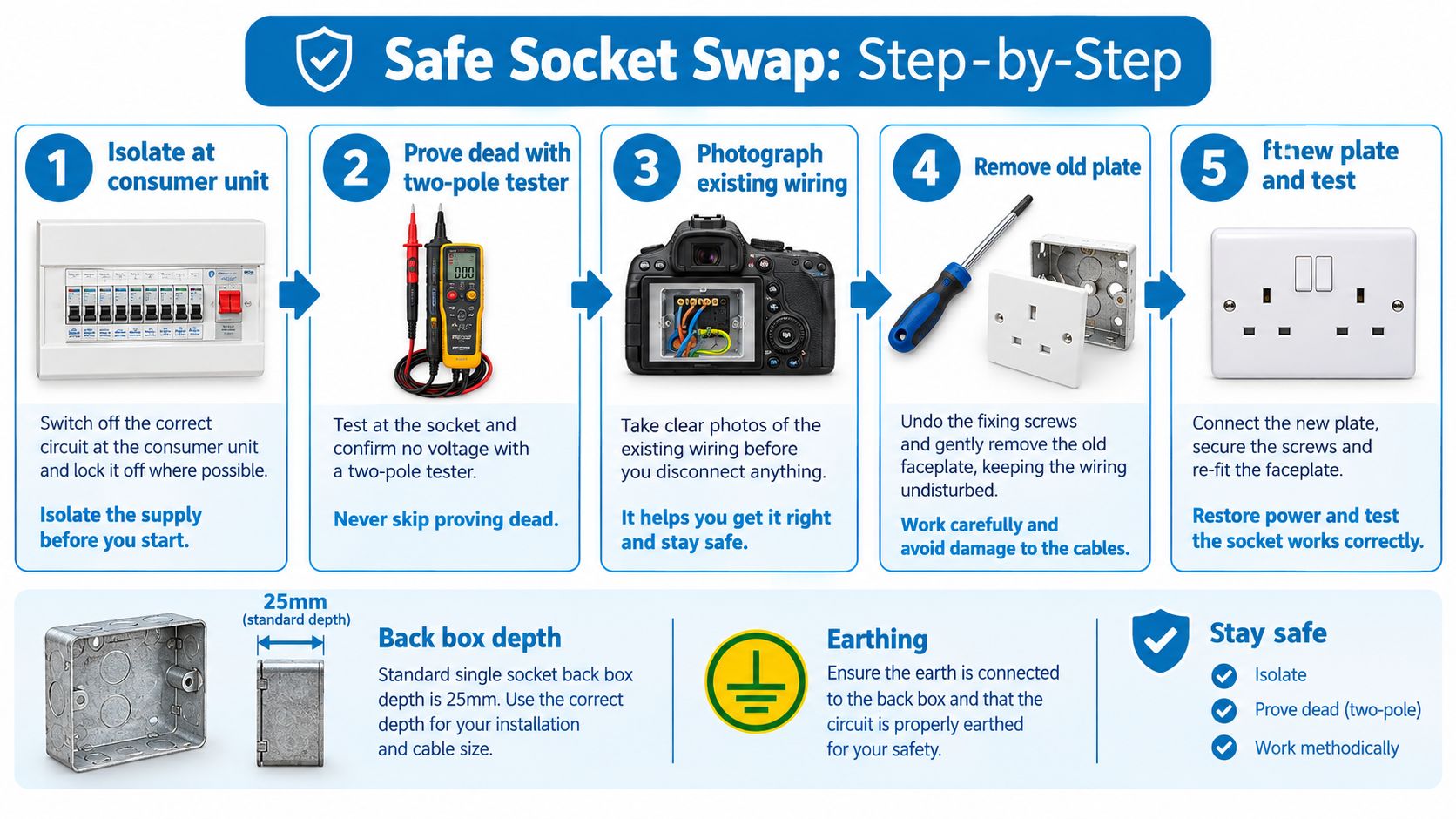
A standard 25 mm back box may leave little room behind a metal accessory, especially with several conductors and an extra earth connection. A 35 mm or 47 mm metal box gives more working space, but changing the box affects both the electrical installation and the finished wall. In a completed room, that work may require opening plaster, tile or other surfaces.
The faceplate must sit square and flush. Do not force a distorted plate against an uneven wall with the fixing screws, or fold cables into sharp bends to make a shallow box accept the accessory. Check the manufacturer's drawing for the exact fixing arrangement. Double-gang sockets are commonly designed for a BS 4662 back box, but the existing box still needs inspection for sound threads, secure mounting and enough usable depth.
The earth path through the metal plate must remain continuous. Depending on the socket's design, this may use a fixed earth contact or a flying earth lead to the back box. The circuit protective conductor must terminate correctly at the socket, and any bonding link between the plate and box must be fitted and tight. A decorative finish does not compensate for a missing or unreliable earth connection.
For a plain-language overview of the physical process, these double socket installation tips can supplement, but not replace, the manufacturer's instructions and required testing.
Stop if you find aluminium cable, rubber-insulated wiring, a mixed or uncertain ring, heat damage, scorching or loose terminals. After fitting, complete the appropriate continuity, insulation, polarity, earth fault loop and RCD checks before energising. If you do not have suitable calibrated test equipment or cannot interpret the results, use a registered electrician.
A socket's compliance has two layers. BS 1363 governs the accessory itself, while BS 7671 governs the electrical installation around it. A brushed finish can satisfy the visual brief while the circuit remains unsuitable, inadequately protected or poorly documented.
For domestic socket outlets rated up to 32 A and intended for use by ordinary persons, BS 7671 Regulation 411.3.3 requires 30 mA RCD additional protection, as summarised in UK installation guidance. On a ring final circuit, an unfused spur may supply only one single socket or one double socket. (Socket-outlet installation and RCD guidance)
That rule matters during extensions and refurbishments. Adding a second accessory, extending a circuit or converting a point from a spur can change the design assumptions. A radial circuit may be appropriate in one situation, while a ring final may suit another, but the choice depends on cable size, protective device, route, loading and the installation design, not on the faceplate.
Landlords have further responsibilities under the Electrical Safety Standards in the Private Rented Sector Regulations. The installation needs periodic inspection and an EICR at least every five years, with remedial action where the report identifies an unsafe condition. New circuits and certain electrical work in dwellings may also fall within Building Regulations Part P requirements.
Flats, HMOs, student accommodation and other multi-occupancy properties deserve a more conservative approach. Shared risks, restricted escape routes and increased equipment use make circuit protection and fire precautions central to the specification. UK technical guidance highlights non-combustible consumer-unit enclosures, RCD protection and, in some higher-risk housing types, AFDD protection for socket-outlet circuits up to 32 A. (UK fire-safety and electrical protection technical manual)
A metal consumer unit can be part of the wider fire-safety conversation, but changing the consumer unit or protective devices isn't a casual accessory upgrade. Review the installation as a whole, and use the guidance in these Premier Builders electrical FAQs when you're preparing questions for an inspection.
| Property type | Inspection frequency | Key standard | Notes |
|---|---|---|---|
| Owner-occupied home | Based on installation condition and professional advice | BS 7671 | Confirm protection and test after alterations |
| Private rented home | EICR at least every five years | Electrical Safety Standards in the Private Rented Sector Regulations | Keep reports and complete required remedial work |
| HMO or student accommodation | Set by the responsible person and applicable obligations | BS 7671 and relevant housing requirements | Consider shared use, fire risk and higher scrutiny |
| Flat or multi-occupancy building | Depends on tenancy, communal and installation arrangements | BS 7671 and building requirements | Check local restrictions, communal supplies and escape considerations |
The surrounding consumer-unit arrangement matters as much as the socket. For background on that equipment, see this guide to a metal consumer unit. The key point remains simple: brushed steel itself isn't the safety issue. Earthing, box condition, circuit protection and competent testing are.
You find the right-looking socket online, then discover that its terminals will not suit the existing conductors or its plate cannot sit safely on the back box. Check the electrical details before judging the finish.
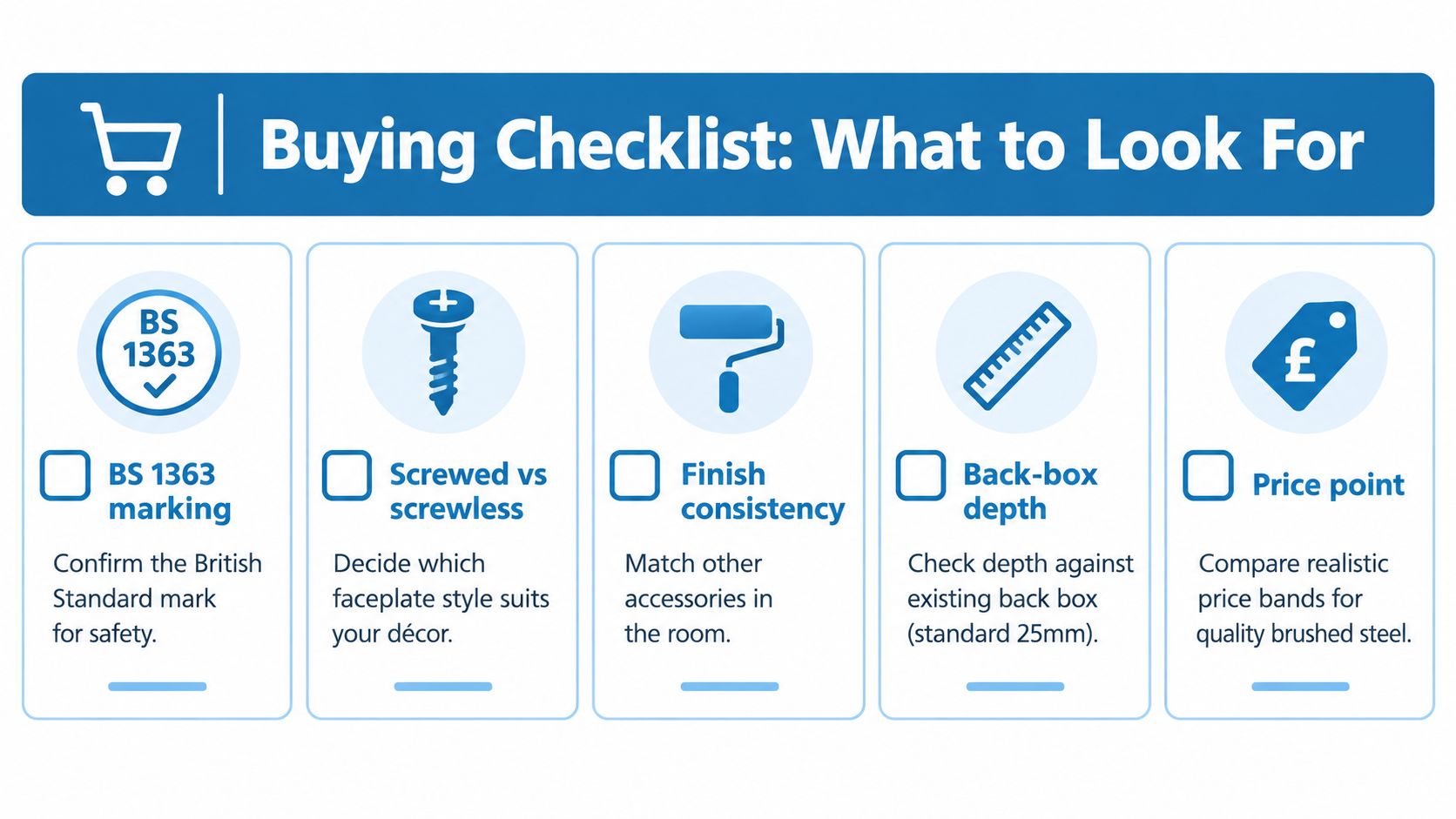
UK brushed-finish double sockets sit across several price levels. A technical UK buying guide places screwed brushed chrome or brushed steel versions around £7 to £10, with screwless versions around £9 to £12. (UK brushed socket price ranges and applications)
The lower band can suit a straightforward replacement, but inspect the terminal design, plate thickness, shutter operation and documentation. A higher-priced product may provide cleaner machining, a neater screwless surround, stronger rockers or a finish that matches other accessories. It still has to fit the box and satisfy the installation requirements.
The faceplate is often the small part of a retrofit. Labour can become the larger cost if the electrician finds a shallow box, damaged cable, missing earth link or inadequate protection. Allow for inspection and remedial work instead of treating the accessory as the complete job.
Measure the box, confirm the circuit arrangement and consider how the room will be used before ordering. You can then visit Neasden Hardware to browse its ironmongery and hardware range, with product knowledge, nationwide delivery and support for tradespeople, landlords and home improvers.