
Order Online
- Straight to your door!
Straight to your door


The door under the sink has dropped about two millimetres. It still shuts, but the bottom corner now catches the frame, the soft close gave up months ago, and the quote on the doormat is for a full new kitchen. Most doors in that state trace back to a worn hinge or a plate screw that has pulled out of the carcass while the cabinet itself stays sound. Swapping or re-seating the hardware is a small job next to the work being quoted.
Picking the best cabinet hinges is a short series of decisions: how thick the door is, how it sits against the carcass, which way it moves, how much it weighs, and who opens it every day. Get those right and a £1.90 clip-on hinge for an 18-25mm door will outlast a £34.71 heavy-duty concealed hinge fitted to a door it was never meant for.
The sections below run through the quick shortlist, the measurements that decide fit, the different closing motions, the access and clearance questions, and the call on whether to adjust, repair or replace.
Quick-pick cabinet hinges from Neasden Hardware
| Hinge | Type | Suits | Price |
|---|---|---|---|
| Ceam 1131 160x32mm 3D Concealed | Concealed, heavy duty | Unrebated, flush-faced timber doors | £34.71 |
| Ceam 1130 132x24mm 3D Concealed | Concealed, medium duty | Unrebated, flush-faced timber doors | £24.60 |
| Ceam 1230 130x30mm 3D Concealed | Concealed, heavy duty | Unrebated, flush-faced timber doors | Confirm current price with Neasden Hardware |
| Blum 71T3750 110 degree Clip On Inset | Clip-on inset | 18-25mm doors | £1.90 |
| Salice Conecta Hinge 25-30mm | Wooden door hinge | 25-30mm thick doors | £4.54 |
| Salice CBY2AE9 Universal | Soft close, 110 degree opening | General doors | £8.97 |
| Hafele 343.90.710 Pie-Cut Corner | Corner hinge, three-way adjustment | Corner carcasses | £9.17 |
| Eclipse 102x102mm Grade 13 Ball Bearing (pair) | Ball bearing | Doors up to 120 kg total mass | £8.54 |
| Salice CEL6XE6XXV Air Soft Close, titanium | Air soft close | Lift-up doors | £32.24 |
| Eclipse Thrust Bearing Parliament 102x76x127mm | Parliament | Lift-up flap doors, in satin, polished or polished brass | Confirm current price with Neasden Hardware |
Read the Suits column before the price. Door thickness and overlay rule out most rows quickly. A 20mm door on a frameless carcass has no use for a parliament hinge. An 18mm door will not take a hinge built for 25 to 30mm stock. Price comes second, because the cheapest line here is only cheap if it fits.
Neasden Hardware stocks a wide range of Salice hinges, including soft close hinges, air hinges, kitchen cabinet solutions and traditional door hinges. Many Salice hinges sold by the business have adjustable functions that let installers fine-tune side, height and depth alignment after fitting. Salice Conecta suits wooden doors 25-30mm thick with 10/12.5mm overlay, while Salice CBY2AE9 gives a 110 degree opening with soft close. When choosing a Salice hinge, consider door thickness, overlay type, opening motion and whether soft close action is required.
The three Ceam hinges are the ones for quality timber doors that sit flush and unrebated, where the adjustment screws sit behind removable cover plates. Ceam 1130 is medium duty at 132x24mm and costs £24.60. Ceam 1131 is heavy duty at 160x32mm and costs £34.71. Ceam 1230 is heavy duty at 130x30mm, and its current price should be checked with Neasden Hardware before ordering.
The Blum and Salice Conecta rows are the everyday kitchen and wardrobe buys. Blum 71T3750 is nickel plated, has a 110 degree opening angle, suits doors 18 to 25mm thick and is compatible with 71B3750. Hafele 343.90.710 handles corner carcasses with three-way adjustability, quick mounting, concealed installation and sturdy construction. Its price is £9.17, shown with a 10% saving from £10.19.
The pad-style Eclipse ball-bearing pair is a different fitting altogether. It is a visible hinge rated for a 120 kg total door mass, not a concealed cup fitting. The Eclipse parliament hinge comes in Satin, Polished and Polished Brass. Check finishes, pack sizes and the current figure before committing, since a two-pack price is not a per-hinge price.
Think of the hinge as the joint of the door. The cup and the plate decide where that joint sits, and everything else, the opening angle, the soft close, the finish, is detail hanging off that decision.
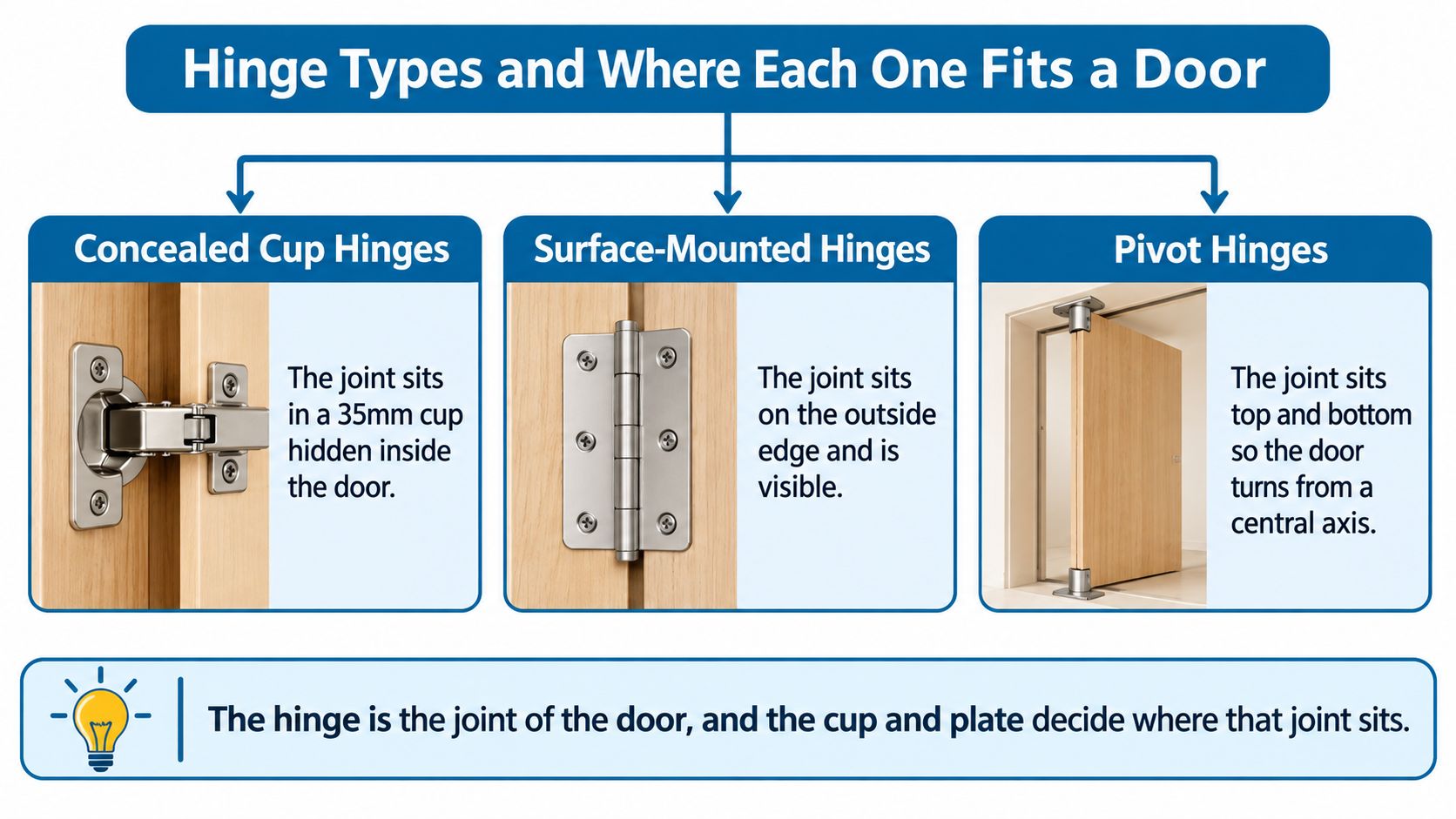
The workhorse of UK kitchen and bedroom furniture sits in a 35mm bore machined into the rear face of the door and clips onto a mounting plate screwed to the carcass side. It gives three-way adjustment, so you can chase a consistent reveal after the door is hanging, and on the Ceam 1131 and 1130 the screws hide under pop-off cover plates, which is why joinery specifiers like them on visible furniture. The hinge specification guidance for UK joinery sets out the standard and installation parameters behind that pattern.
Clip-on inset hinges are for doors that close into the opening rather than over the carcass edge, which is why the Blum 71T3750 is listed for 18 to 25mm doors: an inset door has almost no margin, and the hinge geometry has to match the frame. If you want a broader survey of how soft-close mechanisms differ across these families, soft-close hinge options explained by The Cabinet Coach covers the types side by side.
Overlay is the other half of the decision. Full overlay covers the carcass edge when shut. Half overlay lets two doors share a central partition. Inset sits flush inside the frame. The carcass build usually settles this before any hinge name comes into it.
Blind corner cabinets need a pie-cut corner hinge that swings the door clear of the neighbouring run, and the Hafele 343.90.710 gives three-way adjustment, quick mounting and concealed installation for exactly that geometry. Lift-up flaps take a different part again: the Eclipse stainless thrust bearing parliament hinge comes in satin, polished or polished brass, and the 99x40x1mm counter flap hinge is the one for bar tops that fold down and need smooth, reliable operation.
Practical rule: match the overlay first, then choose the hinge family. Doing it the other way round is how doors end up needing adjustment beyond the range the hinge was built for.
Five checks take about three minutes with a tape and a ruler, and they'll save a return.
Cabinet hinge measurements and typical values
| Measurement | Where to check | Typical value | Why it matters |
|---|---|---|---|
| Door thickness | Door edge | 18-25mm (Blum 71T3750); 25-30mm (Salice Conecta) | Sets the hinge family and fixing depth |
| Cup bore | Back of the door | 35mm for concealed cup hinges | A wrong bore means the cup will not seat |
| Overlay | Door position when closed | Full, half or inset | Decides the hinge geometry |
| Opening angle | Hinge specification | 110 degrees (Blum, Salice Universal) | Clearance for adjacent doors and pull-outs |
| Lateral adjustment | Adjustment screw | Approx. ±2mm | Corrects side-to-side gaps |
| Height adjustment | Mounting plate | Up to ±2mm | Corrects vertical alignment |
| Plate fixing centres | Carcass side panel | Confirm against the manufacturer's data before drilling | A mis-drilled plate shifts the whole door |
Set the hinge arm at 90 degrees to the door edge and check it with a try square before you drive a screw. Fine-tune afterwards. The adjustment screws exist to correct small errors in the fitting, not to rescue a cup drilled 3mm off centre.
Use at least two hinges per door and add a third on anything tall or heavy. A third hinge shares the screw and cup load, but it won't rescue a wide door: as the door's centre of mass moves away from the hinge line, the load increases, and no number of hinges changes that.
A damper is a small hydraulic cylinder that takes over in the last few centimetres of travel and eases the door home.
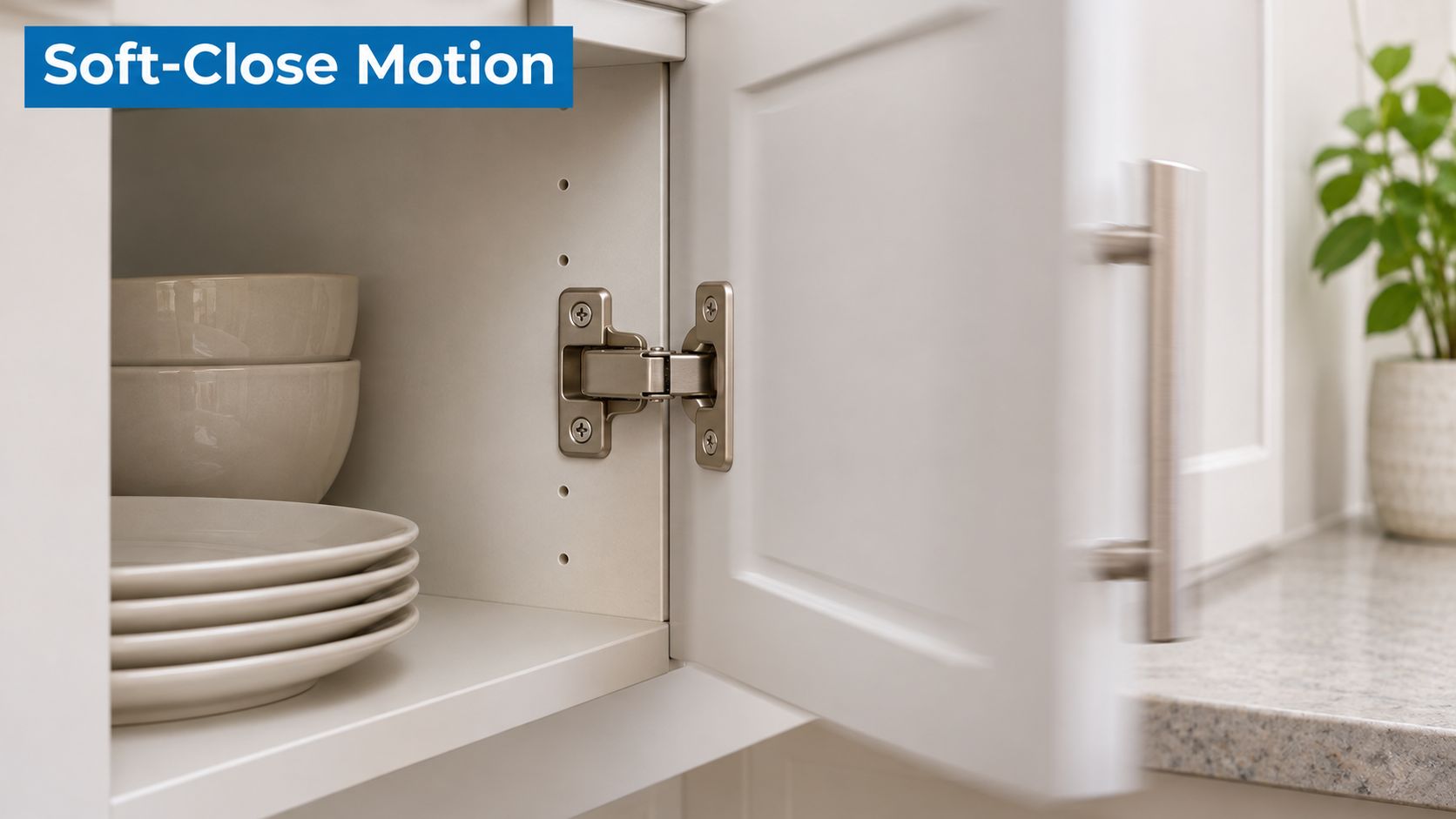
On a swing door, the Salice CBY2AE9 Universal gives a 110 degree opening with soft close in one part, which is why it's the sensible default for a general kitchen door. Where a hinge stops closing properly or the door hangs slightly low, work through the adjustment sequence in this guide to adjusting soft-close hinges before assuming the damper has failed.
Salice air hinges integrate with soft-close technology, and they're designed for lift-up and handle-free doors, letting the front rise and stay open at an adjustable angle. The CELPX66XXV Air Push in titanium uses a push self-opening system, so a handle-less door opens with a press. Note the code: the air hinge in the quick picks is the CEL6XE6XXV. Check the code on the product label before ordering, because a push-to-open variant and a plain soft-close variant look almost identical in a photograph.
A swing door pivots on a vertical axis. A flap or lid pivots on a horizontal one. They're covered by different standards: BS EN 15828 covers furniture hinges and stays pivoting on a horizontal axis, and its test regime includes the gravitational loading and stopping forces a flap sees. Never specify a cup hinge for a lift-up front on the grounds that it's "the same hinge, rotated". It isn't.
Ease of use is a separate question from motion. Operating force, door weight, handle position, pinch points and the clearance beside the cabinet all decide whether a door is pleasant or a nuisance.
Choosing between them: soft close for everyday swing doors, an air or push hinge where there's no handle and no grip, and a parliament hinge for a flap. Test the operating force on a sample before you commit a kitchen to it.
Hinge choice changes who can use a kitchen. Only 13% of homes in England meet four basic accessibility criteria, and just 3% have adapted kitchens, according to the Centre for Ageing Better accessibility factsheet. Those figures matter because many people expect to stay in their own home, yet the fitting can still make daily use harder.
The same factsheet records access barriers in 37% of home-improvement and DIY interactions, 31% of home-furnishing interactions and 41% of repair and maintenance-provider interactions. For an older or disabled household, the hinge and the surrounding clearance can be part of that barrier or part of the fix.
Layout sets the frame. Approved Document M supporting guidance calls for a clear access zone of at least 1,500mm in front of and between kitchen units and appliances, with 1,200mm as a minimum between fixed built-in elements in some layouts and 1,500mm where wheelchair access is required. Treat a clear turning area between facing units or between a unit and a wall as good practice, and keep shelving above a work surface within comfortable reach.
The widest-opening hinge is not automatically the accessible one. A wheelchair user needs clear floor space and reachable storage; someone with arthritis needs low operating force and predictable movement. Repair or replacement should be judged the same way. If the carcass, fixings and door are sound, adjustment or a like-for-like hinge may preserve the layout and avoid the disruption of replacing the whole cabinet.
A door that swings 170 degrees into a turning circle has made the room worse. Check the door in its open position against the designed clearance before you order. If it eats the access zone, choose a different motion, not a wider angle.
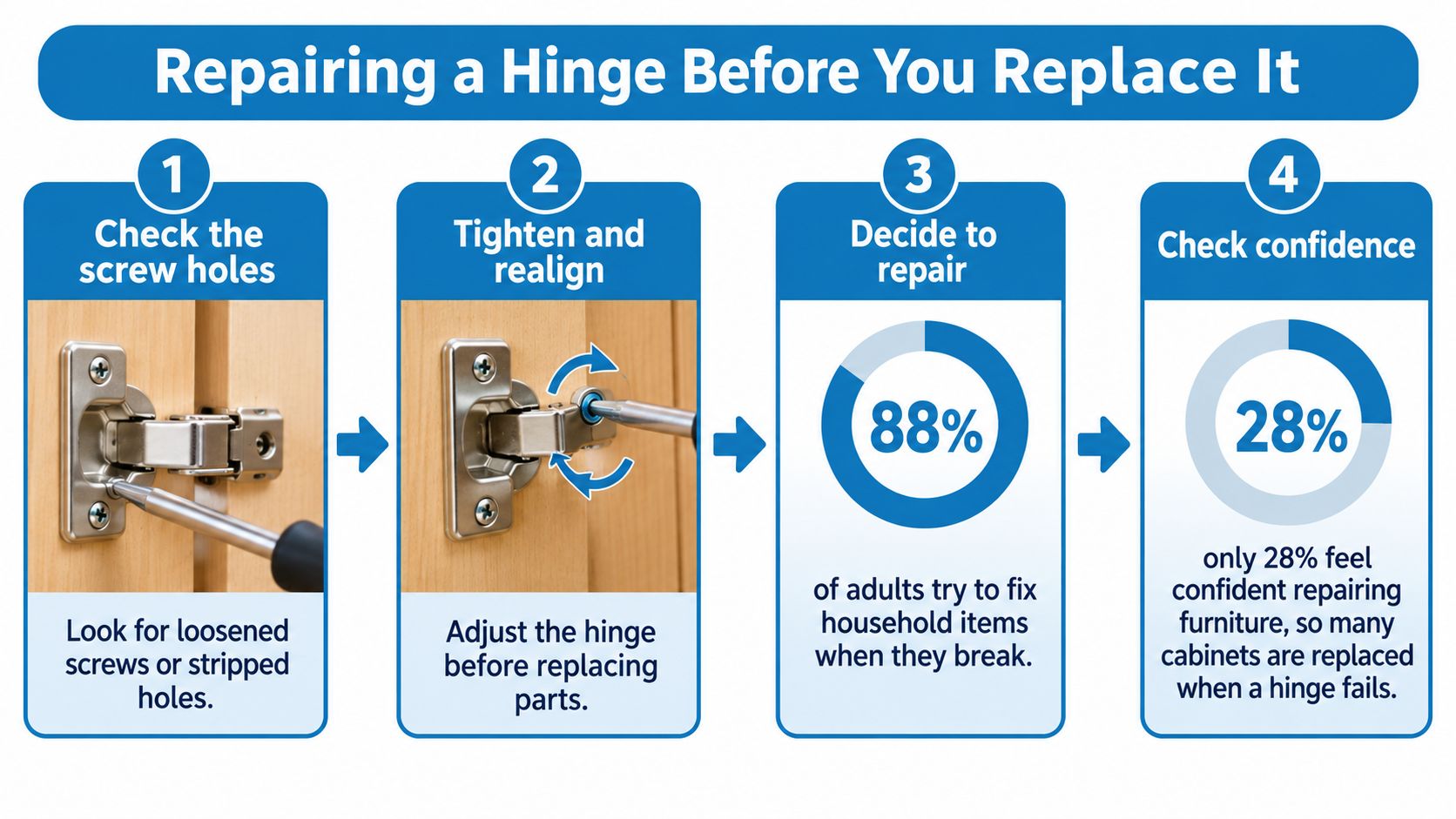
Insight DIY's report on repair and reuse records that 88% of adults try to fix selected household items when damage occurs while only 28% feel confident attempting a simple furniture repair; the same report estimates 13 million household items reach UK waste facilities annually on their route to recycling or disposal, with 51% of identified facilities offering a reuse stream and just 2% offering repair. That gap between willingness and confidence is where serviceable kitchens end up in a skip.
A worn hinge is a small component on an otherwise sound cabinet. Work through the symptom first.
Hinge symptoms, likely causes and fixes
| Symptom | Likely cause | Fix |
|---|---|---|
| Door sags at the free corner | Worn hinge cup or loose fixings | Repair: tighten the fixing screws; fit a heavier-rated hinge if the cup is worn |
| Uneven gap between doors | Plate or hinge out of adjustment | Repair: adjust lateral and height screws within about 2mm |
| Mounting plate pulls out of carcass | Stripped screw in chipboard | Repair: fit a hinge repair plate that bridges to sound material, or glue in a hardwood dowel and re-drill once set |
| Cup spins or sits loose | Oversized or worn cup hole | Repair: fill with a dowel, re-drill and refit |
| Soft close stops working | Adjustment drift or worn damper | Repair: re-set the hinge; fit a new hinge if the damper has failed |
| Hinge pivot binds | Dirt or dry pivot | Repair: clean, lubricate and check alignment |
| Door splits around the screw | Damaged chipboard | Replacement: fit a new door or carcass panel |
The sequence is symptom, check, fix, and only then replace. Start with the cheapest intervention: a screwdriver on the plate screws, then the adjustment screws, then a repair plate or glued dowel, then a re-drill, and only then a new hinge. Skip the longer-screw shortcut on chipboard. It tends to buy you a bigger stripped hole or a screw point through the carcass side.
When a replacement hinge is needed, choose one that adjusts for side, height and depth. It lets you dial the door back into line on the existing plate rather than re-drilling for a different fixing pattern. Swapping a like-for-like hinge is a screwdriver job; a door or carcass panel means measuring, sourcing a matching unit and refitting. That difference in scale is why the threshold matters.
The full sequence for cabinets that have been in place a while is covered in this walkthrough on repairing kitchen cabinets, including the order that avoids making a loose plate worse.
The replacement threshold: change the door or panel only when the chipboard has split around the screw or the carcass edge is crushed. Short of that, the hinge is the part that failed.
Nickel plating, as on the Blum 71T3750, is fine for dry interiors: bedroom wardrobes, pantry doors, a hall cupboard. Grade 13 stainless steel, as on the Eclipse 102x102mm ball bearing pair, is the sensible choice near a sink, a dishwasher or a shower room, where steam sits on the metal. Polished brass on a parliament hinge is a decision about how the room looks, and there's more on that in our notes on brass cabinet hinges if you're weighing finishes.
A documented UK product-testing example reports that the T-type 110 hinge was tested to 200,000 operating cycles, and equates that to approximately 25 years of consistent performance on a cabinet door. The implied rate is roughly 8,000 cycles a year, or about 22 openings a day, which is domestic use rather than laboratory theatre. The same testing information names BS EN 15570 as the primary UK and European reference for hinge strength, durability and corrosion resistance, with BS 6222 cited for domestic kitchen furniture performance, as set out in Titus's account of how it tests hinge performance.
A 200,000-cycle result doesn't promise every installation 25 years. Door mass, fixing quality, cabinet material, alignment, moisture and how often the door opens all move the number. It does give you a comparison point, and that's the whole value.
Ask for the document: "heavy duty" and "soft close" are marketing words. A declared cycle rating against a named standard is a claim you can check.
Adding a third or fourth hinge spreads the load at the screws and the cup, but it doesn't upgrade a hinge that was never rated for the door.
We stock a wide range of Salice hinges across soft close, air, kitchen cabinet and traditional door patterns, which means you can match a replacement to an existing door rather than rebuilding the run around what happens to be available.
The verdict: the best cabinet hinge is the one that matches the door, the load and the way the door is used. Price is a tiebreaker, not the decision. A £1.90 clip-on inset hinge doing the job it was designed for beats a £34.71 heavy-duty hinge forced onto a door that never needed it.
Everything in this guide is on the shelf at Neasden Hardware, from the £1.90 Blum clip-on inset to the Ceam 3D concealed hinges and the Salice air range for lift-up doors. Bring your door thickness, overlay and opening angle to the counter or search the cabinet hinges range online and we'll match the hinge, plate and pack size to the job in one go. Visit Neasden Hardware to check current prices, finishes and stock before your next fit.