
Order Online
- Straight to your door!
Straight to your door


For most UK external doors, a TS 007 three-star euro cylinder is the best default, and an SS312 Diamond cylinder is an equally strong choice for higher-risk homes where insurers want a recognised standard. Neither rating is worth much if the cylinder is the wrong length, sticks out past the handle, or sits in a door that isn't locked properly, which is why the honest answer to "best euro cylinder lock UK" is a fitted assembly, not a product name.
Euro-profile cylinders matter because they're everywhere. West Yorkshire Police note they're installed in the majority of uPVC doors, and the force's euro cylinder security advice records that a particular method of attacking vulnerable cylinders accounts for approximately 20–25% of all burglaries in West Yorkshire. The figure that changes how you should read that number is the next one: about 40% of those incidents do not result in full entry. Attempts and completed burglaries are different events, and a lock's job is to turn the first into the second.
That reframes the whole buying decision. You aren't shopping for the lock that looks strongest. You're shopping for the one that has been independently tested against the attacks someone will try at 3am, in a size that fits your door, behind a handle that doesn't hand the attacker a lever.
"Best" should mean independently tested resistance to attack, not brand reputation, price, finish or how easy it is to fit. The same police guidance identifies two nationally recognised enhanced-security routes for euro cylinders: TS 007 and the Sold Secure Diamond Standard, also known as SS312. Under TS 007, cylinders receive either a 1-star or a 3-star rating, with 3 stars the higher level of protection. The guidance recommends a 3-star cylinder as the minimum upgrade target, and explains that a 3-star cylinder combined with a 2-star security handle reaches the maximum five-star combination under the TS 007 scheme.
Here's how the common options stack up, ranked by security standard rather than price. Prices swing widely by brand, finish and keying, so a price ranking would tell you nothing useful about the door.
| Option | Security standard | Best for | Watch out for |
|---|---|---|---|
| TS 007 three-star cylinder | TS 007 three-star | Most uPVC and composite front and back doors | Confirm the Kitemark on the cylinder or packaging |
| SS312 Diamond cylinder | Sold Secure Diamond (SS312) | Higher-risk homes and doors where insurers ask for a recognised standard | Check the accreditation, not just the name |
| TS 007 one-star cylinder with two-star handle | One-star cylinder, two-star handle | Doors where the handle is being upgraded at the same time | The five-star result depends on both parts being rated |
| Smart euro cylinder | Only if the model carries TS 007 or SS312 | Keyless access for rentals and shared entrances | Certification and battery life vary by model |
| Unrated standard cylinder | None | Internal doors only | Not suitable for external entry doors |
The three-star cylinder is the simplest row in that table and that's exactly why it wins for many users. It carries its full rating by itself. There's no dependency on a handle you haven't chosen yet, no arithmetic about which star goes where, no chance of buying a five-star claim that turns out to be a one-star cylinder and a handle nobody rated.
The one-star plus two-star handle combination is legitimate, and if you're replacing a tired handle anyway it can be a sensible route. Just be clear about what it is: a two-part system where both parts have to be right. Buy a two-star handle and fit it to the wrong backplate and you've spent money on a rating you aren't getting.
Sizing is not a detail. West Yorkshire Police warn that the cylinder should not protrude from the door or handle, because incorrect projection undermines the intended security benefit. A three-star cylinder standing 8mm proud of the escutcheon gives an attacker exactly the purchase the rating was designed to deny. If you want to understand how cylinders sit within the wider lock assembly, our guide to the best door locks for security covers the surrounding hardware.
Find the row above that matches your door, then go straight to sizing. The right cylinder at the wrong length is the most common expensive mistake in this category, and it's entirely avoidable with a tape measure.
Think of TS 007 as a crash-test score. It doesn't tell you how solid a cylinder feels in the hand or how good the brushed brass looks against your door. It tells you how a specific sample held up against a defined set of attacks in a test house, and that's a far more useful number than any adjective on the packaging.
For UK euro-profile cylinders, the strongest technical benchmark is a cylinder independently certified to TS 007 three-star or Sold Secure Diamond SS312, as outlined in the Door and Hardware Federation's TS 007 guidance. TS 007 testing covers five attack modes, and understanding them reveals what your lock must withstand:
Snapping is the one that makes the news and the one police forces talk about most, but a cylinder that only resists snapping is doing half a job.
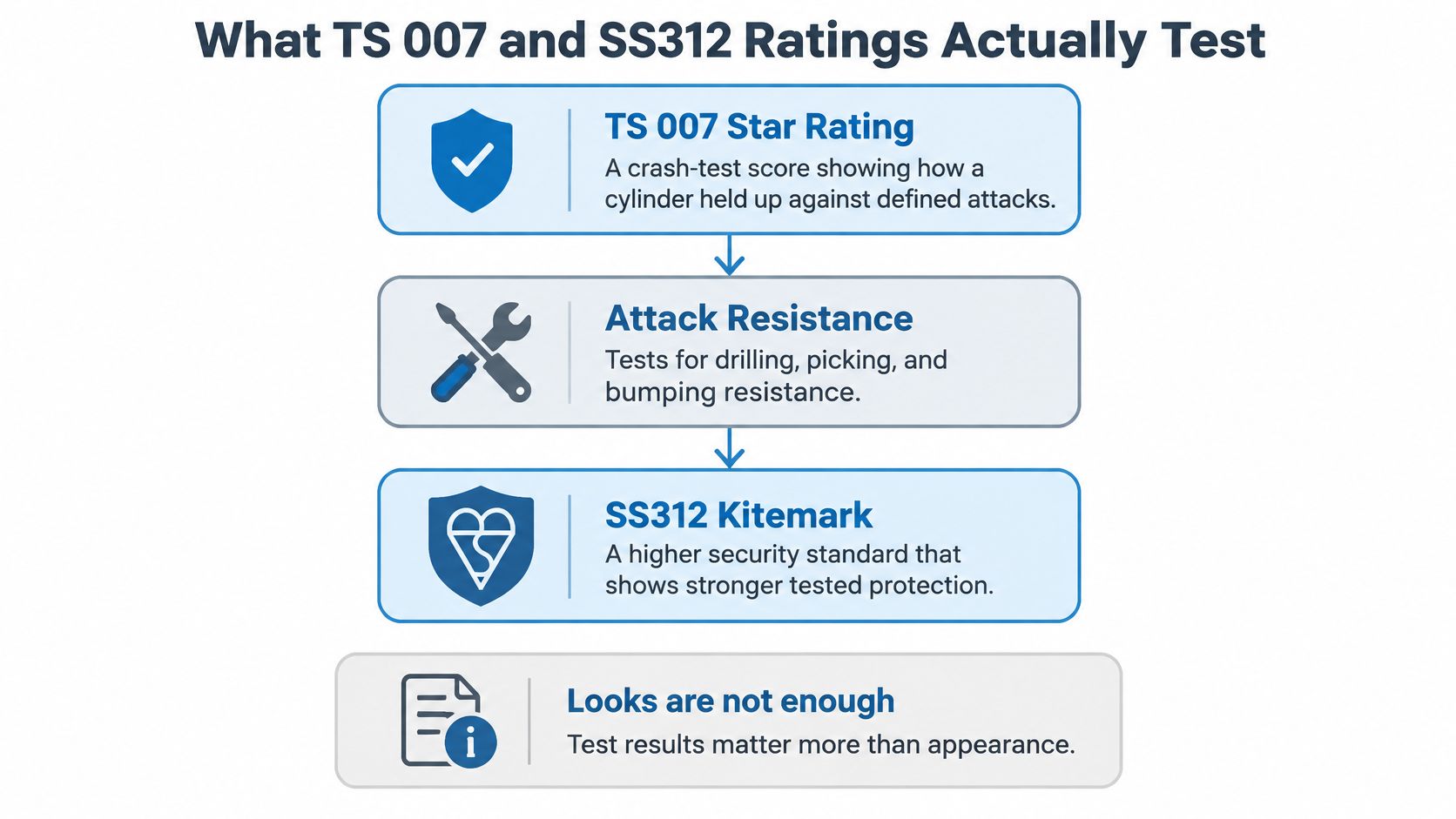
The star gap is where most buyers get confused. A one-star cylinder has some resistance, but it can't reach the top rating on its own. A two-star handle alongside it can bring the door up to the maximum five-star combination. A three-star cylinder provides the complete cylinder rating by itself, which is why West Yorkshire Police identifies it as the preferred upgrade. It doesn't depend on the handle achieving the additional two-star rating.
That independence matters on the doors you meet. Common UK uPVC and composite doors carry multipoint locking systems that are perfectly decent, and a vulnerable cylinder undermines the whole arrangement. The cylinder is the part an attacker can reach in seconds with a pair of grips, so it's the part that gets tested first.
Practical rule: if the word "anti-snap" appears on the box but no Kitemark or SS312 accreditation appears anywhere, you're reading marketing copy, not a test result.
SS312 Diamond is the other recognised route and carries equivalent high-security standing. It's the Sold Secure scheme, run by the Master Locksmiths Association, and it's the accreditation insurers tend to name. Some cylinders carry both. Either is a defensible specification, and neither is better than the other in a way that matters on a domestic front door.
The check itself takes ten seconds. Look for the actual TS 007 three-star Kitemark and/or SS312 accreditation on the cylinder body or the packaging, then confirm the marking applies to the exact model you're buying. Brands produce several cylinders across a range, and the one on the shelf next to the certified one often looks identical. A rating only counts when it's visible and specific to that product.
When fitting professionally, verify the certification marking before the cylinder goes in, check compatibility with the existing lock case, and consider a security handle or escutcheon where the handle system itself is exposed. A certified cylinder behind a flimsy handle isn't a certified door.
A cylinder that's too long protrudes, and one that's too short won't sit properly or engage the cam cleanly. Get the measurement wrong and you either send the lock back or, worse, fit something that gives away the security you paid for. Measure first, order once.
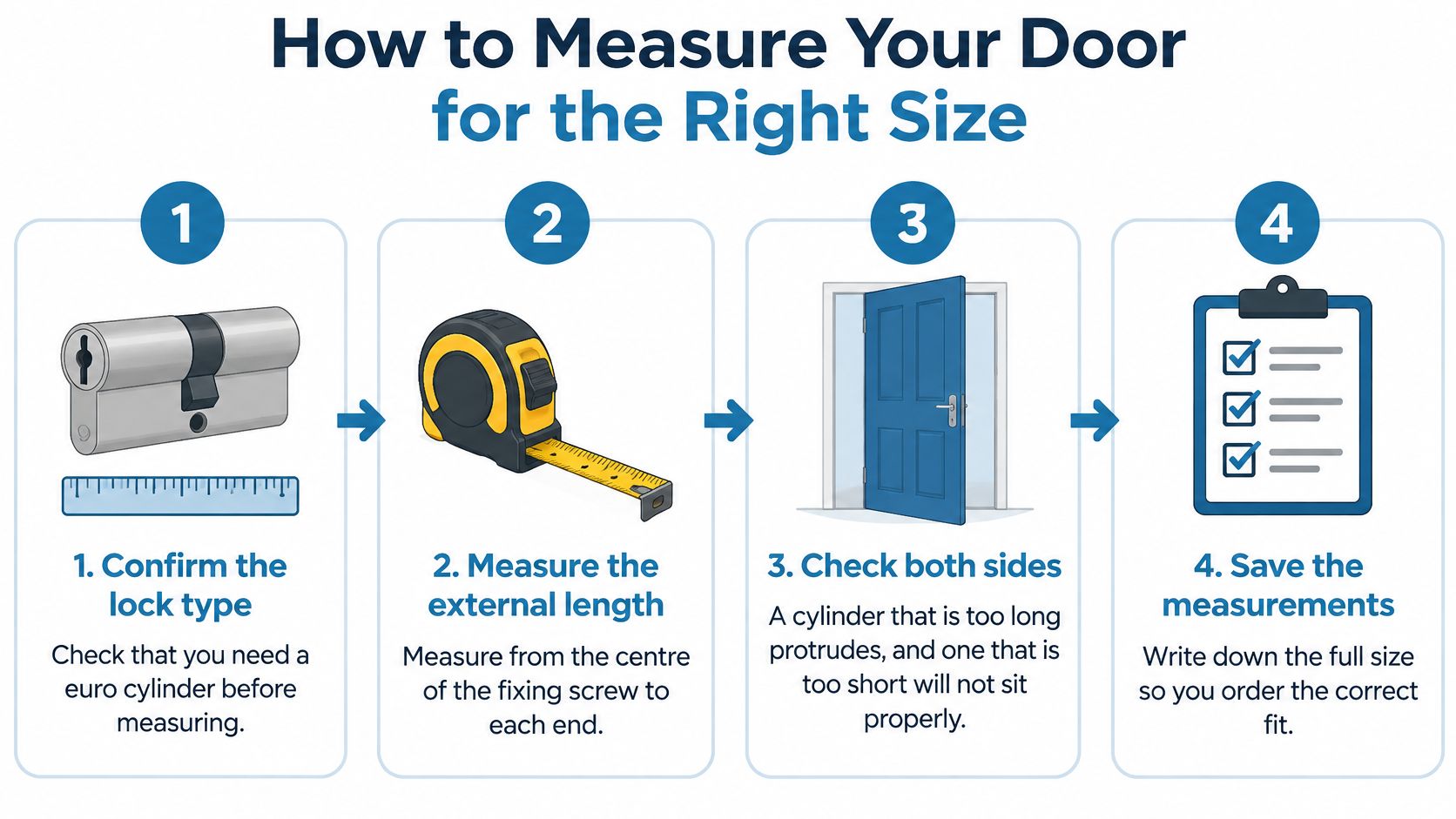
1. Confirm it's a euro cylinder. A euro cylinder is a barrel fixed by a single retaining screw through the door edge, with a cam or tail at the inner end. If the lock in your door is a mortice deadlock with a keyhole plate and no removable barrel, none of this applies and you're in a different product category entirely.
2. Measure from the centre of the keyway to each end. Measure the inside half and the outside half separately, both from the centre of the fixing screw hole. Write them down as internal over external, because that's how they're sold. Two measurements of 35mm each give you a 35/35, which is 70mm overall.
3. Check door thickness and lock case depth. A cylinder long enough for the measurements can still bind if the lock case behind it is shallow, and you don't want to force a barrel into a case that was never machined for it. If the existing cylinder came out easily, the new one of the same size will go in easily.
4. Check the projection against the handle or escutcheon. West Yorkshire Police warn that a cylinder should not protrude from the door or handle, since incorrect projection can undermine the intended security benefit. Stand at the door with the cylinder fitted and check it's flush or fractionally under the handle backplate on both sides.
5. Match the cam or tail. The cam is the rotating paddle at the inner end that throws the lock. Shape and length have to suit the lock case, and a cylinder with the wrong cam will turn in the air and do nothing.
6. Round to the nearest standard size. Cylinders come in set lengths. If your measurement falls between two, take the shorter one only if the cam still engages properly, otherwise move up and check the projection again.
Sizes are always quoted as internal over external, and the overall length is the sum of the two. Here are the standard options you'll meet:
| Size (internal/external) | Overall length | Typical use |
|---|---|---|
| 30/30 | 60mm | Narrow lock cases and tight-fit doors; measure first |
| 35/35 | 70mm | Common fit for standard UK uPVC doors |
| 40/40 | 80mm | Thicker doors or deeper lock cases |
| 50/50 | 100mm | Heavier timber doors or deep cases |
| 60/60 | 120mm | Specialist or unusually deep doors |
A correct fit looks unremarkable, which is the point. The cylinder sits flush or a hair under the handle on both faces, the key goes in without a wiggle, it turns smoothly through the full throw, and the handle returns cleanly to horizontal under its own spring. If the key grates, the barrel is binding. If the handle droops, the cam and the follower aren't happy with each other. Either way, stop and recheck the size before you force anything, because forcing a barrel is how lock cases get damaged.
One more measurement worth taking while you have the tape out: the distance from the door face to the outer face of the handle backplate. That number tells you your maximum projection. Anything longer than that and you're handing over the weak point.
Door material shapes the choice more than most guides admit. The cylinder has to work with the lock case, the handle and the doorset it sits in, and those change with the door. Work down the table to the row that matches your situation.
| Door type or need | Recommended cylinder | Check before buying |
|---|---|---|
| uPVC front door | TS 007 three-star cylinder | PAS 24 doorset certification and projection |
| Composite door | TS 007 three-star or SS312 cylinder | Handle rating and cylinder projection |
| Timber door | TS 007 three-star or SS312 cylinder | Strength of the lock case and hinges |
| Rental or shared entrance | SS312 Diamond or TS 007 three-star cylinder | Key control arrangements with the landlord |
| High-risk ground-floor door | SS312 Diamond cylinder with security handle | Handle compatibility and projection |
| Internal door | Standard cylinder | Security rating is not the main concern |
uPVC is the default case. It's the most common external door setup in the UK, and a TS 007 three-star cylinder is the usual target. Because so many uPVC doors carry multipoint locking, the cylinder is often the only weak component once the door is closed properly. If you want to understand how the cylinder interacts with the rest of the mechanism, read our explanation of what a multi-point locking system is before you buy.
Composite doors with steel faces need attention in two places at once. The handle rating matters because it's part of the assembly, and the projection matters because the cylinder must sit flush with the handle or escutcheon. A composite door is thick, so it's easy to end up with a barrel that looks right from the inside and stands proud on the outside.
Timber doors shift the question to the lock case and the hinges. On a solid timber door, the cylinder is only one part of the answer, and a three-star barrel bolted into a worn case with sagging hinges isn't a secure door however good the cylinder is. That's where the escutcheon earns its place: the STATUS Euro Profile Escutcheons on Round Rose come in pairs, measure 10mm deep, 51mm high and 51mm wide, and cost £5.67 per pair, which is a small spend to tidy up the face of a timber door and shield the cylinder at the same time.
For rentals and shared entrances, cylinder choice has to account for key control. A landlord managing spares needs a cylinder that can be keyed alike across a building or re-keyed between tenancies without replacing hardware. SS312 Diamond or TS 007 three-star cylinders both support that, and the keying arrangement is worth agreeing with the landlord before fitting anything.
High-risk ground-floor doors justify pairing a high-rated cylinder with a security handle. It's the combination TS 007 recognises, and it's the sensible response to a door that opens onto a street or a shared alley.
Before you buy: if the door is a PAS 24 certified doorset, changing the cylinder may affect that certification. Confirm with the door or doorset supplier rather than assuming a high-security cylinder preserves it.
That last point is where UK building regulations meet real life. Guidance cited in Barnsley Council planning documentation identifies Approved Document Q and lists standards including PAS 24:2022, STS 201, LPS 1175, STS 202 and LPS 2081 for doors and windows providing direct access to a dwelling. The same guidance recommends euro-profile cylinders rated TS 007 three stars, STS 217 or Sold Secure Diamond, while warning that changing a cylinder may affect the doorset's PAS 24 certification.
In practice, that means the lock can't be considered separately from the complete doorset. If your door came with paperwork, check it before you spend. If it didn't, and the door is a recent composite in a new-build, assume it may be a certified doorset and ask the supplier.
Stirling Council's published community council minutes state that doors should have either a five-lever mortice deadlock to BS 3621 or a euro-profile cylinder to TS 007 three-star standard, and recommend additional top and bottom mortice bolts and hinge bolts where a door is not multipoint-locking. That last condition does the heavy lifting: the cylinder counts as adequate on its own only when the door already holds itself into the frame at several points.
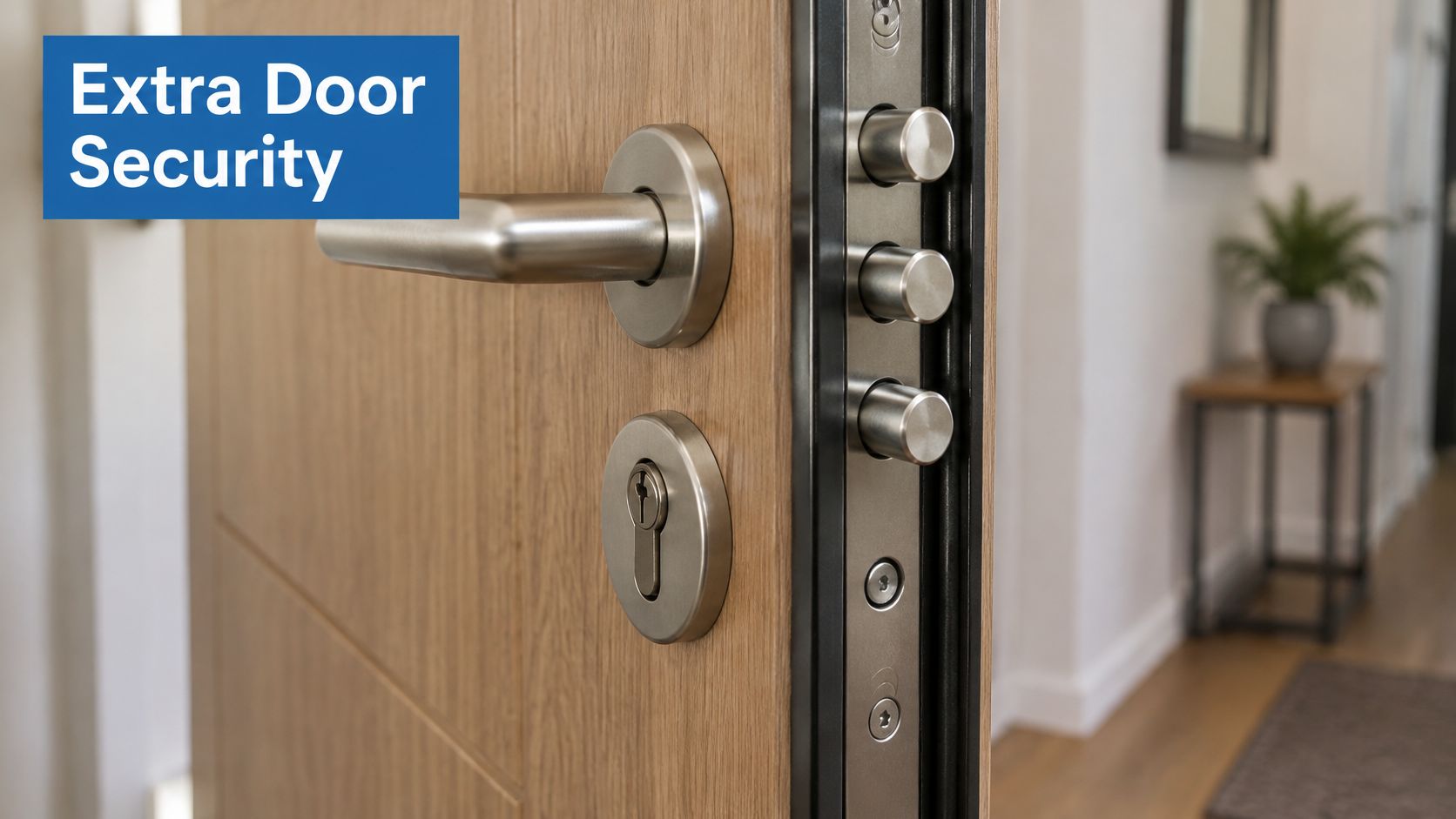
A multipoint door locks at the top, middle and bottom of the leaf, so a defeated cylinder still leaves three or five bolts engaged in the keeps. A single-point door hangs everything on the cylinder and the latch. Same cylinder, very different assembly.
On a single-point door, spending more on the cylinder raises the rating while leaving the geometry untouched. Adding locking points is what changes the geometry. A stainless steel hinge bolt set secures the hinge side so the leaf cannot be lifted off its hinges or prised at that edge, and the Eurospec ABH1000 Security Hinge Bolt Set is made from Grade 316 stainless steel and costs £6.75 for a pair. On the closing side, a lever action flush bolt adds a secondary bolt at the top or bottom of the leaf, and the 20mm satin stainless steel version at £9.24 suits doors where a mortice bolt would be awkward to sink.
Choose by construction, and price second. A flush bolt needs enough solid material in the leaf to sit properly, and a hollow or foam-filled composite door will not take one the way solid timber will. A mortice bolt has the same appetite for depth. Check what you are fixing into before ordering, because a bolt that only engages by half its throw is decoration.
The question to ask: what locks the door if the cylinder is bypassed? If the answer is "nothing else," the cylinder rating is doing all the work on its own.
A three-star cylinder on a multipoint door is a properly protected entrance. The same cylinder on a single-point door with a tired frame and exposed hinges is one well-rated component inside a weak assembly. Where the door is multipoint, put the budget into the cylinder and handle as a matched pair. Where it is single-point, split the budget: hinge bolts first if the door opens outward or the hinge knuckles sit outside, then top and bottom bolts. The supplementary hardware costs less than the cylinder and closes gaps the rating was never designed to cover.
The costliest mistake is a high-rated cylinder in the wrong size. It either protrudes, which gives an attacker the lever the rating was designed to deny, or it's short enough not to engage the cam properly, which means the door doesn't lock the way it should. Everything else on this list is cheaper to fix.
When you've narrowed it down, run the checks in this order:
One action: fit the confirmed size yourself if it's a straightforward single-point door, and book a qualified locksmith if it's a multipoint or high-risk door where a mistake costs more than the call-out.
If you're doing the fitting yourself, our walkthrough on how to install door locks covers the sequence from removing the old barrel to checking the handle returns cleanly. The job is manageable with a screwdriver and a tape measure, as long as the measurements are right before you start.
The wider point is that lock damage keeps appearing as a route into UK homes even as burglary totals move. A well-rated cylinder in a well-fitted assembly is the answer, and the assembly is the part most buying guides skip.
Neasden Hardware supplies euro-profile cylinders, escutcheons and the secondary hardware that turns a good lock into a secure door, from a Wembley showroom backed by more than thirty years in the ironmongery trade. If you're upgrading an entrance, start with the cylinder size and work outward to the handle, hinge bolts and bolts, and we'll help you match the parts to the door you have. Browse the range and check current pricing at Neasden Hardware.