
Order Online
- Straight to your door!
Straight to your door


The popular advice is simple. Pick the shiniest lever on the shelf, assume chrome means it will last, and copy it onto every door in the building. That advice fails in ordinary use. A mirror finish can glare under downlights, disappear against a pale door, and sit on a mechanism that was never meant for a school corridor or a washroom cleaned every day.
Chrome is a look, not a durability or accessibility rating. Start with the door, the room and the people who'll use it. Then check the grade, the grip and the fit before you order.
The brightest finish is often the least practical. That's the confusion to clear up first when you're comparing door handles in chrome. Extra shine doesn't mean extra quality, and it can make daily marks, glare and weak contrast worse.
Chrome and chrome-like finishes compared
| Finish | Look | Marks and glare | Best fit | Watch-out |
|---|---|---|---|---|
| Polished chrome | Mirror shine | Fingerprints and glare show quickly | Formal internal doors and low-traffic rooms | Weak contrast on pale or glossy doors |
| Satin chrome | Soft silver | Marks less obvious and glare is lower | Kitchens, family homes, rentals and care settings | Still needs a clear colour difference from the door |
| Stainless look | Cool brushed silver | Low glare, similar to satin | Busy or damp-adjacent doors if the metal grade suits | Not the same corrosion performance as chrome plate |
| Mixed metals on one scheme | Silver with brass, black or nickel | Each finish shows marks at its own rate | One accent room, kept consistent per door | Do not mix finishes on the same leaf or pair |
Polished chrome is mirror bright. It suits a formal internal door where hands are usually dry and the room isn't wiped down constantly. In a family kitchen, rental hallway or school corridor, you'll see fingerprints after ordinary use and you'll be cleaning to keep the effect, not to keep the handle hygienic.
It also throws light back. Under ceiling downlights, that glare can make the lever harder to read for someone with low vision, especially on a white or gloss door where there's little colour difference to begin with.
Satin chrome scatters light instead of reflecting it in one hard shine. Marks stay quieter, the surface feels calmer on painted timber, and you won't chase every touch with a cloth. For most lived-in rooms, that's the easier finish to live with.
A stainless or stainless-look lever can read as the same cool silver from across the room, but don't treat it as the same product. The base metal and corrosion behaviour can differ from chrome plate. You're choosing a different material that happens to share a colour, so check it on its own terms.
A finish that hides marks doesn't disinfect better. Cleaning does that.
That distinction matters because buyers often confuse appearance with hygiene. Satin may look cleaner for longer between wipes, but it still needs the same routine cleaning as polished chrome. Choose it for lower glare and less visible marking, not for a hygiene claim it can't make.
Shape and visibility limit the finish choice. Guidance discussed in Suffolk Latch Company's accessible handles overview favours hardware operable with one hand and a closed fist, commonly with return-to-door levers placed around 900 to 1000 mm above finished floor level. A narrow polished knob can fail that test even if the finish looks premium.
Work through five checks for each door. Can you operate it with a closed fist, does it glare, how quickly do marks show, how often will someone wipe it, and does the door colour give clear contrast? If polished chrome fails on glare or contrast, satin isn't a downgrade. It's the correct answer for that door.
Pick the matching row in the table first. Then let the grade checks decide whether that finish should stay on your list at all.
Chrome doesn't mean durable. Two levers can look identical in polished chrome and be built for completely different buildings. One belongs on a bedroom door. The other belongs on a communal entrance that gets pulled, bumped and cleaned all day.
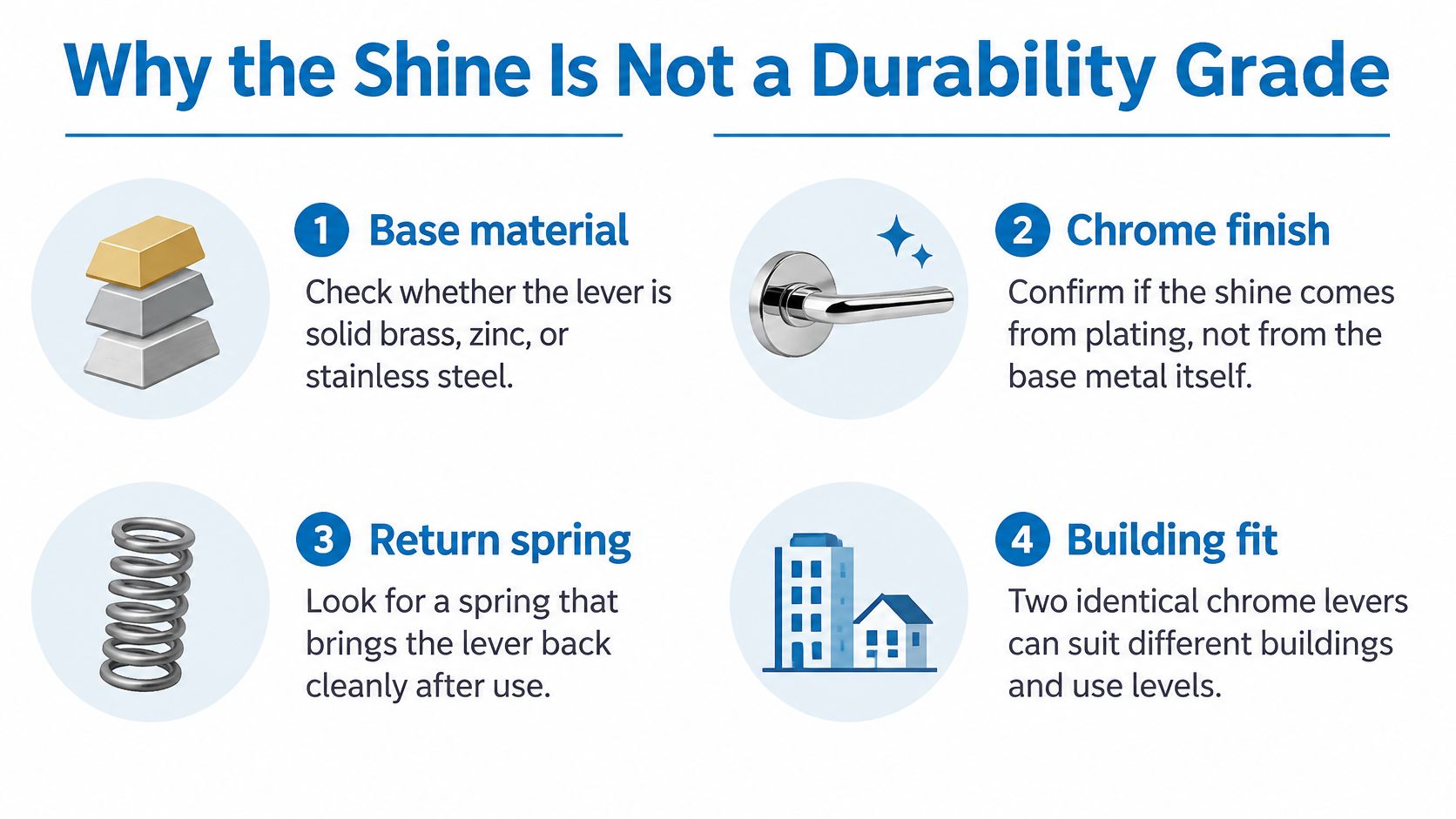
Ask what's underneath and what's been tested. A supplier should be able to tell you the base material, whether the chrome is plated onto it, what return spring brings the lever back level, and how it's fixed through the door. A lever that droops after a year usually has a weak spring or poor fixings, not a finish problem.
Then ask for the BS EN 1906 classification. That code covers category of use from light residential work to heavy public use, durability and cycle testing, suitability for fire and smoke doors, plus safety, security, operation and corrosion. It's slower to read than a finish label, but it's the document that tells you where the handle belongs. The same discipline helps with larger building choices, where it pays to compare balcony glazing systems on specification rather than on a photograph alone.
Concrete test figures make the point clearer. A Pro Installer report on a UK handle range describes handles tested to 100,000 operating cycles and an 80 kg lever pull, with BS EN 1670 corrosion performance up to Grade 5 and up to 480 hours of salt spray testing depending on finish. Those numbers describe that tested range. They don't transfer to every other chrome lever that looks similar in a catalogue.
An attractive polished lever can be wrong for a coastal site because salt air attacks plating that wasn't graded for it. It can be wrong for a washroom cleaned daily with strong products, and wrong for a communal entrance where trolleys and bags knock the lever end. In each case the failure looks like wear, but the cause is a mismatch between grade and environment.
Fire doors add a stricter limit. The handle has to sit inside the doorset's tested or assessed fire-performance evidence. Swapping standard furniture for an unverified chrome model, even one that fits the same holes, can undo that specification.
Practical rule: If a supplier can't state the use category, corrosion grade and fire-door evidence, don't upgrade the handle on appearance alone.
Guarantees need the same careful reading. In that UK example, cover was 10 years mechanical and only 5 years for decorative finishes. That's a useful warning for any brand. The mechanism may be covered long after the shine isn't.
Before you order, request these items in writing:
A handle that suits the metal display may not suit the door. Start with the leaf itself, its panels, paint and proportions, then choose a shape that repeats something already in the room.
Handle styles by door type
| Style | Best door | Watch-out |
|---|---|---|
| Slim rose lever | Modern flush door | Keep the rose small so it does not look heavy |
| Scroll lever on backplate | Panelled or period internal door | Backplate hides old screw holes; check hole centres first |
| Mitred lever | Contemporary or painted door | Should repeat a shape already in the room |
| Return-to-door lever | Accessible route or busy hall | Stops the hand slipping and reduces snagging |
| Low-profile flush pull | Sliding door | A projecting lever is the wrong shape |
A slim rose suits a modern flush door because the door face is flat and uncluttered. A larger backplate balances a panelled or period door, where a tiny rose can look lost, and it can cover old screw holes from the previous handle. Measure those holes first, because a backplate only helps if it covers them.
A scroll or mitred lever should echo a shape that's already present, such as a cornice line, a cabinet pull or a window handle. If it introduces a third unrelated style into a small room, it'll look chosen from a catalogue rather than for the space. Colour decisions work the same way, which is why guidance on where to split two wall colours is useful when a door sits between two paint tones and the handle needs to read clearly against both.
Keep every fitting on the same leaf in agreement. The lever, escutcheon, hinge and bolt should share one finish family, even if you use a second metal on lights or cabinet handles elsewhere in the room. Mixed finishes on one door look like replacements fitted at different times.
Polished chrome pairs naturally with gloss paint, glass and pale stone. Satin chrome sits more easily beside matt paint, oak and brushed appliances, because none of those surfaces is trying to outshine the others. On a sliding door, use a low-profile flush pull so the face stays clear as it passes the frame or pocket.
Matching has legal limits too. A House of Commons Library briefing on accessibility notes that Part M of the Building Regulations 2010 requires new buildings in England to make reasonable provision for access and use, without prescribing one single handle design, while the Equality Act 2010 can require shops and businesses in England, Wales and Scotland to make reasonable adjustments. In an existing shop, copying the old knob in fresh chrome may preserve the look and preserve the disadvantage.
Use the pairing rule to finish the choice. One finish per door, one style per room, and a second metal only as a planned accent. On external or bathroom doors, keep the finish family but select the version graded for moisture rather than copying the indoor lever exactly.
Fit is something you can measure before the old handle comes off. Put the tape measure first, because it prevents the two common failures with door handles chrome buyers discover too late, a grip that slips and a door that's stiff to open.
Chrome handle size and reach checks
| Check | Benchmark | What to look for |
|---|---|---|
| Lever grip diameter | At least 19 mm | A tubular grip a closed fist can hold |
| Clearance to the door face | About 45 mm | Knuckles clear the door |
| Hand-grip zone | At least 95 mm | Enough length to grasp |
| Pull handle diameter | 19 to 35 mm | Within the BS 8300 guidance range |
| Height above finished floor | About 900 to 1,000 mm; spindle often 900 to 1,050 mm | Reachable standing or seated |
| Opening force | No more than 15 N suggested; some users 13.3 N | Latch, closer and alignment, not the plating |
On an accessible route, favour a lever over a knob. A knob needs a tight grasp and a wrist twist. A lever can be pushed down with one hand, a closed fist, or even a forearm when someone's carrying shopping.
The GAI specifiers guide to ironmongery and accessibility gives a lever grip section of at least 19 mm in diameter, approximately 45 mm clearance between the back of the handle and the door face, and a minimum 95 mm hand-grip zone. For pull handles, BS 8300 guidance gives 19 to 35 mm diameter, with positioning generally centred around 900 to 1,000 mm above finished floor level.
Those three lever figures work together. Diameter gives the fist something to close around, clearance keeps knuckles off the door, and grip length stops fingers crowding against the rose. A return-to-door end, where the lever curves back towards the door, stops the hand sliding off and reduces the chance of a sleeve or bag strap snagging. If you're comparing lever and pull layouts for a heavier door, our guide to choosing a door handle pull works through the fixing and grip choices.
Some project standards set their own ceiling for height, so check whether your refurbishment brief has a limit to meet rather than assuming any lever position will pass. Measure from finished floor level, not from bare boards before flooring goes down.
Contrast is part of fit, not decoration. A highly reflective lever on a light or glossy door may not be visible enough, because visibility depends on the Light Reflectance Value difference between handle and door. Hold the sample against the actual door in the room's real lighting. If you have to squint to find it, someone with low vision will struggle more.
Then check the mechanical fit the finish can't solve:
Inclusive-mobility guidance in that GAI summary recommends manual doors operable with no more than 15 N of force, noting some users may be unable to exert more than 13.3 N. A closer set too strong, a swelling seal, or a door that's dropped on its hinges can push the force up even with a perfect lever. Fix the door, adjust the closer, then judge the handle.
End with a tape-measure check before ordering. Grip diameter, clearance, grip length, height, screw centres and door thickness, written down for each door, will catch most ordering mistakes.
Chrome plate is thin. Clean it gently and it'll keep its shine for years. Scrub it with the wrong product once a week and you'll dull it yourself, then blame the finish.
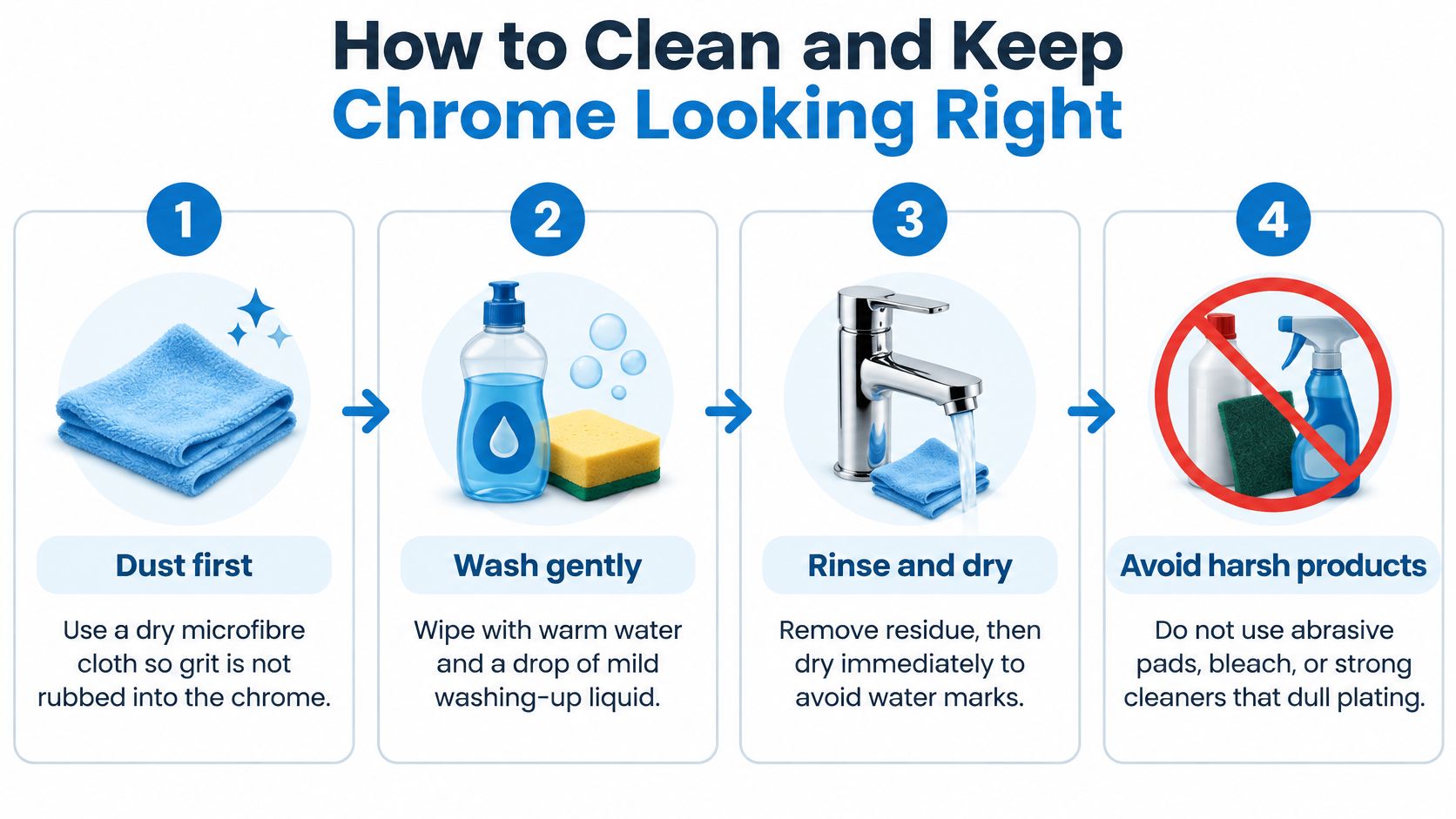
Follow these steps in order:
In a bathroom or kitchen, wipe after heavy steam or grease rather than letting a week's build-up harden. Small, frequent wipes with a soft cloth do less damage than one determined scrub at the end of the month.
Keep these away from door handles in chrome finishes:
Apply any cleaner to the cloth, not to the handle. That controls where it goes and stops liquid running behind the rose, where it can sit against screws and the door face.
If plating has worn through to a yellow or grey base metal, cleaning won't restore it.
At that point you're looking at the material underneath, and no polish will put chrome back. Replace the handle and choose the replacement grade for the room that wore the first one out. A bathroom lever that failed early usually needed a better corrosion grade, not stronger chemicals.
A shorter decorative guarantee is another reason for gentle cleaning. Treat the finish as the most delicate part of the handle, because mechanically it usually is. The lever, spring and fixings will often outlast the shine if you don't scrub the shine away first.
Rules about finish and grade only make sense once they meet a real door. These four situations cover most of the decisions UK buyers, landlords and fitters face, and each one turns on a single decisive change.
A Victorian terrace refit with panelled internal doors painted a deep green gives polished or satin chrome plenty to work against. A scroll lever on a backplate suits the panels, covers the old screw holes, and stands out clearly against dark paint. Match the hinges and bathroom bolt to the same finish so the door reads as one set.
The decisive change here is contrast. Repaint that same door pale grey gloss and the polished lever all but disappears. Satin chrome, or a darker door colour, restores the difference.
Hands in a family kitchen are wet, floury and in a hurry. A satin chrome return-to-door lever is the calmer choice because marks show less, the curved end keeps a damp hand from slipping off, and children can't catch sleeves on a projecting tip. Height still matters for comfortable reach, and our notes on door handle height in the UK set out how to position furniture consistently across a house.
The decisive change is satin instead of polished. You keep the silver colour and lose the daily fingerprint chase.
A tenant or customer who can't grip a round knob is at a disadvantage every time they use the door. The Equality Act 2010 can place a duty on landlords, employers and service providers to make reasonable adjustments, and swapping a knob for a lever is the kind of inexpensive change that tends to fall within it. Sorting the handle is far cheaper than leaving the barrier in place.
The decisive change is a lever instead of a knob, specified for usability rather than chosen because it's metallic. A chrome knob would be a fresh finish on the same old problem.
On a flat entrance or school corridor door, state the use and corrosion grades on the order and keep the handle within the fire-door evidence for that doorset. In a coastal washroom that's cleaned constantly, check salt-spray performance or move to a suitable stainless grade instead of copying an indoor polished lever.
The decisive change is a stated grade. Chrome describes the look on the shelf. The grade describes how the handle copes with the room, and only the second one protects the specification, the tenants and the person signing off the work.
Turn your measurements into an order sheet and order from it, not from memory in the shop. For each door, confirm the finish from the comparison you chose, the lever shape, rose or backplate, spindle length and square size, screw centres and door thickness. Note whether it's a fire door or sits on an accessible route, because either answer limits which models you can use.
Measure old hole centres before assuming a backplate will cover them, and note the existing latch and closer so the replacement doesn't change the opening force. For a fire door, confirm the handle is covered by the doorset's tested or assessed evidence before you order, not after it arrives. On commercial, educational or multi-occupancy work, state the BS EN 1906 classification and BS EN 1670 corrosion grade on the order rather than the finish name alone.
Two stocked examples show why the details matter. The Zoo Hardware PR02 Project Victorian scroll lever is chrome plated on a zinc base material, has a face fix backplate and a 100 mm steel spindle, and is supplied with wood screws. The Project Victorian scroll lever on a 150x40 mm backplate is priced at £10.42 in Satin Chrome and in Polished Chrome, while the 19mm Mitred Lever Handle On Push On Rose 52mm Dia Grade 201 SSS costs £6.65. Same silver family, different construction, shape and price.
For external, coastal or washroom doors, specify a suitable stainless grade or higher corrosion grade where chrome plate is the wrong choice. Ask for the current price and lead time before you promise a fitting date, keep a copy of the measurements with the order, and follow a consistent fitting method such as our guide on how to install door handles so the fitter works from the same figures you ordered against.
Bring your measurements, door thickness and screw centres to Neasden Hardware and we'll help you match polished chrome, satin chrome and stainless-look levers to the right grade for each door, from a single bedroom replacement to a full rental or school refit. Browse the range online or visit the Wembley showroom for practical advice on spindles, backplates, fire-door evidence and fixings before you commit to an order.