
Order Online
- Straight to your door!
Straight to your door


You've arrived home with shopping bags in both hands, it's getting dark, and the porch switch is just out of reach. A dusk to dawn light bulb removes that small daily nuisance. Fit it correctly, and the light responds to fading daylight rather than waiting for you to find the switch.
The important buying decision isn't which bulb looks brightest on the shelf. Cap type, sensor position, lux thresholds, heat, enclosure, and IP rating decide whether the lamp works reliably. In some outdoor situations, a complete fitting with an integral photocell is a better long-term choice than a retrofit bulb.
A dusk to dawn light bulb is a conventional lamp shape with a small light sensor and switching circuit built into its base. The common retrofit versions use a BC B22 bayonet cap or an ES E27 Edison screw cap, so they can fit an existing holder without adding a separate sensor, timer or smart hub.
The bulb watches the surrounding light level. As evening brightness falls below its operating threshold, it switches on. As daylight returns, it switches off again. Your ordinary wall switch still controls the mains supply, so you can isolate the fitting or leave the automatic function disabled whenever you need to.
The simple distinction: a photocell reacts to ambient light, a PIR reacts to movement, and a timer reacts to the clock.
That difference matters at the front door. A motion sensor might leave the area dark until somebody approaches, then illuminate it for a short period. A timer can switch on at a chosen time, but it won't adjust naturally as sunset changes through the seasons. UK street lighting commonly uses daylight-linked photocells rather than fixed time clocks, and West Sussex notes that dusk and dawn timing can vary by about 15 to 20 minutes across the year as daylight changes (West Sussex daylight-controlled street-lighting guidance).
A dusk to dawn bulb is therefore suited to places where you want dependable background illumination throughout the hours of darkness. That might mean a sheltered porch, a small side passage, a communal entrance or a modest shop frontage. It isn't automatically the most economical choice for a driveway that only needs light when someone walks across it, where a PIR may be more appropriate.
The sensor doesn't measure sunset as an event. It measures brightness at the fitting, which is why the bulb's position and the lantern's glass matter. The following points, including lux thresholds and the deliberate gap between switching levels, explain why two apparently similar bulbs can behave differently.
Think of the photocell as a tiny light meter attached to the bulb, rather like an eye watching the sky. It doesn't recognise “evening” or “morning”. It detects how much light reaches its surface and passes that information to the switching circuit.
Many photocells use a cadmium sulphide, or CdS, photoresistor. In brighter conditions its electrical resistance falls. As the light fades, resistance rises. The circuit interprets that change and decides whether the lamp should be energised.
That decision is expressed in lux, the unit used for illuminance. UK control guidance gives examples around 20 lux for dusk and 70 lux for dawn, while UK-grade photocells can be specified with switching thresholds in the 35 to 70 lux range (UK lighting-controls guide; UK photocell product specification).
A sensor that switched at one identical level in both directions would be liable to chatter. A passing headlamp, a bright cloud break or light reflected from wet paving could make the circuit switch repeatedly. Manufacturers prevent this with hysteresis, a deadband between the turn-on and turn-off points.
Some UK outdoor photocells specify a switch-on level of 70 lux and a switch-off level of 80 lux, while another specification uses a 35 lux switching level with a 1:0.5 switching differential (UK outdoor photocell specification). The exact settings vary by product, so don't assume every dusk to dawn bulb will activate at the same point.
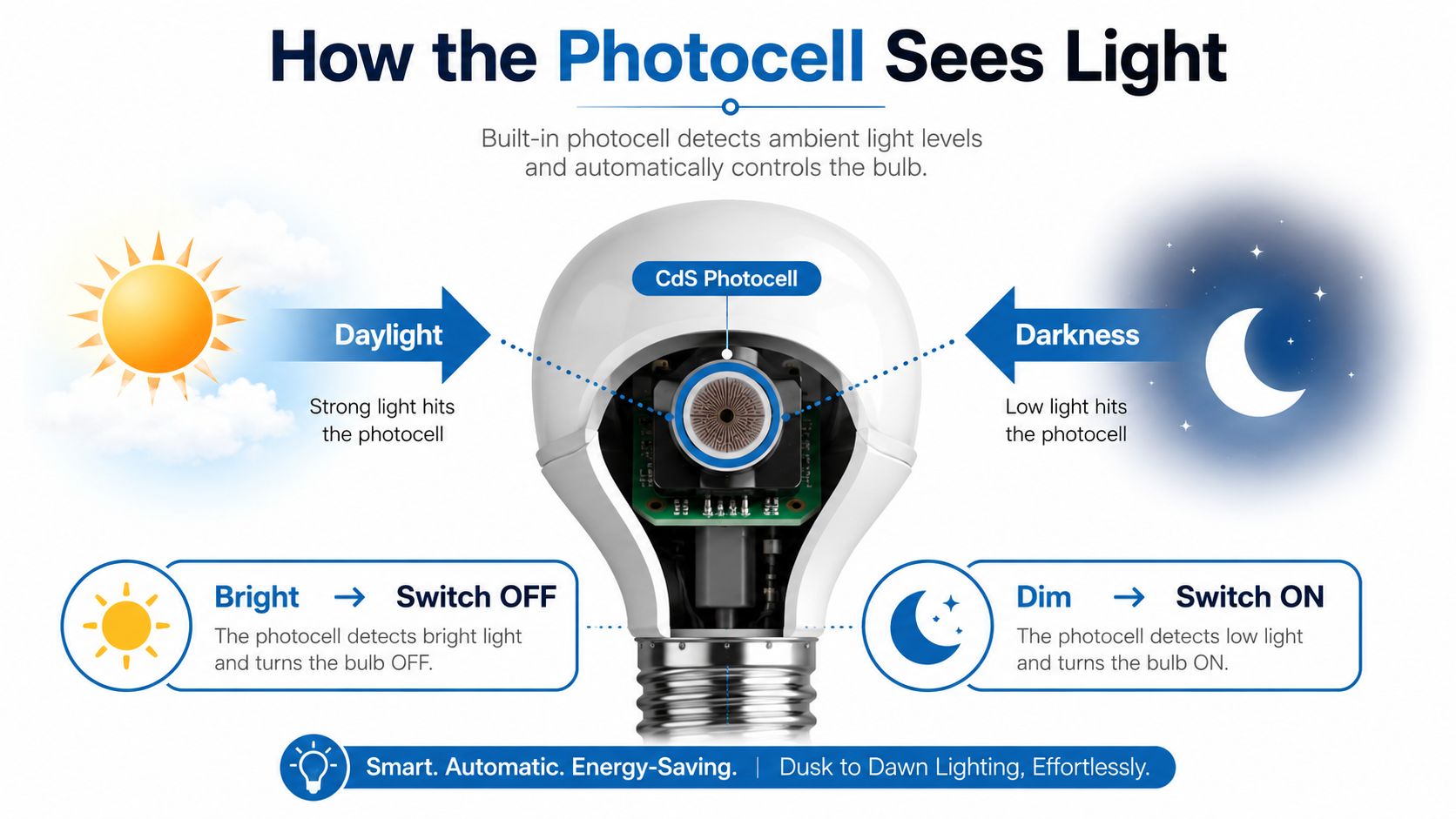
Positioning can be more important than the printed lux figure. Keep the sensor clear of a porch wall, heavy eaves and frosted glass that blocks the sky. If the bulb sees its own light reflected from a pale wall, it may decide that morning has arrived and switch off, then switch back on when the reflection disappears.
The opposite problem occurs near bright artificial light. A security flood, neighbouring lantern or sodium street lamp can shine directly on the photocell and make it believe daylight has returned. Turn the sensor towards open ambient light, not towards another lamp, and allow for the fact that the sensor reads light at its own position rather than at the edge of the driveway.
A porch lantern may accept the right cap size yet still be the wrong home for a dusk-to-dawn bulb. For most UK retrofit jobs, LED is the sensible starting point because it reaches full brightness immediately, runs cooler than halogen and is commonly supplied as a non-dimmable lamp. Check the fitting, enclosure and sensor position before comparing brightness.
Typical LED sensor bulbs sit in the 6 to 12 W range and may replace a 40 to 60 W halogen lamp. Indicative LED life is 15,000 to 25,000 hours, but these are product-range examples, not promises. Read the manufacturer's declaration, particularly where the lamp will operate inside an enclosed lantern or face cold and damp conditions.
Halogen still appeals where a low purchase price and warm appearance matter. It reaches full output without a noticeable warm-up period, but its high operating temperature can cause trouble inside compact lanterns and close to sensor electronics. For a detailed comparison of halogen and LED technology trade-offs, see this halogen vs LED comparison guide.
| Bulb type | Typical wattage | Average life | Warm-up time | Indicative running cost |
|---|---|---|---|---|
| LED sensor bulb | 6 to 12 W | 15,000 to 25,000 hours | Instant full output | Roughly 15 to 30p per 1,000 hours |
| Halogen sensor bulb | Product dependent | 2,000 to 4,000 hours | Instant full output | Higher than an equivalent LED |
| Smart sensor bulb | Product dependent | Check manufacturer specification | Usually instant, network features may vary | Depends on wattage and standby behaviour |
CFL sensor bulbs are less suitable for many outdoor jobs because cold conditions can delay useful light. Smart Wi-Fi, Zigbee and Bluetooth bulbs can provide remote overrides, schedules and grouped control. Confirm that the product suits 230 to 240 V UK supplies, and check what happens after a power cut. A network-dependent bulb may not behave like a simple photocell.
The better purchase is sometimes a complete exterior fitting rather than a sensor bulb. An integral photocell luminaire combines the enclosure, light source and control, reducing the risk of pairing a bright bulb with a lantern that has poor weather protection or obstructs the sensor. A product such as the RA Polo Combi LED bulkhead is designed as one unit, which can be a more dependable choice for exterior security lighting.
The right setup depends on what the light needs to do. A front-door lamp usually needs welcoming, modest illumination. A side passage needs coverage and reliable switching. A commercial bin store or car park needs weather protection, repeatable control and easy maintenance.
| Location | Recommended setup | Typical wattage | Minimum IP rating |
|---|---|---|---|
| Sheltered porch | LED B22 or E27 sensor bulb in a suitable lantern | 8 to 12 W | IP44 |
| Driveway or side passage | Brighter LED sensor bulb, or PIR floodlight with photocell | 15 to 25 W | IP54 |
| Garden path | Low-voltage G4 or MR16 sensor arrangement, or a photocell-controlled strip | Product dependent | Outdoor-rated equipment |
| Commercial exterior | Integral photocell luminaire with sealed housing | Project dependent | IP65 |
An existing porch lantern can be a straightforward retrofit if it has a clear upper window and the bulb's sensor can see the changing sky. A decorative fitting with a thick frosted globe may look attractive but can delay or distort the sensor's response. For a driveway, a sensor bulb may not spread light widely enough, so a PIR floodlight with a separate photocell can provide stronger illumination only when movement occurs.
Garden spike lights need extra care because many use low-voltage G4 or MR16 lamps and a separate driver or transformer. A sensor bulb designed for a 230 to 240 V holder isn't interchangeable with a low-voltage lamp. For path marking, a photocell-controlled LED strip or festoon can sometimes give a cleaner result, especially where individual spike lamps would be difficult to maintain.
A retrofit bulb is convenient, but an integral photocell luminaire can be the better answer for exposed walls, communal areas, signage and commercial exteriors. The housing can provide a more suitable IP seal, the sensor can be positioned deliberately, and the fitting may use a replaceable LED board rather than a small bulb trapped behind unsuitable glass.
Lighting decisions also benefit from advice that considers the property as a whole, not just the lamp. These lighting experts at Cultivate House Detailing offer useful context for thinking about placement, appearance and exterior function.
In rural gardens, don't illuminate every boundary because automatic lighting makes it easy. Aim fittings downwards, avoid unnecessary glare and consider wildlife and dark-sky concerns. A warm, controlled pool at the entrance is often more considerate than a bright flood pointing across the garden.
Replacing a bulb in an existing fitting is often a straightforward DIY job, but the holder and supply still need care. A typical UK outdoor fitting operates at 230 to 240 V AC. Isolate the circuit at the consumer unit, then confirm it is dead with a suitable tester before touching the lamp or holder. If the wiring, holder or enclosure is damaged, or the work involves a new circuit, use a qualified electrician.
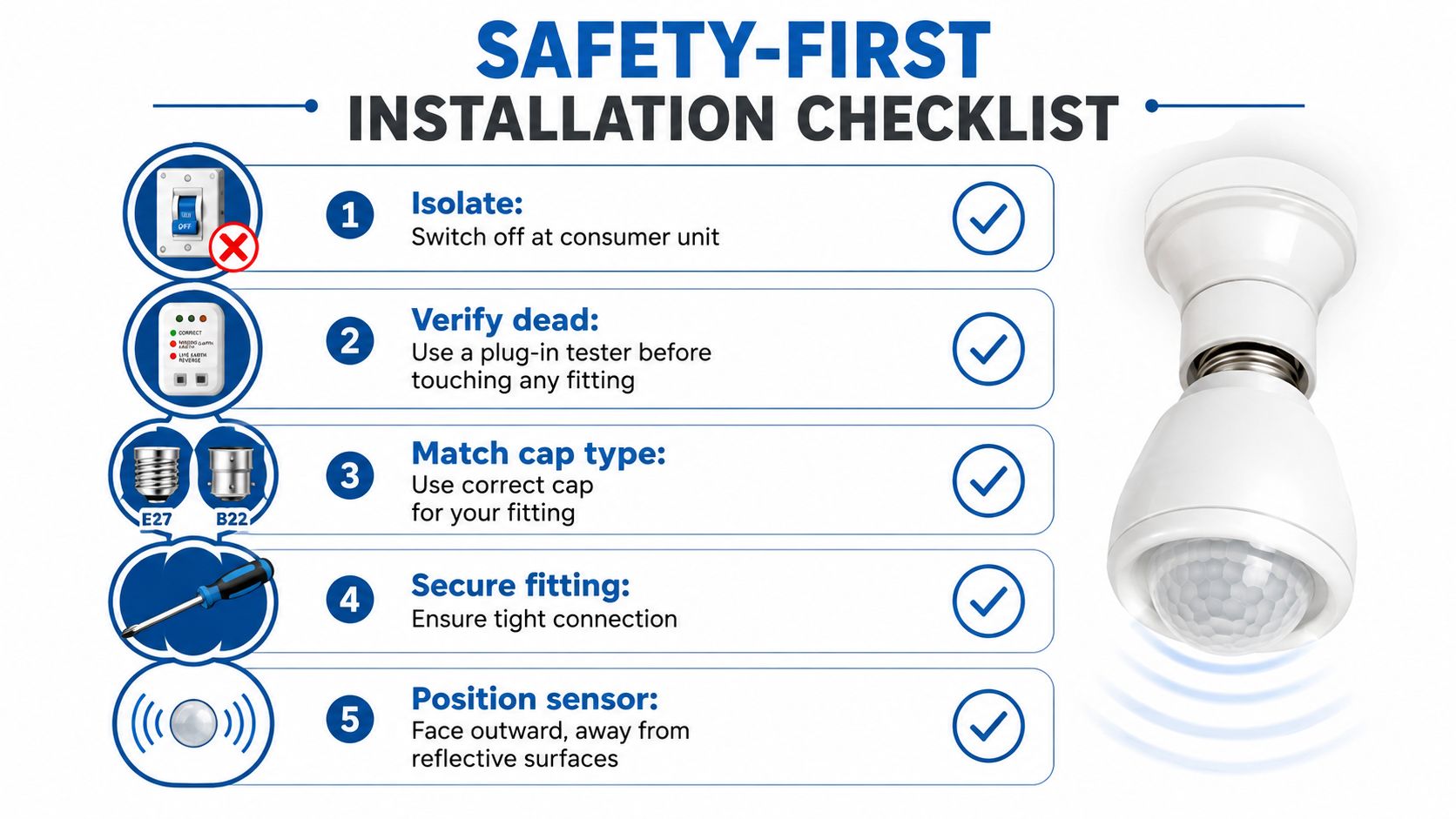
Allow for a switching delay. Some photocell products use a delay of about 10 to 15 seconds to ignore brief flashes of light, while particular bulbs and fittings may take longer to settle. Do not assume the lamp has failed because it does not change state immediately after you cover or uncover the sensor. The switching behaviour and rated load should match the product instructions, such as this UK photocell installation specification.
Give the sensor a clear view of ambient light. A nearby wall, reflective fascia or security floodlight can make the photocell read the wrong conditions. Recessed or north-facing positions may receive daylight later, so the lamp could switch on or off at an unexpected time. Follow the manufacturer's orientation guidance rather than assuming one compass direction always works.
For installation work in England and Wales, new external circuits fall under electrical safety requirements commonly associated with Part P. A competent person registered with NICEIC or NAPIT should handle that work. A direct bulb replacement is different, but stop if you need to alter wiring, the holder or the enclosure.
If connector types are unfamiliar, this guide to push-wire connectors explains the difference between traditional terminals and push-fit accessories. Do not open a live fitting to experiment.
For a visual walkthrough of the installation steps, see the video below.
A dusk to dawn bulb saves energy mainly by preventing daytime operation. The sensor doesn't make the lamp free to run, and a lamp that stays on throughout the night can still use more electricity than a motion-controlled fitting. The useful comparison is between the automatic lamp and the type of lamp it replaces.
The following illustration uses the stated UK example of a 9 W LED and 42 W halogen, each operating for roughly 4,000 hours a year, with an electricity price of about 24.5p per kWh for standard variable tariffs in 2024 to 2025. The underlying cost calculation is straightforward, but your tariff and actual darkness hours will vary.
| Bulb type | Wattage | Hours/year | kWh used | Annual cost |
|---|---|---|---|---|
| LED sensor bulb | 9 W | Roughly 4,000 | About 36 kWh | About £8.80 |
| Halogen sensor bulb | 42 W | Roughly 4,000 | About 168 kWh | About £42 |
These illustrative figures produce an annual difference of about £33 per fitting. The calculation is based on the stated tariff and operating hours, not a guarantee of household savings. A separate PIR that runs for only short periods can use less still, although it won't provide continuous light for someone approaching late at night.
Running-cost check: multiply wattage by actual operating hours, divide by 1,000, then multiply by your tariff in pounds per kWh.
Public lighting shows why automatic control has become more than a convenience feature. A UK street-lighting survey recorded 1,280,587 dusk-to-dawn streetlights, representing 33% of all streetlights in its dataset, alongside 5.1 million non-CMS streetlights analysed nationally. It also recorded 116 councils, or 55% of councils covered, operating part-night policies affecting 362,353 streetlights, with annual street-lighting energy use estimated at 1,887 GWh (UK street-lighting survey).
Devon County Council reported a fall in street-lighting energy use from about 31 million kWh in 2015/16 to 12 million kWh in 2023/24, with annual revenue savings in excess of £6 million at £0.33 per kWh. Its dimming examples include changing output through the night, and a separate trial update linked a pre-dawn change from 25% to 40%, alongside other measures, with approximately 2.2 GWh annual energy reduction and about 500 metric tonnes of carbon savings (Devon and Cornwall street-lighting information).
For wider household energy choices, this UK green power comparison provides broader context. A sensor bulb still uses electricity during its operating period, so use an override or PIR where all-night illumination isn't necessary.
Start with the fitting, not the brightness printed on the front of the box. A Victorian terrace porch may suit an E27 or B22 LED sensor bulb in an IP44 lantern, while a modern semi-detached driveway may need an IP65 floodlight with a separate photocell or PIR. A flat's shared hallway often needs an indoor-rated fitting and building-management approval rather than an outdoor bulb.
The UK smart-lighting market is projected to rise from $431.1 million in 2025 to $737.2 million by 2030, representing an 11.3% CAGR, according to the cited market projection (UK smart-lighting market projection). That growth makes connected control worth considering for landlords and property managers, but a smart bulb still needs the correct cap, enclosure and sensor position.
Warm 2700K light generally suits a welcoming entrance, while cool 5000K light gives a crisper security appearance. Neither colour temperature fixes a poorly positioned sensor. Likewise, a low standby output or smart override won't compensate for an enclosed bulb that overheats.
For common electrical, lighting and hardware requirements, browse the electrical products collection. Before you leave the counter, ask one practical question: is the photocell facing a wall or the sky?
Neasden Hardware offers practical electrical and hardware supplies for tradespeople, landlords and home improvers, backed by long-standing product knowledge and a Wembley showroom. Visit Neasden Hardware to compare suitable fittings, connectors and installation essentials, then choose a dusk to dawn solution that matches your property rather than buying the brightest bulb.