
Order Online
- Straight to your door!
Straight to your door


You're halfway through a seized brake job. The apprentice reaches for the impact driver, the T40 skates across the bolt head, and the star recess starts losing its outer wings. More power won't rescue that fastening. A poor fit, a tired bit, or the wrong variant has already decided the outcome.
A T40 Torx bit is a substantial workshop size, but it isn't a universal answer for every large-looking star recess. Its 6.65 mm point-to-point profile, fastener compatibility, shaft format and condition all matter. Treat it as a working part of the fastening system, not as a permanent accessory that stays in the drawer until something jams.
A decade-old caliper carrier bolt is a good test. The head may be corroded, the joint may have settled under load, and access may force the driver slightly off-axis. If the T40 has already seen repeated impact use, its lobes can be rounded before they look obviously damaged. The driver then slips sideways and chews the recess, while the operator blames the impact setting.
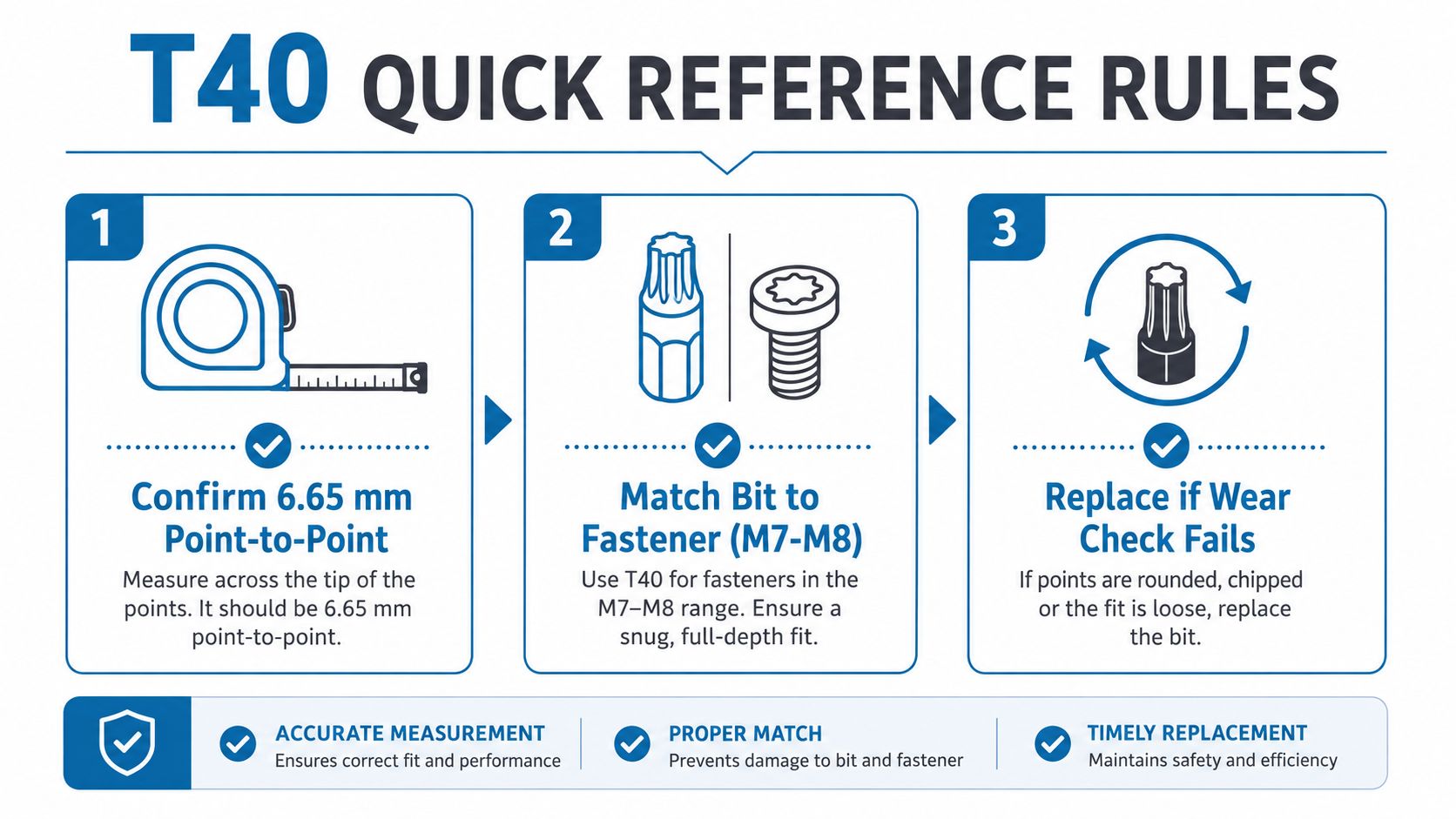
The first check is simple. Clean the recess, press the bit fully home and confirm that the profile is T40. The size is defined under ISO 10664, and UK distributor guidance gives its point-to-point width as about 6.65 mm (UK Torx size chart). That dimension matters more than the brand printed on the bit.
T40 sits in the mid-to-large part of the internal Torx range. In workshop terms, it bridges lighter M6 work and heavier M8-style structural applications. It appears on automotive fixings such as brake caliper hardware, suspension components and larger engine fittings, as well as machinery, structural assemblies and some substantial furniture fixings. An industrial specification chart places T40 around M7 to M8 fasteners and in a high-torque class (Torx specifications).
The profile works because the six driving lobes engage the recess with broad flank contact. A correctly seated bit transfers force through those faces instead of relying on a small point that can climb out under load.
Workshop rule: if the bit doesn't sit squarely and deeply in a clean recess, stop before applying torque. The extra seconds spent checking fit are cheaper than extracting a damaged bolt.
A T40 is therefore the right tool when the fastener is designed for that envelope, the recess is clean and intact, and the bit is still sharp at its driving corners. If any of those conditions fail, a stronger driver merely increases the damage rate.
T40 is a size designation within the Torx family, not a measurement in millimetres. The profile follows ISO 10664, and a fresh T40 measures about 6.65 mm point-to-point, across the outer tips of the six-lobed star (Wera T40 technical listing).
Hold a clean bit under a bench light. You'll see six lobes radiating from a central pilot, with each lobe presenting a relatively flat driving face. That shape gives the socket more useful contact than a cross-head recess, where the driver can climb out as axial force and torque rise. The depth of the recess also helps keep the bit located, provided the fastener head hasn't filled with rust, paint or swarf.
T40 is larger than T30 and smaller than T45. A UK-facing chart lists T30 at 4.74 mm, T40 at 6.65 mm, and T45 at 7.82 mm point-to-point (Torx size chart). Those neighbouring sizes can look deceptively similar when a fastener is dirty or partly rounded.
| Size | Point-to-point | Typical fastener | Common use |
|---|---|---|---|
| T30 | 4.74 mm | Smaller general fixing | Machinery, fittings and automotive trim |
| T40 | 6.65 mm | M7 to M8 style fixing | Caliper, structural and heavy equipment work |
| T45 | 7.82 mm | Larger heavy-duty fixing | Larger automotive and industrial assemblies |
The measurement is a useful confirmation, not permission to force a near match. A T45 may enter a damaged T40 recess partway, but it won't make the original geometry correct. Likewise, a T40 in a T30 recess may initially feel tight because its tips catch the damaged edges, then destroy them when torque is applied.
Some manufacturers add colour coding, but colours aren't standard across the trade. Bench shorthand also varies. T40, TX40 and similar markings usually refer to the standard internal profile, while T40H or IP40 commonly identifies a security version with a centre pin. External E-Torx sockets are a different system altogether. Before use, compare a new bit with the suspect one. Look for crisp corners, even lobe symmetry and an undamaged centre. A dropped bit can develop a tiny burr that prevents full seating, even when the printed size is correct.
T40 commonly turns fixings in the M7 to M8 range, which is why it appears on substantial automotive and structural work. UK technical guidance associates the size with applications including brake hardware, heavy equipment, trailer hitches and larger fasteners (T40 heavy-duty applications). The bit has enough flank area to transfer useful torque without the immediate cam-out associated with smaller profiles under heavy load.
Published size guides place T40 in a maximum torque range of roughly 54.1 to 65.1 N·m (Torx bit size guide). That figure describes a size and application envelope, not a universal tightening instruction for every bolt. The fastener manufacturer, vehicle maker and joint design remain the authority.
A brake caliper bolt and a structural timber screw can both use T40, yet they don't behave alike. Their material, thread pitch, coating, clamping load and joint hardness alter the relationship between applied torque and useful preload. A steel automotive bolt may need controlled breakaway force after corrosion has developed, while a coated construction screw may drive into a softer substrate and offer a completely different resistance pattern.
For vehicle work, use the specified tightening value rather than borrowing a generic T40 figure. A practical explanation of how fastener grade, torque and installation conditions interact is available in this guide to automotive fastener torque targets explained.
Older vehicles can carry an M6 fixing with a Torx recess that looks larger because the head is deep or dirty. Size the recess itself, not the thread you expect to find. Stainless fixings create another trap. Their friction behaviour can make the driver feel loaded early, and a worn bit may round the recess before the nominal torque range has been reached.
T40 is also used in motorcycle engine cases, suspension joints and heavy landscaping fixings. In every case, the practical question is the same: does the bit fill the recess completely, and is the joint asking for controlled torque or seized-fastener breakaway? Those are different jobs, and they rarely reward the same driver setting.
The shortest useful T40 is often the best choice. A 25 mm insert keeps the working end close to a 1/4-inch hex impact holder or compact drill chuck, which helps around caliper carriers, seatbelt anchors and crowded machine frames. UK suppliers list common T40 trade lengths including 25 mm and 70 mm (Torx size guidance), while security-bit ranges also show 25 mm and 89 mm options (UK security screwdriver bits).
Longer bits solve access problems, not torque problems. A 70 mm or 89 mm shaft can reach a recessed engine bay, appliance panel or gearbox housing, but the extra length flexes and twists more readily. That movement reduces control at the recess, particularly with an impact driver. Use the shortest bit that gives a straight approach.
| Format | Typical length | Best use | Limitation |
|---|---|---|---|
| Standard insert | 25 mm | Compact power drivers and tight automotive access | Limited reach |
| Extended bit | 70 to 89 mm | Recessed housings, engine bays and deep panels | More shaft flex and torsional movement |
| Tamper-resistant T40H | Commonly 25 mm or extended | Security fasteners with a visible centre pin | Won't seat correctly in a standard recess |
The T40H variant has a centre bore to clear the pin in a security fastener. It's useful on commercial equipment, public-use furniture and selected motorcycle components. Don't put a pinned bit into an ordinary recess if the centre feature prevents the driver from reaching the bottom. Conversely, a standard T40 cannot engage a pinned fastener.
Check the shank before ordering. Many inserts use a 1/4-inch hex for magnetic quick-change holders and impact drivers. A 3/8-inch square-drive bit holder is a different interface, even if the working end is identical. For a broader selection of holders, sockets and driver accessories, see the driver bits, sockets and holders collection.
The published T40 envelope of about 54.1 to 65.1 N·m is a useful warning line, not a setting to copy blindly (Torx torque guide). The correct tightening value comes from the fastener or machine specification. The bit still needs enough reserve to complete the job without being pushed beyond its own strength.
On a combi drill, begin with a low clutch setting and increase it only while the bit remains fully seated and the fastener moves cleanly. The numbered clutch positions aren't calibrated torque values across brands, so “position 10” on one drill cannot be treated as equivalent to position 10 on another. Drill mode bypasses that control and can deliver far more force than the small T40 interface can tolerate.
An 18V impact driver behaves differently. Its pulses help with dynamic resistance, especially when a clean bit sits squarely in a hard-to-reach fixing. Static breakaway is another matter. A hand ratchet gives the operator a slower, more controllable rise in force and can reveal whether the recess, thread or joint is failing before the impact mechanism compounds the damage.
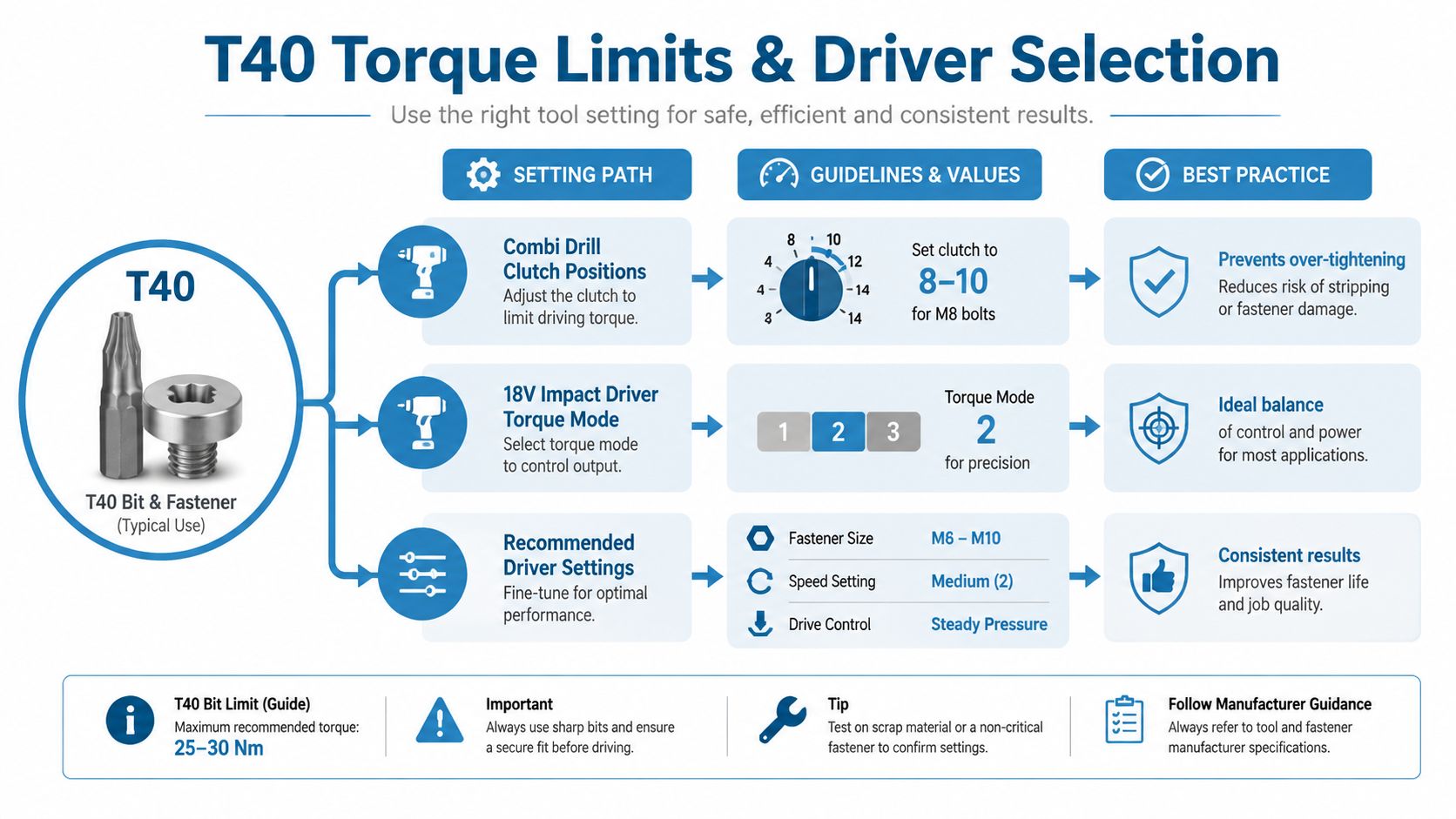
A high-output 1/4-inch hex impact driver can overwhelm a T40 insert before the bolt appears to have moved. The bit's lobe tips shear or deform first, leaving a damaged recess and an apparently untouched fastener. Choose a driver with a controllable mode, and check the bit maker's torque-to-failure information where it is available.
For motorcycle work, manufacturer-specific figures matter more than a generic bit chart. A useful reference for finding Scrambler tightening torques illustrates why the vehicle specification must lead the tool choice. For a compact 18V option, inspect the control settings and holder design of the DeWalt McLaren DCF85MP2T impact driver, rather than selecting a driver solely on its headline output.
The reflex to buy a stronger bit is often wrong. A T40 usually gives warning signs before it rounds a fastener, and those signs are easier to identify on the bench than after the recess has been damaged.
Start with the lobe flanks. A new bit has crisp, even corners. A used one may show a bright, burnished strip where repeated loading has polished the driving face. Inspect the tips for micro-flattening, then compare the bit directly with a new example. On a T40H, inspect the centre pin bore and surrounding metal for distortion. Finally, examine the fastener face for a circular scuff, which can indicate that the bit has been moving rather than driving squarely.
A measurable corner flat is a discard signal. One workshop threshold is around 0.15 mm of corner flattening, assessed against a new bit, as set out in the supplied technical guidance. That is deliberately early. Waiting until the driver visibly skates means the lobe has already lost the shape that keeps it seated.
Use a sacrificial M8 bolt for suspect tools. Seat the bit fully, apply firm axial pressure and load the bolt by hand with a controlled ratchet. You're looking for rocking, incomplete engagement or a tendency to climb out. Don't test a questionable bit first on an expensive caliper carrier or a fastener buried inside a machine.
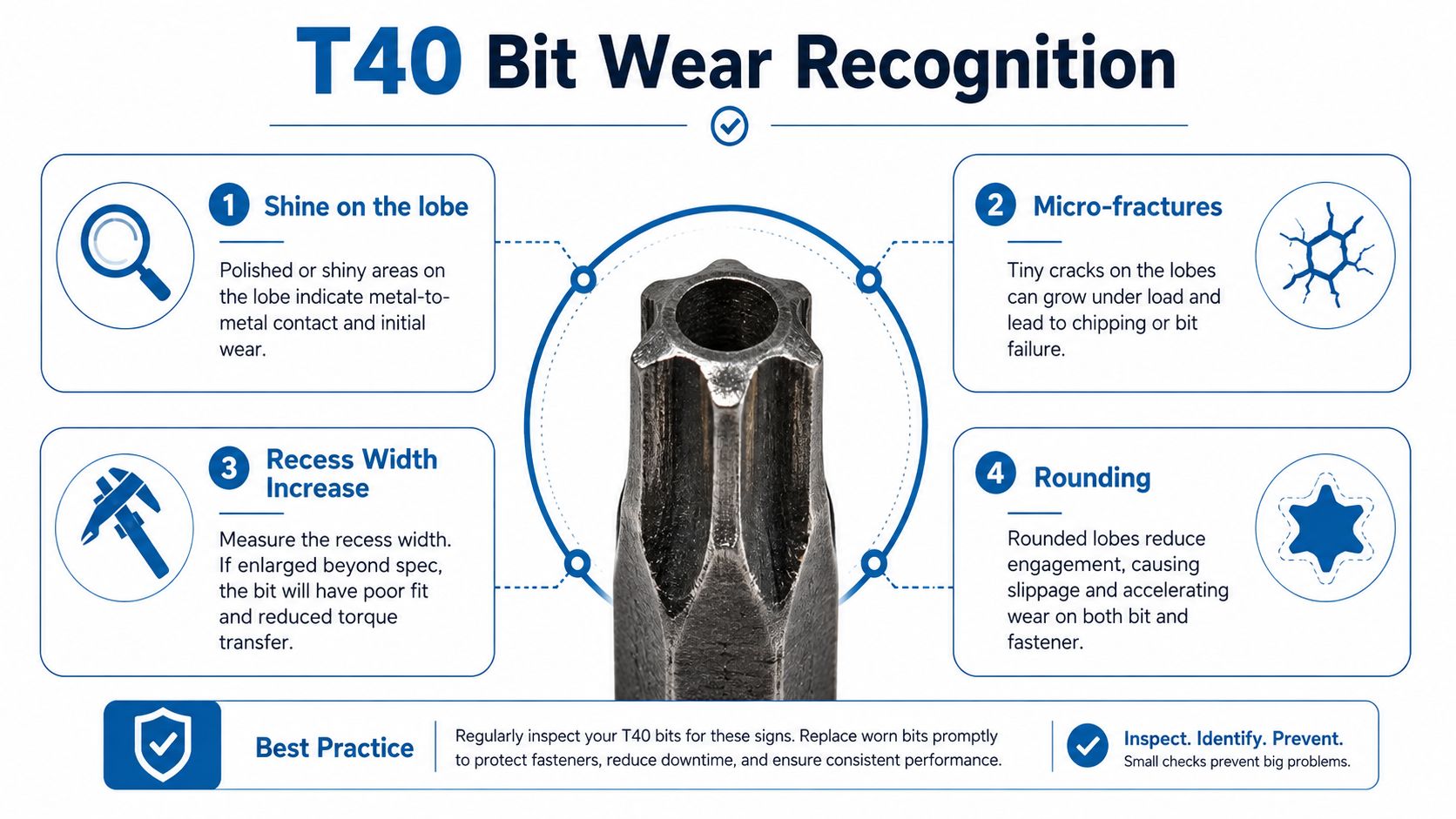
A worn bit may not strip the recess on the first pulse. The initial impact can crush the lobe edges slightly, while the next few pulses remove enough material for the bit to climb. That is why a fastener can look fine during the first attempt and fail on the third or fourth.
Diagnostic rule: if the same T40 rounds two clean fasteners in a row, stop blaming the driver. Check the bolt material, thread condition, clamp load and alignment before fitting another insert.
When extraction is already necessary, use a dedicated tool rather than repeatedly hammering in a larger Torx. A Faithfull four-piece screw extractor kit can form part of that recovery plan, but extraction remains the fallback. The better result is to replace the worn bit before it marks the first recess.
Run this check before the driver touches the fastener.
Replace the insert at the first visible lobe-tip rounding, a shiny burnished appearance on the drive faces or repeated cam-out at sensible torque. Keep a fresh T40 and T45 in the van pocket. Having the next size available turns a damaged-recess guess into a quick comparison at the workbench.
Neasden Hardware supplies driver bits, holders, fixings and power-tool accessories for professional workshops and serious DIY jobs, with practical product guidance from its London-based team. Visit Neasden Hardware to compare T40 formats, source replacement bits and organise the right accessories before the next seized fastener stops the job.