
Order Online
- Straight to your door!
Straight to your door


You've fitted a neat 100 mm fan, switched it on after a shower, and still found the mirror dripping and the ceiling beginning to mark. That result is common when the installation is judged by the fan's diameter or free-air rating rather than by the airflow it delivers through the completed duct route.
A 4 inch extractor fan can be a sound choice for a domestic bathroom, but only when the fan, controls, ducting, external terminal and replacement-air path work as one system. The practical question is not just whether the fan fits a 100 mm hole. It's whether it removes moisture reliably, safely and in line with the applicable UK guidance.
You return home after a long day and find the bathroom mirror clouded, the paint softening near the ceiling and wallpaper lifting at the seams. The fan runs, but the room stays humid long after the shower has finished. Replacing the grille may improve appearances, yet it won't correct a restricted duct, a weak fan or moisture entering from a plumbing defect.
The English Housing Survey for 2023–24 found a marked association between ventilation and damp. 60% of dwellings with inadequate ventilation had damp, compared with 5% where ventilation was adequate, according to the English Housing Survey housing-quality findings. That doesn't mean every damp bathroom needs a new extractor, but it does show why ventilation deserves proper diagnosis rather than being treated as an afterthought.
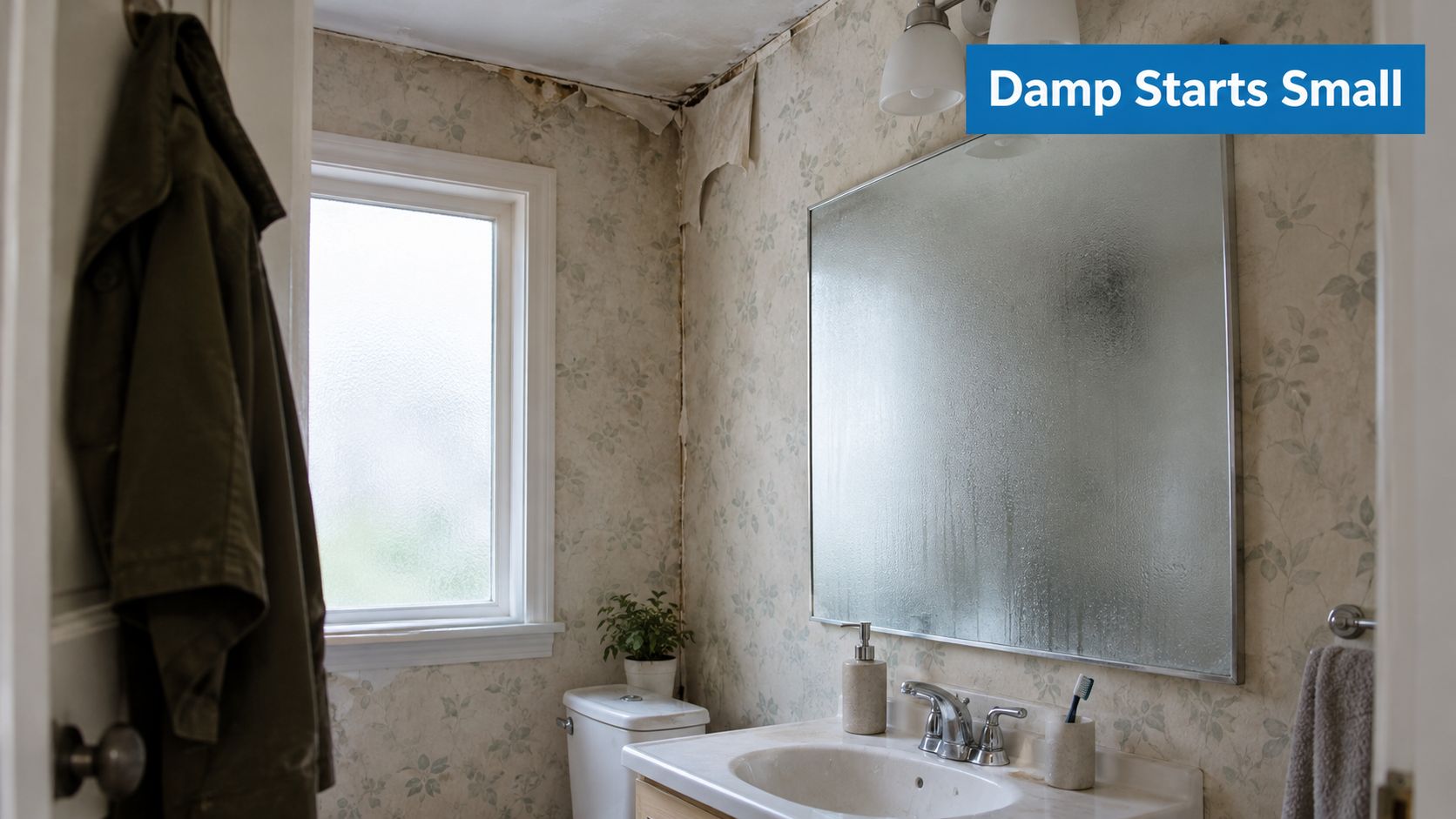
Start by checking whether the damp is concentrated around the shower, fan outlet, window reveal or plumbing connections. Condensation usually appears on colder surfaces and follows bathing, while a leak can leave a localised mark that persists when the room hasn't been used.
A fan also needs replacement air. If the bathroom door seals tightly and there's no transfer grille or suitable undercut, the fan may struggle to draw air from the room. The result can be poor extraction, excessive noise or air being pulled from an undesirable route.
Site rule: Treat a fan as part of a ventilation system, not as a decorative fitting with a motor behind it.
For broader moisture-control measures, a practical bathroom mould prevention guide from Modern Bathrooms is useful alongside the extraction assessment. If external walls or masonry are contributing to moisture ingress, review the relevant advice on a water seal for brickwork before assuming the fan is responsible for the whole repair.
The key performance figure for a typical 4 inch, or 100 mm, bathroom extractor in England is 15 litres per second for intermittent extraction. That equals 900 litres per minute or 54 cubic metres per hour, giving you a measurable duty to check instead of relying on the fan's physical diameter. The benchmark is set out in UK building-control ventilation guidance.
The difficulty is that manufacturers often quote free-air performance. That is the airflow measured with little or no resistance attached. Once the fan is connected to a duct, bends, a backdraught shutter and an external grille, the delivered volume can fall substantially.
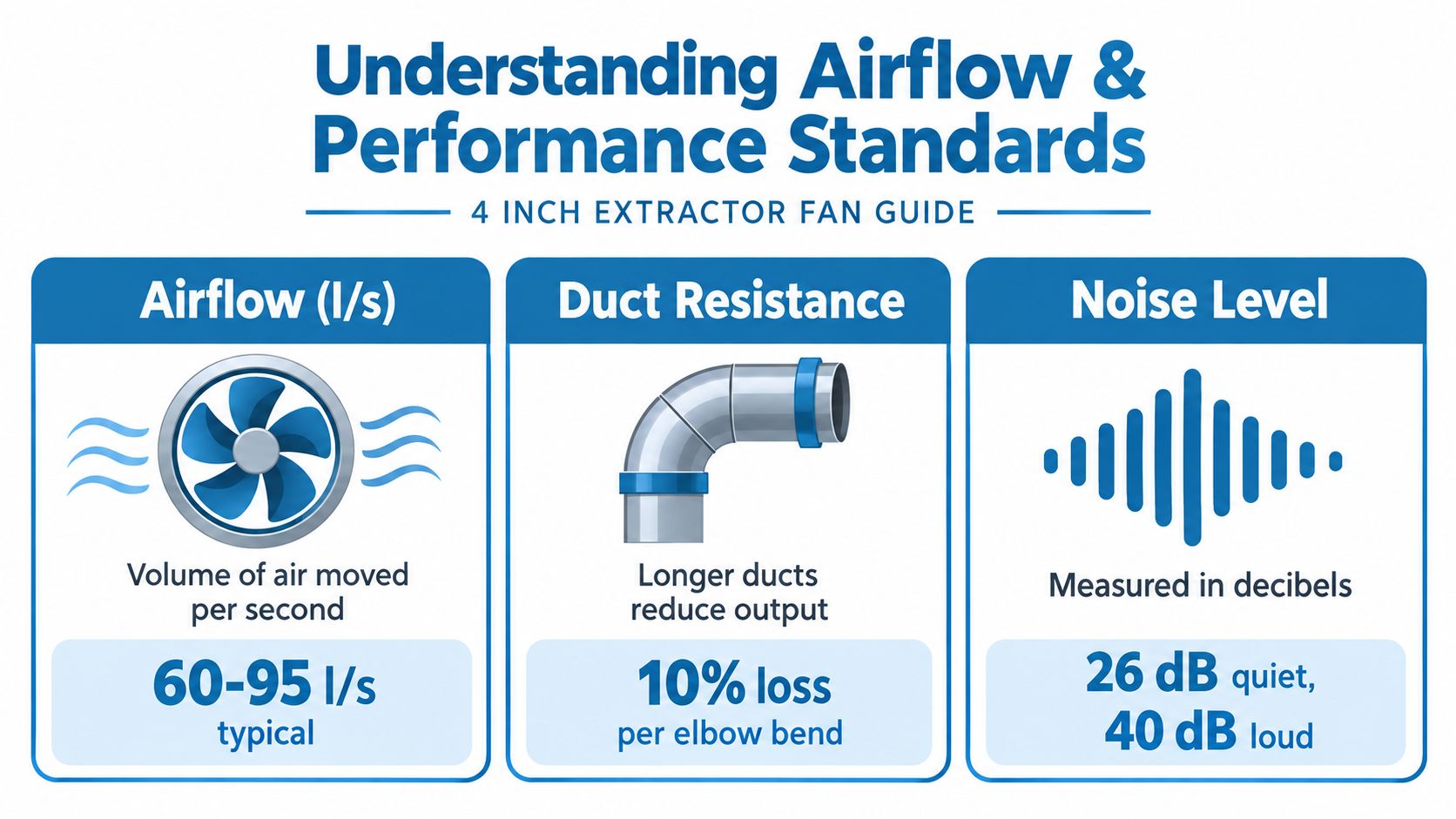
Before choosing a fan, identify the manufacturer's performance curve or pressure-flow information. You need to know what the unit delivers at the resistance created by your actual installation, not what it achieves on an unrestricted test bench.
A short, straight run through an external wall is a comparatively forgiving arrangement. A ceiling-mounted fan feeding a long route through a loft, several bends and a restrictive terminal is not. Flexible ducting can sag, kink and collect condensation, while a stiff shutter may take more pressure to open than expected.
Keep the route as direct as the building allows. Use smooth ducting where practical, support flexible sections so they don't collapse and seal every joint. Check the external grille for dirt, paint or insect debris, because a clean fan cannot compensate for a blocked termination.
The fan's diameter remains useful because it helps match the duct and fittings, but it isn't proof of compliance. A 100 mm fan that achieves the required duty under installed resistance is preferable to a larger-looking specification that loses most of its output in the ductwork. For wider regulatory context, compare the domestic requirements with this explanation of NCC compliant bathroom ventilation, while checking the rules that apply to your own jurisdiction.
Intermittent and continuous fans do different jobs, so they shouldn't be selected from the same number without checking the operating category.
An intermittent system normally runs when the light, pull switch, timer or sensor calls for extraction. Its bathroom target is the higher moisture-removal duty of 15 l/s, as set out in Approved Document F Volume 1. The installation therefore needs enough capacity to clear the moisture produced during bathing within the operating period.
A continuous mechanical extract system works at a lower background rate and increases output when the room needs more ventilation. UK guidance gives a bathroom background rate of 8 l/s, with a boost rate equivalent to the 15 l/s intermittent requirement. The fan's control strategy and commissioning settings matter as much as its maximum output.
| System | Operating pattern | Bathroom airflow to check | Practical concern |
|---|---|---|---|
| Intermittent | Runs during or after use | 15 l/s | Needs suitable switching and overrun |
| Continuous | Runs at background rate and boosts | 8 l/s background, 15 l/s boost | Must be commissioned for both modes |
A common mistake is fitting a continuous unit but leaving it configured as a simple switched fan. Another is buying an intermittent fan for a design that depends on background ventilation. Those choices can leave the room under-ventilated between showers or fail to remove the moisture peak after use.
Look at the controls before looking at the fascia. A humidity sensor can respond to changing conditions, while a light-triggered fan may run whenever the room is occupied but stop too soon after the shower. The right arrangement depends on the building, the room's use and the intended ventilation design.
A compact bathroom can still stay damp if the fan's published output collapses once ducting, bends and an external grille add resistance. Choose the operating category first, then check the fan's installed airflow at the system pressure. Diameter helps, but it does not guarantee performance.
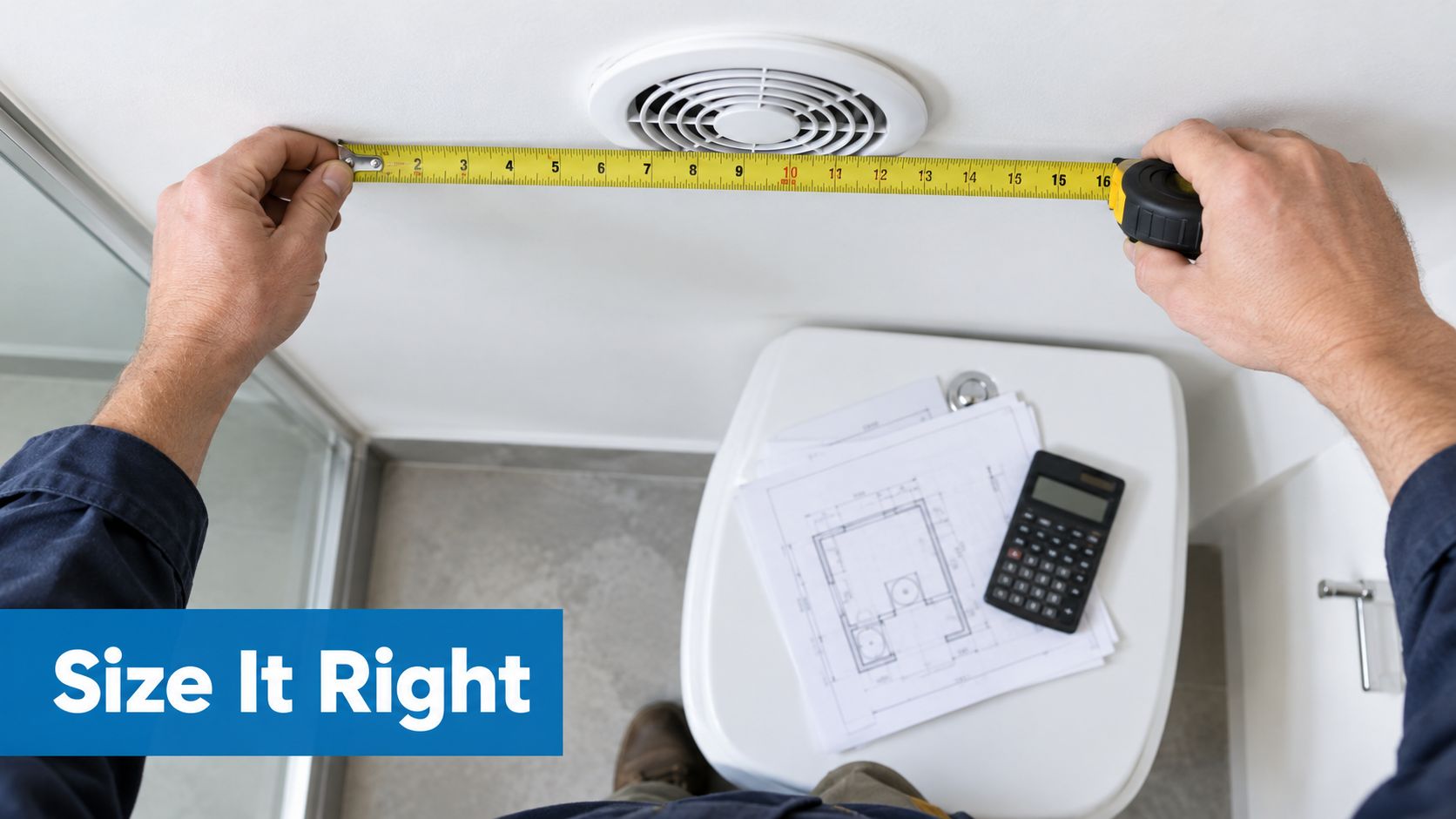
For a normal domestic bathroom, room size matters most when the space is unusually large or when purge ventilation forms part of the design. Approved Document F states that an intermittent fan used to meet purge-ventilation standards in a dwelling bathroom without an external wall should provide four air changes per hour. The requirement is set out in Approved Document F Volume 1 for dwellings.
Calculate the room volume, account for the number and position of wet fixtures, and compare the required duty with the manufacturer's fan curve. Treat the free-air figure as a reference, not as the result you will receive after installation.
Where a dwelling bathroom has no openable window, an intermittent extractor must continue running for at least 15 minutes after the room is vacated, according to Approved Document F guidance on overrun controls. Specify a timer or equivalent control, then wire and set it correctly.
A fan that stops with the light can clear steam during the shower yet leave moisture behind afterwards. Set the overrun to the manufacturer's instructions, and confirm that the isolator arrangement permits safe disconnection during maintenance.
For non-domestic work, use the applicable building category rather than the domestic figure. Approved Document F Volume 2 specifies 15 l/s per shower or bath and 6 l/s per WC pan or urinal for intermittent extraction outside dwellings. One shower and one WC therefore require 21 l/s, equivalent to 75.6 m³/h, under that calculation, as detailed in Approved Document F Volume 2.
Airflow is only half the job. A bathroom extractor combines electricity, moisture and a confined space, so the fan's certification and installation position must be checked before any wiring begins.
The Institution of Engineering and Technology's guidance on BS 7671 states that a suitable 230-volt extractor fan may be installed in bathroom Zones 1 or 2, provided equipment in those zones has protection against moisture ingress of at least IPX4. Read the IET guidance on BS 7671 bathroom fan installations and match the fan's certified rating to its actual location.
A timer or overrun fan can remain energised after the light is switched off. The isolator arrangement must therefore disconnect the line, neutral and switched-live conductors, with the isolator positioned outside Zones 0, 1 and 2.
The fan should have an accessible means of isolation, particularly in a windowless room. That allows safe servicing without leaving the electrician working in darkness or relying on a remote consumer-unit switch.
The duct must discharge outdoors, never into a loft or cavity. Seal the fan spigot, support the duct and protect the external opening with an appropriate terminal that doesn't create unnecessary resistance.
For ceiling or plasterboard work, select fixings for the substrate and the fan's weight rather than relying on whatever is in the toolbox. Guidance on choosing fixings for plasterboard walls can help with the mechanical side, but electrical design, testing and final certification should be handled by a competent electrician working to the current BS 7671 requirements.
A new fan can fail to cure mould when the underlying problem is a leak, cold surface, poor heating, blocked duct or missing replacement air. It can also create false reassurance, encouraging a ventilation-only fix where the building fabric needs attention.
The English Housing Survey 2024–25 reported that 31% of households, representing 7.7 million homes, reported condensation, damp or mould. Among households reporting damp, 42% used extractor fans, compared with 83% who opened windows, according to the survey's findings on perceptions and housing quality. Those figures don't prove that fans are ineffective. They do show that a fan alone isn't the whole story.
Check the duct for crushing, disconnection and condensation. Inspect the outside grille while the fan runs, and test whether air is moving at the terminal rather than assuming the motor's noise proves extraction.
Look for staining that follows rainfall, failed silicone, leaking traps or cold corners. Improve heating and surface insulation where appropriate, and deal with penetrating damp or plumbing faults directly. A fan cannot repair a roof, wall or pipe.
Cleaning matters too. Dust on the grille and impeller restricts flow, while a dirty shutter can stick. After repairing the source, use suitable finishes such as mould-resistant paint, but don't use paint to conceal recurring moisture.
Before signing off a 4 inch extractor fan, inspect the complete route from the bathroom to the outside terminal. Judge performance at the resistance created by the installed ductwork, rather than relying on the fan's free-air rating. A larger diameter alone does not guarantee effective extraction.
A compact fan can perform well when its duty, duct route and controls match the room. If the route is restrictive or the building has a persistent defect, replacing one 100 mm fan with another may just repeat the original mistake. Sign off the installation only after checking both the equipment and the conditions in which it operates.