
Order Online
- Straight to your door!
Straight to your door


Ever wondered what's tucked away inside your door, silently keeping it secure? Chances are, it's a mortise lock. Think of it as your home's hidden guardian, a tough mechanism fitted neatly into a pocket—or 'mortice'—cut directly into the edge of the door.
A mortise lock, sometimes spelt mortice lock, is a mainstay for external wooden doors across the United Kingdom for one simple reason: it's incredibly strong. Unlike a standard cylindrical lock that’s just bolted onto the door's surface, a mortise lock integrates the entire lock body inside the door itself. This small but crucial design difference makes it far more resistant to being forced open.
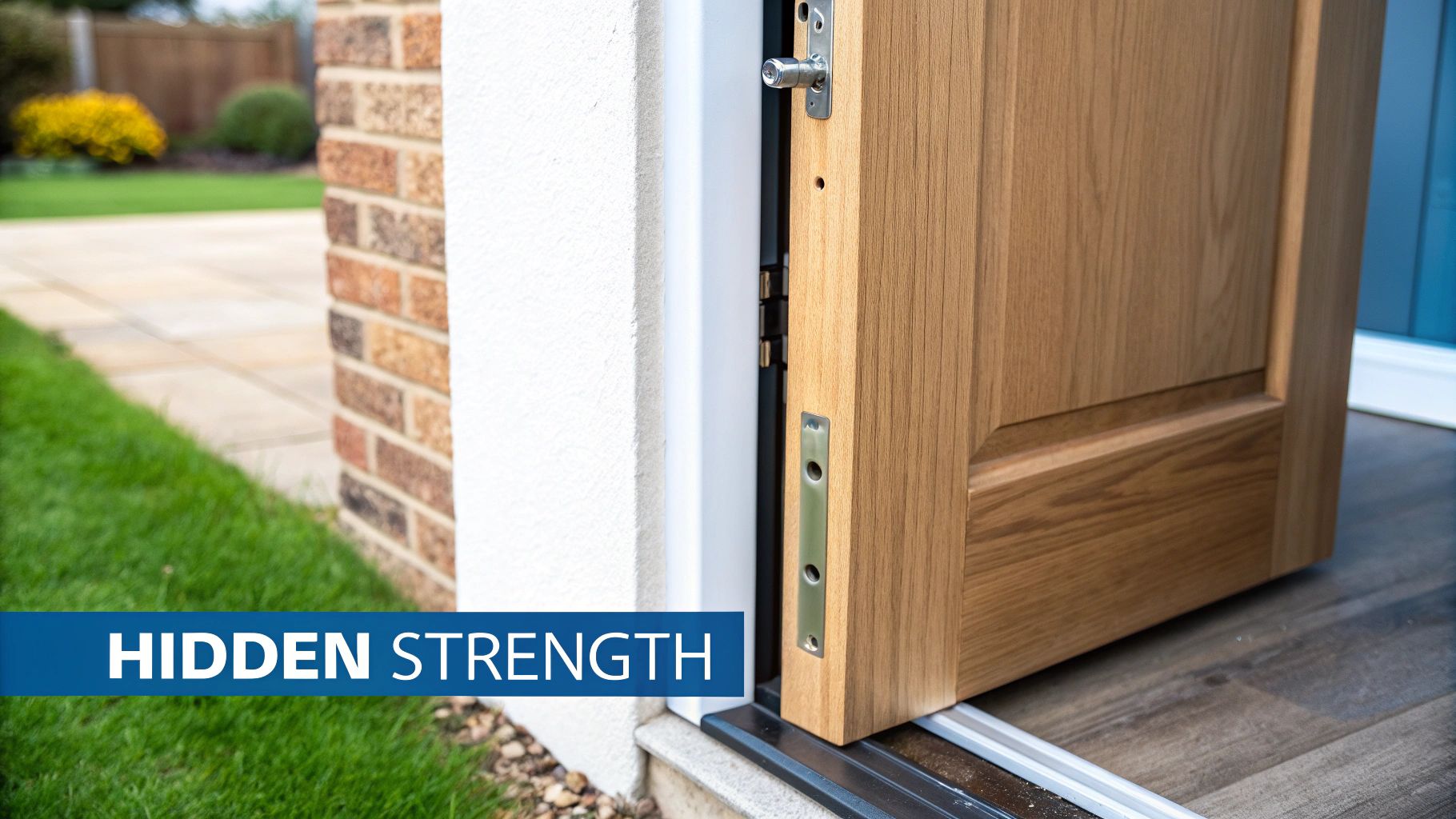
Tucking the lock away inside the door creates a formidable barrier. The lock case, latch, and deadbolt are all housed within the timber, making them much harder for anyone to tamper with or bypass. It's no surprise that many UK insurance providers insist on them, especially models that meet specific security standards.
The trust in mortise locks isn't just about where they sit. It's about how they work. The internal mechanism, often involving a complex series of levers, presents a tricky puzzle for any would-be intruder to solve without the correct key. The most secure versions are specifically designed to stand up to common methods of attack.
To really appreciate the hidden strength of your front door, it's a good idea to get to grips with potential vulnerabilities and how to guard against them, which includes understanding and preventing lock snapping.
The real benefit of a mortise lock is its concealed, integrated design. By embedding the mechanism within the door, it uses the door's own structure for extra strength. This creates a much more secure and durable solution than any surface-mounted alternative.
In this guide, we'll unpack why this classic lock remains a cornerstone of British home security. We'll explore how it works, why it has been trusted for centuries, and how to choose the right one for your property, starting with its core components and why the British Standard matters so much.
The mortise lock is far more than just a security device; it's a piece of British architectural history. Its story starts not in a factory but in the grand Georgian and Victorian homes where security and status went hand-in-hand. Unlike simpler locks bolted onto a door's surface, the mortise lock was a quiet emblem of superior craftsmanship and wealth.
Fitting one was a job for a master joiner, who would meticulously chisel out a precise cavity—the mortice—into the edge of a solid timber door. This was a slow, highly skilled process, making the lock a feature exclusive to properties of real distinction. The hidden mechanism and flush finish signalled a level of quality that was simply out of reach for the average household. It was a subtle but unmistakable statement of affluence.
So how did it go from a luxury item to a household standard? It all hinged on a key development in security technology. While mortice locks trace their origins back to the 18th century, their widespread adoption came after a moment of true ingenuity. Initially, the painstaking installation, which could take a skilled joiner 4-6 hours per door, kept them exclusive.
That all changed in 1818. Portsmouth-based inventor Jeremiah Chubb patented his groundbreaking lever tumbler mortice lock, a design that dramatically improved security. This was a genuine catalyst. By 1850, the use of mortice locks in urban homes had surged by an estimated 300%, making robust security accessible to the growing middle class. To get the full picture, you can delve deeper into the fascinating history of the mortice lock.
This shift during the Industrial Revolution effectively democratised home safety. As manufacturing techniques improved, what was once a bespoke fitting became a reliable and attainable security standard. The core principles of Chubb's design—using levers to secure the bolt—are still fundamental to the high-security mortise locks we rely on today.
From its beginnings as a status symbol to its current role as an insurance-approved necessity, the mortise lock's journey reflects a wider story of British innovation and domestic life. Its design has been refined over the centuries, but its core purpose remains exactly the same: to provide concealed, robust, and reliable security.
The mortise lock's strength has always come from being an integral part of the door, not just an addition to it. This foundational principle is why it has endured for over 200 years as a trusted security solution in the UK.
Today, when you turn the key in a modern 5-lever BS3621 mortise lock, you’re engaging a mechanism with a rich heritage. Understanding this history helps explain why it remains a fixture in properties all over the UK, trusted by homeowners and security professionals alike.
To really get what makes a mortise lock so secure, you have to picture what’s going on inside the door itself. It’s not just a single part; it’s a compact mechanical system where every component has a critical job. When you turn that key, all those parts move in perfect sequence to throw the bolt and secure your door.
At the core is the lock body, a tough metal case hidden away inside the mortise pocket. This case is the fortress that protects all the moving parts from tampering. Inside is where the real security feature lies: a set of finely calibrated levers. These are flat metal plates that the unique shape of your key must lift to an exact height before the bolt is allowed to move an inch.
When you lock or unlock the door, several parts spring into a carefully choreographed sequence. It's the interplay between these components that gives the lock its strength.
A well-made mortise lock is a symphony of moving parts. Here's a look at the essential components and how they work together to keep a door secure.
Key Components of a Mortise Lock and Their Functions
| Component | Primary Function | How It Contributes to Security |
|---|---|---|
| Lock Body | Houses and protects the internal mechanism. | A robust metal casing shields the levers and bolt from brute force attacks and drilling. |
| Levers | Act as tumblers that must be aligned by the key. | The number and precision of the levers (5-lever is the British Standard) create thousands of unique key combinations, making the lock extremely difficult to pick. |
| Latchbolt | Keeps the door closed when it's not locked. | This spring-loaded, angled bolt holds the door shut against the frame, allowing it to be opened with just the handle. |
| Deadbolt | Secures the door into the frame when locked. | A solid, rectangular bolt that extends deep into the frame. Unlike the latch, it cannot be pushed back without the correct key, providing the main locking security. |
| Strike Plate | Reinforces the door frame where the bolts engage. | A metal plate that prevents the frame from splintering under force and provides a solid housing for the bolts to lock into. |
Each part plays a vital role, turning a simple door into a formidable barrier.
The number of levers is what really separates a high-security lock from a basic one. A 5-lever lock, for example, offers exponentially more key combinations than a 2 or 3-lever model, making it a nightmare for anyone trying to pick it. This idea of using complex internal mechanics for security has come a long way, evolving from old-school craftsmanship to today's highly engineered standards.
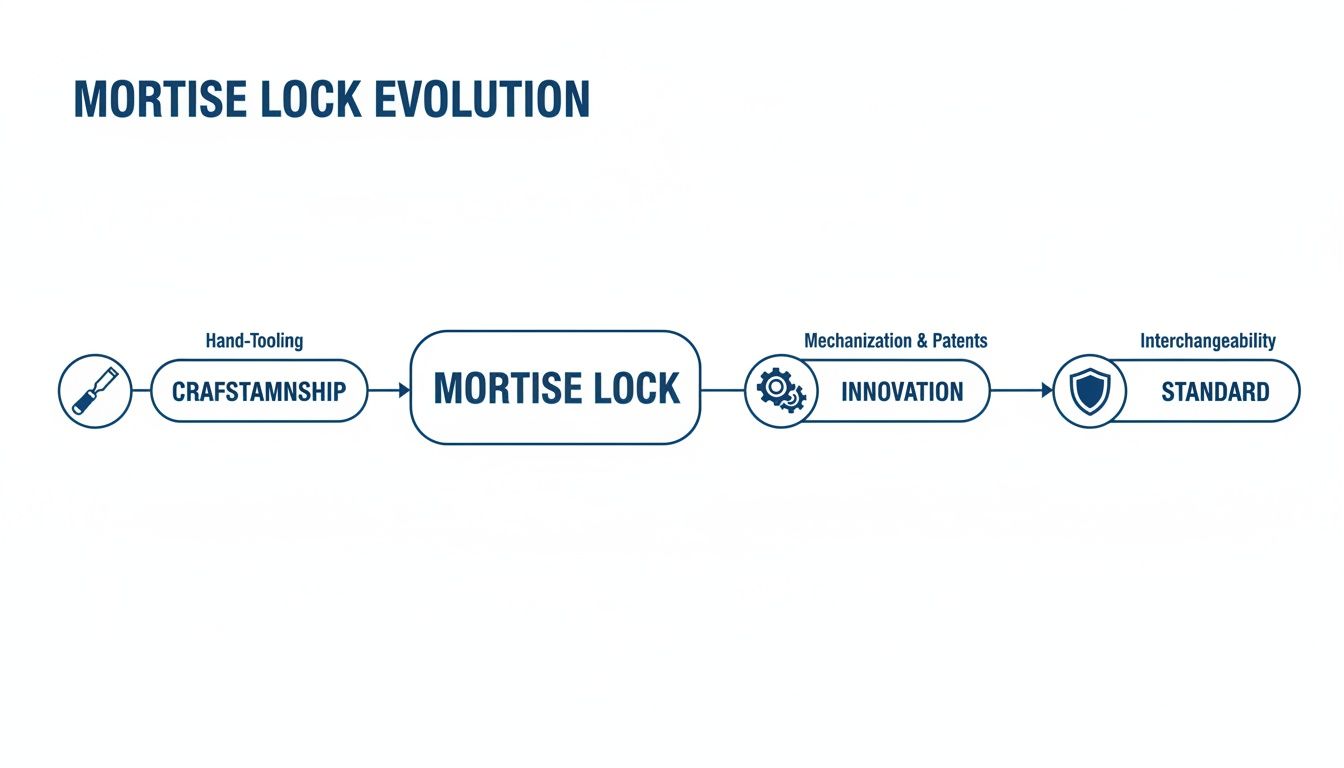
This image perfectly captures the journey from bespoke, hand-chiselled locks to the precision-engineered security we depend on today.
On some mortise locks—especially sashlocks that work with door handles—you'll find a separate cylinder mechanism. This is the part that contains the keyhole and the pins. While both mortise and cylinder locks are staples of home security, it's useful to know how they differ. To get a better handle on this, you can learn more about what a euro cylinder lock is and its own unique way of working.
Think of a mortise lock as a miniature vault built right into your door. The key is the secret combination, the levers are the tumblers, and the deadbolt is the heavy vault door. Only the correct key can line up every single lever perfectly to slide that bolt open.
Picking the right mortise lock isn't just a grab-and-go decision; it's about matching the lock’s function and security level to what that specific door needs to do. Not all mortise locks are built the same, and understanding the core differences is key to securing every room in your house properly.
First up, you need to know the difference between a sash lock and a deadlock. Think of a sash lock for any door that needs a handle—your back door, for instance. It has a latch that keeps the door shut when you close it (operated by the handle) and a separate deadbolt for when you need to lock it up securely with a key. A deadlock, however, is all about security. It has no handle or latch, just a deadbolt operated solely by a key, making it a great secondary lock for a front door.
The number of levers inside a mortise lock is the single most important clue to its security level. This is where you can’t afford to cut corners.
In the UK, lock security is heavily influenced by regulations and insurance requirements. The BS3621 standard, first introduced way back in 1963 and updated in 2016, is the benchmark. It requires 5-lever models to stand up to serious force and picking attempts. Today, these locks cover an estimated 92% of insurance-approved front doors.
The golden rule for external timber doors is to use a 5-lever mortise lock that is BS3621 compliant. This is what almost every UK home insurance provider will insist on. The lock itself will be stamped with the British Standard Kitemark, which is your proof it’s been tested against drilling, picking, and brute force.
The door itself is a massive factor when choosing a mortise lock. These locks are a perfect match for solid wood doors, where they can be properly housed for maximum security. However, they are generally a poor fit for uPVC or composite doors, which are designed for multi-point locking systems instead.
For high-security commercial properties, pairing the right lock with the right door is vital. A complete guide to commercial steel doors shows how these heavy-duty doors are often the ideal candidates for high-security mortise locks. Getting this combination right means the door and lock work together as a team to protect your property. To see how these locks stack up against other options, have a look at our guide on the best door locks for security.
So, why do locksmiths and security experts get so excited about mortise locks, especially for timber doors? It all comes down to a few key advantages that go way beyond just a simple lock and key. The real strength of a mortise lock comes from the fact that it's fitted inside the door, not just bolted onto the surface.
Think of it this way: instead of just being stuck on, the lock becomes a part of the door itself. This integrated design uses the door's own structure as a shield, making it incredibly tough against brute-force attacks like someone trying to kick it in. You can pry a surface-mounted lock off, but a mortise lock is dug in deep.
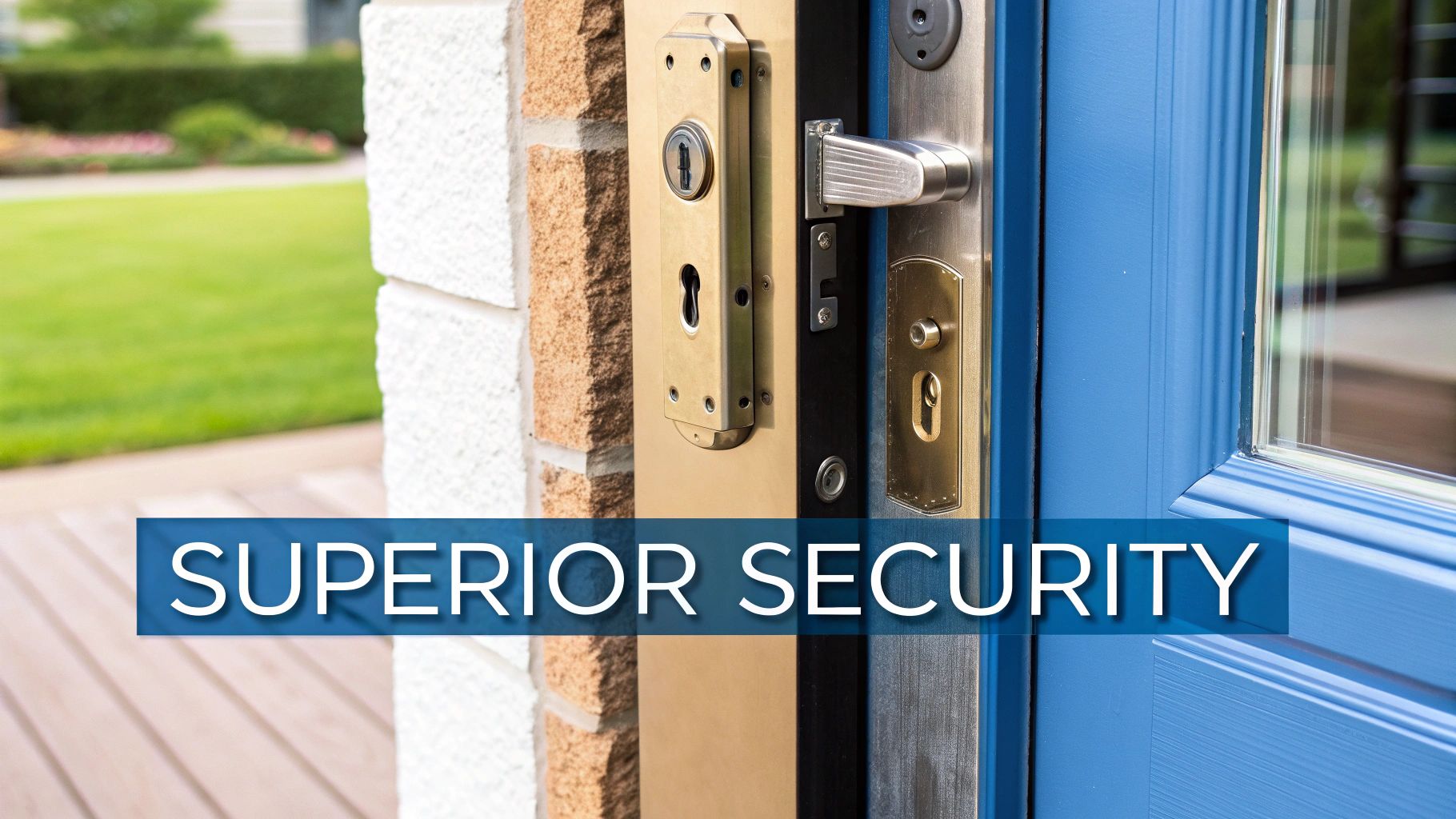
Beyond its sheer physical strength, a good mortise lock is a clever piece of engineering. The complex internal lever system, especially in BS3621-compliant models, is built specifically to frustrate anyone trying to pick or manipulate it.
These insurance-approved locks are packed with features designed to stop common break-in methods cold:
This focus on proper engineering is precisely why they’re so trusted. In fact, UK crime data from 2024 showed 15% fewer break-ins at homes with mortise locks compared to those with only cylinder locks. It’s also why over 65% of heritage sites still count on their proven security. You can dig deeper into the enduring relevance of mechanical locks if you’re interested in the data.
A properly fitted mortise lock is a long-term investment in your property's safety and value. Its durability ensures it can withstand decades of daily use without compromising on security, offering lasting peace of mind.
Finally, you don’t have to sacrifice style for security. Because the main body of the lock is hidden away inside the door, you can pair it with a massive range of door furniture. Whether you want ornate brass handles for a traditional look or sleek, modern levers, the choice is yours. This lets you get top-tier security without messing up your home's aesthetic. Plus, their incredible longevity means a well-maintained mortise lock will probably outlast the door it’s fitted to.
Think of it this way: the entire process requires cutting a deep, precise cavity—the mortise—into the edge of your door. If that pocket is even a few millimetres too wide, you’ve permanently weakened the door's structure, making it far easier to kick in. Trying this yourself on an external door is a massive gamble with your home's security.
A professional arrives with specialist tools, like a mortising jig, designed to cut a perfectly clean and exact pocket. They know precisely how to fit the lock without compromising the door's integrity, ensuring the whole mechanism sits flush and operates like a dream.
A poorly installed mortise lock is often less secure than a cheaper, correctly installed surface lock. The quality of the fitting is just as important as the quality of the lock itself.
If you’re curious about what’s involved, our detailed guide on how to install door locks walks through the process. It really highlights why professional expertise is so crucial for this job.
The good news? Once a mortise lock is correctly installed, it’s remarkably low-maintenance and can easily last for decades. A few simple checks and good habits are all it takes to keep it working as smoothly as the day it was fitted. Following these tips will prevent unnecessary wear and keep your investment protecting your home for years to come.
These best practises are easy for anyone to follow:
Even after getting to grips with how mortise locks work, you might still have a few practical questions knocking about. We get it. Here are some straightforward answers to the queries we hear most often from UK homeowners, helping you feel confident about your home's security.
For most UK home insurance policies, the answer is a firm yes. A BS3621-compliant 5-lever mortise lock is pretty much the standard requirement for all external wooden doors. This specific British Standard is what insurers look for because it means the lock has been properly put through its paces against common break-in methods like drilling, picking, and brute force.
While it's the industry norm, you should always double-check the small print in your policy documents just to be sure. But fitting a lock that meets the BS3621 standard is your best bet for staying compliant and keeping your home secure. Just look for the British Standard Kitemark stamped on the lock's faceplate—that’s your proof.
Not quite. Mortise locks are designed specifically for solid timber doors that are thick enough to house the lock body without becoming weak. As a rule of thumb, a door needs to be at least 44mm thick to safely have a mortise pocket cut into it.
This means they generally aren't a good fit for uPVC, composite, or most metal doors. Those door types have a different construction and usually rely on multi-point locking systems designed for their specific frames. Trying to force a mortise lock into an unsuitable door is a bad idea—it can seriously weaken the door itself and make the lock far less effective.
The suitability of a mortise lock is fundamentally tied to the door's material and thickness. Forcing a fit on an incompatible door type is a significant security risk.
Figuring out what kind of mortise lock you have is usually quite simple. The first place to look is the faceplate—that’s the thin metal strip you see on the edge of the door when it’s open.
High-security locks have to be clearly marked. You should see a stamp that says '5 Lever'. If it’s an insurance-approved, BS3621-compliant lock, you'll also spot the well-known British Standard Kitemark symbol. If you can’t find any of these markings, it’s a safe bet that you have a less secure 2 or 3-lever lock, which is only really suitable for internal doors like bathrooms or bedrooms.
For all your security needs, from BS3621-compliant mortise locks to a wide range of door furniture and hardware, trust the experts at Neasden Hardware. Explore our extensive collection and find the perfect security solutions for your home at https://neasdenhardware.co.uk.