
Order Online
- Straight to your door!
Straight to your door


Choosing the right cabinet hinge might feel like one of the smaller details in a project, but get it wrong, and you'll notice. It’s the secret to doors that hang perfectly straight, open without a fuss, and close silently for years to come. The world of hinges is surprisingly vast, from traditional butt hinges you see on classic furniture to the slick, modern concealed European hinges that are completely hidden from view.
This guide is a practical walkthrough of everything you need to know. We'll cut through the technical jargon and focus on what really matters for your project, whether you're tackling a full kitchen renovation, upcycling a piece of furniture, or building something from scratch.
Picking out the right hardware is about more than just how it works; it’s a design choice that helps define the character of your cabinets. Think of it like choosing the right pair of shoes for an outfit—the hinge has to match the style and purpose of the piece it's fitted to.
The right hinge is what guarantees both longevity and usability. A flimsy hinge on a heavy oak door will quickly lead to sagging and alignment problems, while the wrong style can clash with the look you're going for. Getting your head around the basics empowers you to make a confident choice.
We'll be covering a few key factors:
This foundational knowledge is crucial before you start looking at specific options from trusted UK suppliers like us here at Neasden Hardware. To make the best selections, it's also helpful to understand the bigger picture of cabinetry first; you can check out this comprehensive kitchen cabinet guide for more on that.
The demand for quality hardware is definitely on the rise. In fact, the UK kitchen furniture market is forecasted to hit a value of £2.5 billion by 2030, with a huge chunk of that growth driven by the need for better, more advanced hinges in homes and commercial projects alike.
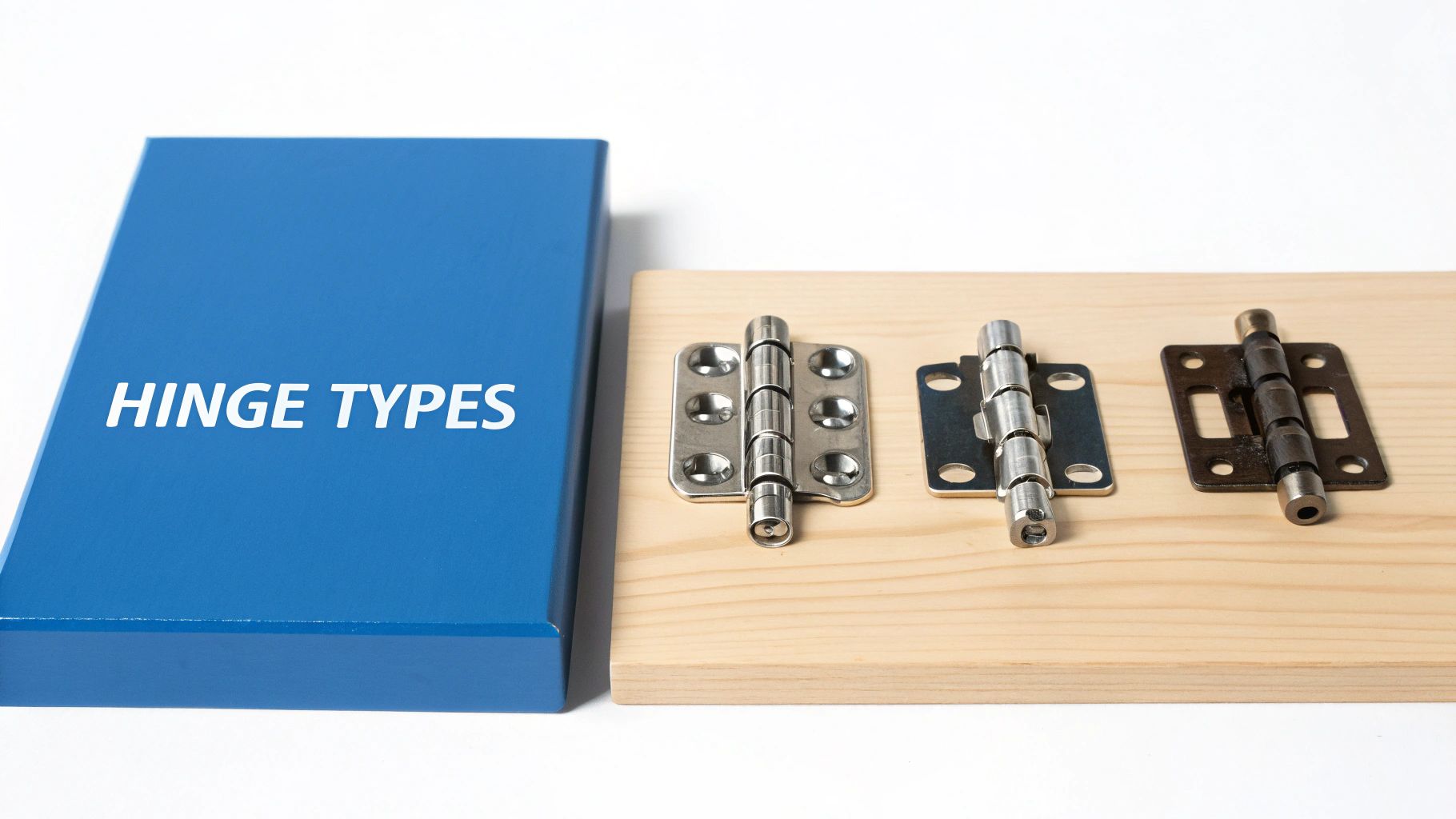
Now that we know why picking the right hinge is so important, let's meet the main players in the world of cabinet hardware. Each type brings a unique mix of style and function to the table, designed for different cabinet styles and how you use them. We'll go beyond dry definitions and look at how these hinges really perform in the real world.
Often called European hinges, these are the undisputed champions of contemporary kitchens and furniture. Their superpower? They’re completely invisible when the cabinet door is shut. This creates that clean, seamless look that’s so popular in modern design.
Think of them as the silent stage crew of your kitchen, doing all the heavy lifting behind the scenes without ever stealing the show. Their invisibility lets your beautiful cabinetry take centre stage, not the hardware holding it all together.
This clever design has made them a market leader. The UK actually holds a major slice of the European hinge market, especially in the invisible hinge segment, with a 17.6% share that’s set to grow. It just goes to show how much we value these sleek, premium solutions.
In complete contrast to their hidden European cousins, butt hinges are one of the oldest and most straightforward hinge types you’ll find. They’re made of two metal plates, or 'leaves', joined by a central pin. One leaf is set into the cabinet frame and the other into the door, leaving only the barrel of the pin visible when closed.
You’ll spot butt hinges on traditional, period-style furniture where the hardware itself is part of the charm. They offer a sturdy, reliable, and timeless look that speaks of quality craftsmanship. Their simplicity is their strength, providing rock-solid support for inset doors that sit perfectly flush within the cabinet frame.
A key takeaway is that the choice between concealed and butt hinges often comes down to a single question: do you want your hardware to be a statement piece or to disappear completely?
Ever wondered what holds the long lid on a toy box or a piano keyboard cover in place? That’s the work of a piano hinge, also known as a continuous hinge. It's essentially one very long butt hinge that runs the entire length of the door or lid it’s supporting.
This continuous design spreads the weight evenly across the whole join. This gives it exceptional strength and stops the warping or sagging that you might get with several smaller, separate hinges. They are the perfect solution for any long, narrow application that needs uninterrupted support.
For the ultimate minimalist look, pivot hinges are a fantastic option. Unlike other types, they’re mounted at the very top and bottom of the door. This allows the door to swing open from a single point at the corner.
This unique mounting style means very little hardware is visible, creating a sleek, 'floating door' effect. It’s perfect for high-end cabinetry or frameless glass doors. While they can be a bit trickier to install, the clean and sophisticated result is often worth the extra effort for a truly custom look.
To help you picture which hinge is the best fit for your project, here’s a quick breakdown of these common types. This table makes it easy to compare their key features at a glance.
If you want to dive even deeper, you can also explore this excellent resource on the various kitchen cabinet hinge types.
| Hinge Type | Visibility When Closed | Best For | Key Feature |
|---|---|---|---|
| Concealed (European) | Completely invisible | Modern, frameless kitchens and sleek furniture | Adjustable and hidden for a seamless look |
| Butt Hinge | Only the pin barrel is visible | Traditional furniture and inset cabinet doors | Classic, durable, and simple design |
| Piano (Continuous) | The pin barrel is visible | Long lids (e.g., toy boxes, benches) | Provides continuous support along the entire length |
| Pivot Hinge | Minimal visibility at top and bottom | High-end custom cabinetry and frameless doors | Creates a unique 'floating' door effect |
Each of these hinges has a distinct job to do, and understanding what makes them tick is the first step towards a brilliant project. If you’re leaning towards a modern aesthetic, it’s well worth exploring why concealed hinges are the secret to sleek cabinetry to see just how they can transform your space.
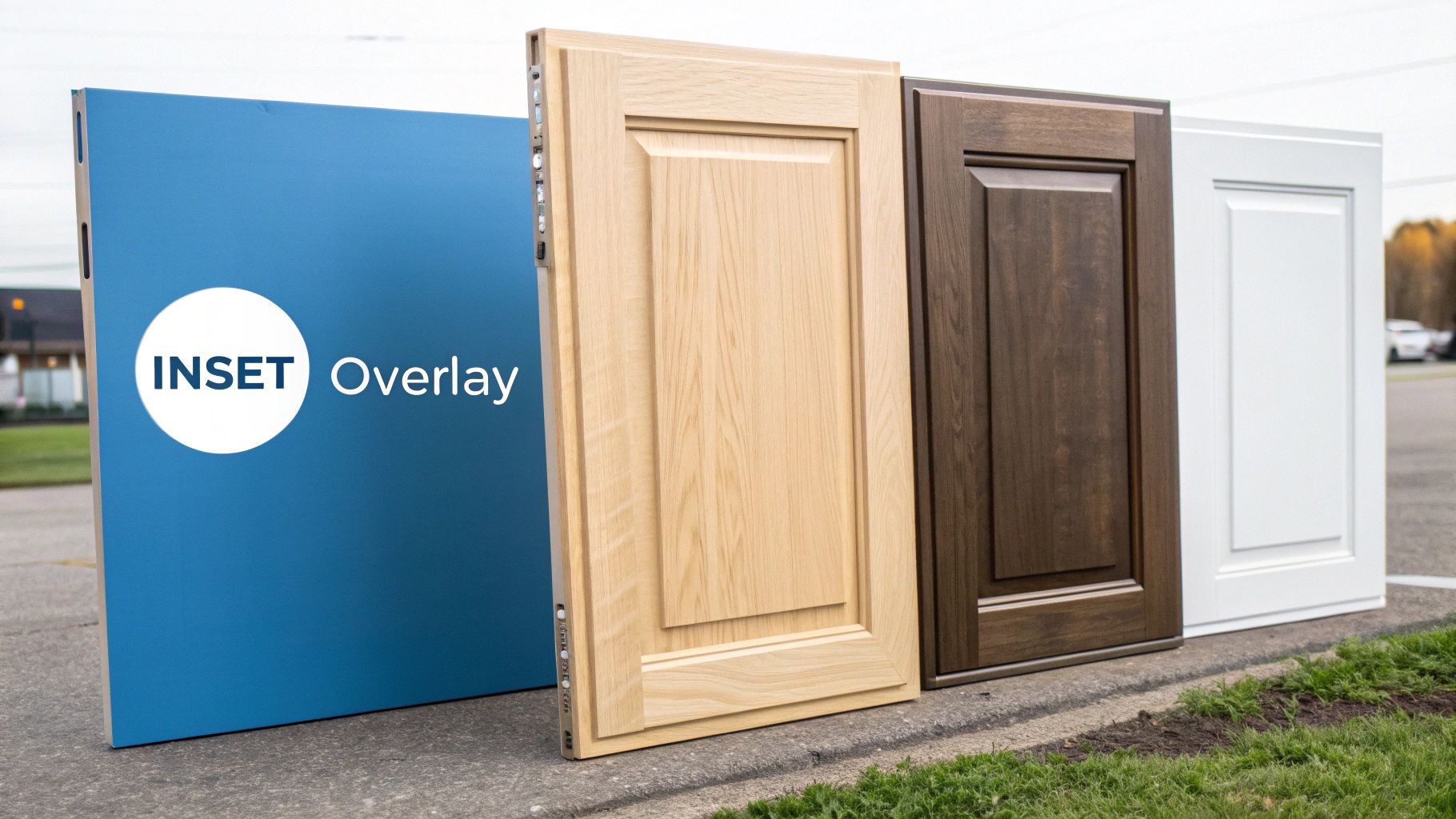
So, you've got a handle on the different types of hinges out there. Fantastic. Now for the most important part of the puzzle: figuring out how your cabinet door actually sits on its frame.
This relationship between the door and the frame is the single biggest factor in choosing the right hinge. A hinge made for one style simply won't work on another, so getting this right from the start is absolutely essential.
You'll come across three main cabinet door styles: Inset, Full Overlay, and Half Overlay. Once you know what to look for, telling them apart is easy, and it will instantly narrow down your hinge choices.
Think of an inset door like a perfectly hung picture sitting completely inside its frame. The face of the door is flush with the cabinet frame, giving you that clean, classic look that really shows off the quality of the joinery. It's a timeless style, often found in high-end traditional kitchens and bespoke furniture.
Because the door sits inside the opening, the hinges have to be mounted on the interior edge of the door and the inside of the cabinet frame. This is where traditional butt hinges feel right at home, with their pin barrel sitting elegantly in the gap between the door and the frame. You can also find specific concealed or pivot hinges made for inset doors if you're after modern function with a classic look.
When you choose an inset door, you're opting for a style where precision is key. The hinges must accommodate this flush fit, making traditional options a popular and authentic choice for achieving that perfect finish.
Full overlay doors do the exact opposite of inset. Instead of sitting inside the frame, the door sits entirely on top of it, covering the cabinet frame completely when closed. This creates that seamless, uninterrupted wall of cabinetry that's become the hallmark of modern, minimalist kitchen design.
With full overlay, you see very little of the cabinet frame between the doors and drawers. This style is almost always paired with concealed European hinges. These clever bits of engineering are designed to mount to the inside of the door and the cabinet wall, letting the door swing open while completely overlapping the frame.
The "overlay" measurement is critical when you're buying these hinges, as it tells you exactly how much the door covers the frame. For more on classic joinery, take a look at our guide on how butt hinges make all the difference in joinery projects.
Half overlay, sometimes called partial overlay, is a common style you'll see in a lot of kitchens. Here, the cabinet door partially covers the frame, leaving a small, uniform bit of it showing around the door. This is often used on cabinets where two doors share a central partition, known as a stile.
Each door is designed to cover half of this central stile, so they can open without bumping into each other. Just like full overlay, this style relies on concealed European hinges, but you have to choose a model made specifically for half overlay. These hinges are cranked differently to make sure the door sits just right, allowing for that partial reveal of the frame.
Getting to grips with these three styles—inset, full, and half overlay—is the bridge between knowing about hinge types and actually picking the right one for the job. It turns what can be a confusing choice into a logical process, ensuring your doors hang perfectly and work flawlessly.
Once you’ve nailed down the basic style of hinge for your cabinet doors, it’s time to look at the features that can make a real difference in daily use. Modern hinges do a lot more than just swing a door; they can bring a level of quiet convenience to your home that genuinely improves how you interact with your furniture. These functional upgrades are what separate a decent cabinet from a great one.
The most popular innovation in recent years has to be the soft-close mechanism. This clever feature is all about bringing a bit of peace and quiet into your home.
Think of it like a tiny, invisible helper tucked inside your hinge. That’s pretty much what a soft-close mechanism is. It’s a small hydraulic damper built right into the hinge body that catches the door in its last few inches of travel, guiding it to a smooth, silent close. No more accidental slams or jarring bangs—just a satisfyingly gentle finish every single time.
This feature is perfect for:
A soft-close hinge isn't just about cutting down noise; it’s a functional upgrade that extends the life of your cabinetry by preventing the daily impact stress that comes from slamming doors.
It’s easy to mix up soft-close with self-closing hinges, but they do different jobs. A self-closing hinge uses a spring to actively pull the door shut once it’s been pushed past a certain point. This ensures the door latches securely, which is great for keeping everything looking tidy and preventing doors from being left slightly ajar.
However, a standard self-closing hinge doesn't have that hydraulic damper. This means while it will close the door for you, it won't stop it from closing with a bang. The good news is that many modern soft-close hinges also have a self-closing spring built-in, giving you the best of both worlds—a door that pulls itself shut and then glides to a soft landing.
The UK lock and hinge manufacturing industry, which is behind these clever mechanisms, is a key part of our national manufacturing scene. Despite some recent challenges, the sector is made up of over 740 businesses and brings in an estimated £975.1 million in revenue, proving the ongoing demand for quality British hardware. To get a better picture of the market, you can learn more about the UK’s lock and hinge manufacturing industry.
Another feature that often gets overlooked is the opening angle. This simply determines how far the cabinet door can swing open. It might seem like a minor detail, but getting the angle right can make a massive difference to how easy your cabinets are to use.
A standard concealed hinge usually has an opening angle of around 110°. This is perfectly fine for most kitchen cupboards, as it gives you plenty of access without the door swinging out so wide it hits something.
But in certain situations, a wider angle is a lifesaver. For a corner cabinet or a cupboard right next to a wall, a 170° hinge is a game-changer. It allows the door to swing completely out of the way, giving you full, unobstructed access to whatever’s inside. No more awkwardly reaching around a half-open door to grab what you need. Understanding these little upgrades helps you choose hinges that truly improve your daily routine.
Getting your measurements spot on is the crucial step that stands between a seamless installation and a frustrating trip back to the hardware store. To avoid the headache of ordering the wrong hinges, you need to be precise. This straightforward guide will walk you through exactly what to measure, ensuring you have all the correct information before you buy.
Following these steps will guarantee a perfect fit the first time, transforming a potentially tricky task into a simple pre-purchase checklist.
For modern concealed hinges, three key measurements are non-negotiable: the cup size, the drilling distance, and the overlay. Getting these right is essential for a door that hangs straight and operates smoothly.
Cup Size: This is the diameter of the large hole, or 'cup', drilled into the back of the cabinet door where the main body of the hinge sits. The most common size in the UK is 35mm, which is standard for most kitchen cabinets. However, smaller doors might use a 26mm cup, so always measure your existing one if you're replacing like for like.
Drilling Distance (or 'K' Measurement): This is the distance from the edge of the cabinet door to the edge of the cup hole. This measurement is vital as it affects how the door sits against the frame. A standard drilling distance is typically between 3mm and 6mm.
Calculating the Overlay: The overlay is the amount by which the cabinet door covers the cabinet frame when closed. To measure this, close the door and mark the edge on the frame with a pencil. Then, open the door and measure from the inside edge of the cabinet opening to your pencil mark. This distance is your required overlay.
Beyond the technical measurements, the material and finish of your hinge play a huge role in both durability and aesthetics. The right choice depends entirely on the hinge's location and the style you're aiming for.
A polished nickel or antique brass finish can add a touch of classic elegance to a traditional kitchen, perfectly complementing the cabinetry. In contrast, a simple zinc or chrome finish provides a clean, understated look that works well in modern designs.
For high-moisture areas like utility rooms or bathrooms, durability is paramount. In these environments, stainless steel is the undisputed champion. Its excellent resistance to rust and corrosion ensures your hinges will continue to function flawlessly for years, even when exposed to damp conditions.
This infographic shows the progression of hinge features, from standard operation to the convenience of self-closing and the refinement of soft-closing mechanisms.
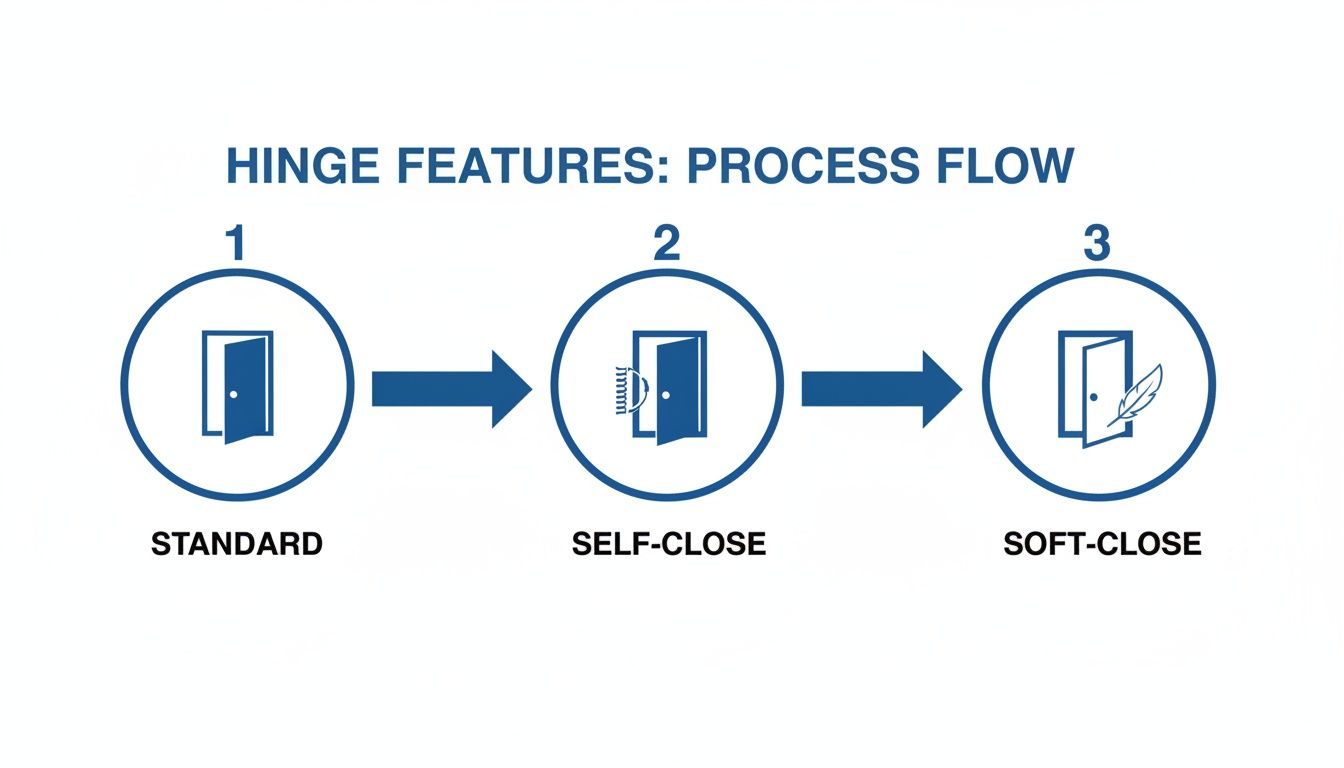
The visualisation clearly illustrates how hinge technology has evolved to enhance user experience, moving from basic functionality to automated and silent closing actions.
One of the most overlooked, yet critical, factors in hinge selection is the weight of the cabinet door. A hinge is rated to support a certain amount of weight, and exceeding this can lead to serious problems down the line.
Heavier doors made from solid wood or MDF require more robust hinges—and often more of them—to prevent sagging. A door that sags not only looks untidy but also puts immense strain on the cabinet frame and the hinges themselves, leading to premature failure.
As a general rule, a standard kitchen door up to about 100cm tall typically needs two hinges. For taller or heavier doors, such as those on a larder unit, adding a third or even a fourth hinge provides the necessary support to keep it perfectly aligned. Always check the manufacturer's specifications for load capacity before you buy. For detailed fitting instructions, you can learn more about how to install concealed hinges in our dedicated guide.
Before you head to the checkout, it’s worth running through a final checklist. Getting these details right from the start saves you time, money, and a whole lot of hassle. Think of this table as your pre-flight check for a perfect hinge installation.
| Measurement or Factor | What to Check | Why It Matters |
|---|---|---|
| Overlay | Measure how much the door covers the cabinet frame. | Ensures the door sits correctly and has the right reveal (gap) when closed. |
| Cup Size | Measure the diameter of the hole in the door (35mm is standard). | The hinge must fit perfectly into the existing recess for a secure fit. |
| Drilling Distance | Measure from the door edge to the cup edge (usually 3-6mm). | Affects the overlay and how the door aligns with the cabinet frame. |
| Door Weight | Estimate the weight of your door. Is it solid wood, MDF, or a lighter material? | Determines how many hinges you need and their required strength to prevent sagging. |
| Door Thickness | Measure the thickness of your cabinet door. | Some hinges are designed for specific door thicknesses; a mismatch can cause issues. |
| Material & Finish | Consider the environment (e.g., bathroom vs. kitchen) and your desired style. | Guarantees long-term durability and complements your overall design aesthetic. |
| Opening Angle | Decide how wide you need the door to open (e.g., 95°, 110°, 170°). | Crucial for corner cabinets or where full access to the interior is needed. |
Taking a few moments to confirm these points will ensure the hinges you choose are a perfect match for your project, giving you a professional-quality finish that lasts.
Even after you get your head around the different hinge types, a few practical questions always seem to pop up mid-project. Here, we tackle some of the most common queries we hear from our customers, giving you clear, straightforward answers to help you lock in your choices.
Think of this as your go-to reference for those final, crucial details that make the difference between a good job and a great one.
Yes, and in most cases, it’s a very straightforward and satisfying upgrade. If your cabinets currently use standard European-style concealed hinges, you can often find a soft-close version with an identical cup size (usually 35mm) and drilling pattern, making it a simple swap.
For older cabinets with traditional butt hinges, the process is a bit more involved. You'll likely need to fill the old screw holes and carefully drill new ones to fit the modern hinge style. Always measure your existing hinges and overlay before buying new ones to get the best possible match.
The key to a successful swap is matching the critical dimensions: cup size, drilling distance, and overlay. Get these right, and upgrading to the quiet convenience of soft-close hinges can be a quick weekend project.
The number of hinges you need comes down to the door's height and weight. Skimping on hinges is a false economy—it can lead to sagging and put unnecessary strain on both the hinges and the cabinet frame itself.
As a general rule of thumb for a standard kitchen cabinet door:
This is a common point of confusion, but the distinction is simple. A self-closing hinge has a spring mechanism that actively pulls the door shut from a certain point, making sure it latches securely. The key thing to remember is that it won’t stop the door from slamming.
A soft-closing hinge, on the other hand, has a hydraulic damper built-in. This little mechanism kicks in during the final few inches of closing, guiding the door to a gentle, silent close. Many modern soft-close hinges are also self-closing, giving you the best of both worlds: a door that pulls itself shut and the quiet landing you want.
At Neasden Hardware, we provide a vast selection of high-quality hinges to suit any project, from sleek soft-close models to traditional butt hinges. Browse our full range of cabinet hardware and find the perfect fit for your needs.