
Order Online
- Straight to your door!
Straight to your door


You close the side gate after a wet winter and hear the familiar scrape across the paving. The latch no longer lines up, the hinge pin has started to rust around the weld, and lifting the leaf by hand is now part of opening it. The gate probably looked sound when it was fitted. The mistake was hidden in the hardware.
Galvanised gate hinges are not difficult to choose, but they must be matched to the gate's weight, width, post and surroundings. A cheap tee hinge can be perfectly adequate on a light garden gate, while the same fitting can fail quickly on a boarded side gate. Coating matters too, but a good galvanised finish won't rescue an undersized hinge or a badly aligned post.
A gate rarely starts failing with a dramatic break. More often, the bottom rail gradually drops, the latch strikes the keep, and the owner lifts the handle to get the leaf closed. By the time the hinge pin is visibly pitted, the gate has already been putting extra strain on the post, fixings and frame.
The hinges carry the gate's static load, but that isn't their only job. They control the swing geometry, hold the leaf at the correct distance from the post and transfer movement into the fixing point. A wide gate creates force on the hinge side, especially when closeboarded timber catches wind or when users pull hard on a stiff latch.
Counter advice: Choose the hinge for the complete gate assembly, not for the hinge length shown in a product photograph.
The British market has settled around repeatable sizes because stocked hardware is quicker to specify than bespoke fabrication. UK listings include a 600 x 165 mm medium-duty field gate hinge set with a 19 mm pin, suitable for gates up to 75 mm thick, while galvanised tee hinges are also commonly listed at 400 mm for heavyweight domestic gates and shed doors. A separate catalogue repeats 600 mm as a field-gate benchmark. These examples show why size conventions help, but they don't replace checking the actual gate weight and post construction.
A proper hot-dip galvanised hinge is a steel fitting protected by a zinc coating formed during immersion in molten zinc. It isn't painted silver, and it isn't the same as a thin electro-zinc finish. The zinc reacts with the iron surface and creates a bonded coating with a degree of metallurgical attachment.
That bond matters on a gate. Hinges are knocked during installation, rubbed as the knuckle moves and exposed at edges, threads and fixing points. Zinc provides barrier protection and also acts sacrificially, helping protect exposed steel when the coating is locally damaged. It won't make a poorly designed hinge indestructible, but it gives outdoor steelwork a far better starting point than untreated or lightly plated metal.
The governing standard for hot-dip galvanised coatings on fabricated iron and steel articles is BS EN ISO 1461:2022, which superseded BS EN ISO 1461:2009. The British Galvanizers Association explains that hot-dip galvanising is covered by the single standard EN ISO 1461, with the older BS 729 superseded. See the Association's explanation of the galvanising standards when a supplier's wording is unclear.
BS EN ISO 1461 sets coating requirements and test methods. It deals with minimum local and mean coating thickness, sampling and inspection, rather than promising a fixed service life in every location. For steel over 6 mm, the minimum local coating is 70 µm and the minimum mean coating is 85 µm. For steel over 3 mm to 6 mm, the minimum local coating is 55 µm and the minimum mean coating is 70 µm, as set out by the British Galvanizers Association guidance.
| Coating | Typical thickness | Standard | Expected outdoor life |
|---|---|---|---|
| Hot-dip galvanised steel | Specified by article thickness under EN ISO 1461 | BS EN ISO 1461 | Depends on environment and zinc loss |
| Zinc-plated steel | Product-dependent and generally lighter than hot-dip galvanising | Product specification required | Shorter protection where the coating is thin or damaged |
| Painted steel | Film thickness depends on preparation and paint system | Paint-system specification required | Depends heavily on preparation, damage and maintenance |
Don't accept “galvanised” as a complete specification without asking what process was used. Electro-zinc can look neat on a shelf, while zinc-rich paint can be useful for repairs, but neither wording automatically gives you the hot-dip coating associated with EN ISO 1461.
A hinge on a sheltered inland garden gate faces a different service environment from one on a coastal driveway. Specify the corrosion category first, then judge the hinge against its coating thickness, gate weight and exposure. “Rust resistant” on a product listing is not a specification.
The Galvanizers Association identifies C2 and C3 as common corrosion categories across large areas of the UK and Republic of Ireland. In C2 environments, indicative zinc loss is 0.1 to 0.7 µm per year, while C3 gives 0.7 to 2 µm per year, as set out in the engineers' and architects' galvanizing guide.
C2 generally covers sheltered, low-pollution rural conditions. C3 is the stronger starting point for ordinary urban exposure and sites affected by coastal or industrial pollution. Breaking surf, heavy salt deposits and aggressive industrial contamination can exceed the usual C2 or C3 choice, so specify the finish more carefully.
Service life depends on coating thickness and annual zinc loss. An 85 µm galvanised coating has an indicative life of about 170, 85, 57, 43 or 34 years at average zinc corrosion rates of 0.5, 1, 1.5, 2 or 2.5 µm per year, respectively. These are coating benchmarks, not promises that the whole hinge will remain sound for that period. Pins, welds, fixings, trapped dirt and repeated gate movement may fail first.
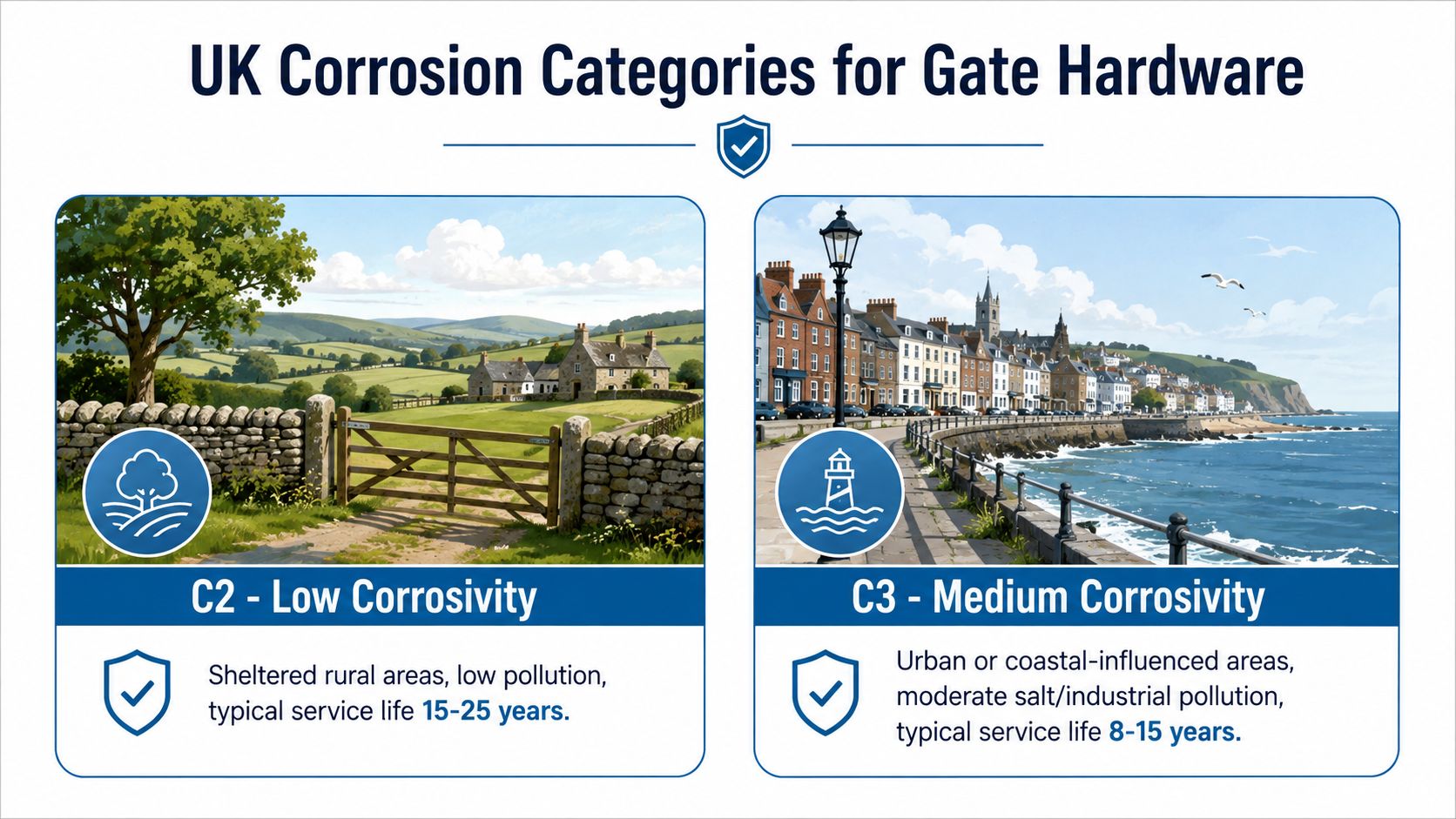
For purchasing, use the infographic's practical guide of 15 to 25 years in C2 and 8 to 15 years in C3, with shorter service expected near the coast. On a heavy, exposed or difficult-to-access gate, specify a thicker protective system, an overcoat or stainless components. A generic galvanised label is not enough.
The hinge shape decides how the gate sits against the post and how its load reaches the structure. Pick the format first, then select the size and coating. A product grid that lists only “light”, “medium” and “heavy” won't answer the important question, which is whether the hinge line suits the gate face and post.
Straight hinges suit a flush-mounted gate that closes flat to the face of the post. They're tidy on a simple timber frame where the hinge leaves can sit squarely without needing to move the gate clear of the post.
Cranked, or dog-leg, hinges are the more useful default for boarded field gates and closeboarded side gates. The offset moves the gate leaf away from the post face, giving the boards and frame clearance as the gate swings. Check that the crank is facing the correct way before tightening, because reversing it can put the leaf in the wrong position and reduce the opening arc.
Tee hinges are sensible on light garden gates and shed doors. The plan requirement often seen at the counter is a gate under 30 kg, but treat that as a light-duty example rather than a universal rating. Timber condition, gate width and use still matter.
Hook-and-band hinges are the serious choice for heavy gates, masonry openings and very large timber posts. The strap spreads the load across the gate, while the hook transfers it into a through-fixed or properly anchored post arrangement. Don't hang a substantial gate from a few screws driven into the edge of a soft post.
Adjustable hinges justify their cost on driveway gates and installations where the leaf may need correction after settling. They let you alter the gate position without dismantling the complete hinge arrangement, which is valuable when the post, ground or gate geometry isn't perfectly forgiving.
For a broader overview of hinge formats, use this guide to different types of hinges. If the project also includes a security gate, compare the wider installation budget with this resource on security gate prices 2026, while remembering that the hinge specification still depends on the actual leaf and post.
| Hinge type | Best for | Typical gate weight | Post material |
|---|---|---|---|
| Straight | Flush-mounted garden and timber gates | Light to medium | Timber or steel |
| Cranked | Boarded field gates and closeboarded side gates | Medium to heavy | Timber, steel or concrete with suitable fixing |
| Tee | Light garden gates and shed doors | Under 30 kg as a light-duty guide | Timber |
| Hook-and-band | Heavy gates and masonry openings | Heavy-duty applications | Large timber, masonry or steel |
| Adjustable | Driveway gates and gates needing later correction | Medium to heavy | Timber or steel, depending on model |
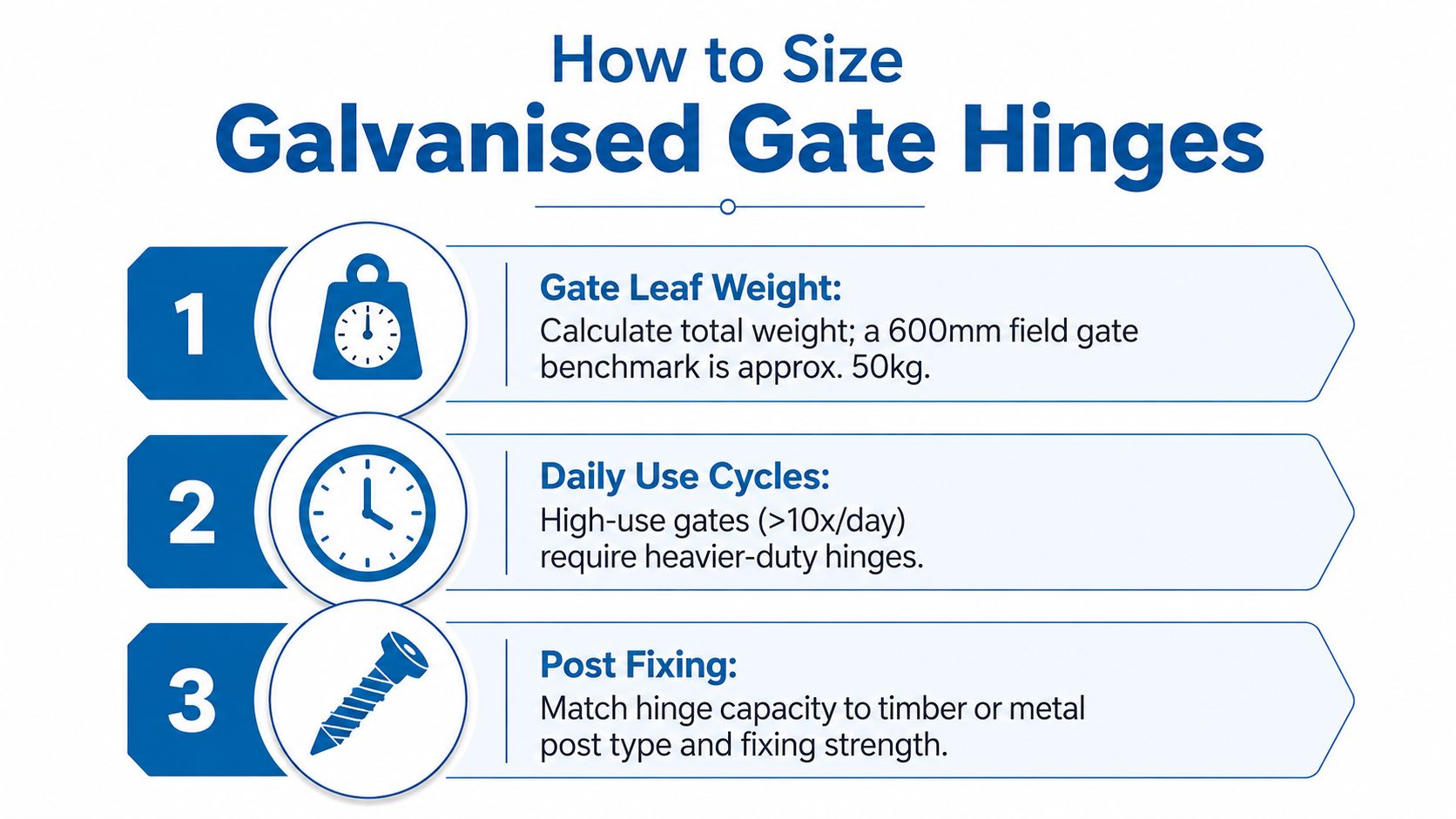
Hinge length alone doesn't tell you whether a set is suitable. Start with the gate leaf weight, then consider width, infill, frequency of use and the strength of the post fixing. A closeboarded leaf can weigh far more than its frame suggests, and wind loading adds repeated stress even when the gate is opened only occasionally.
A useful trade-counter reference is the stocked 600 mm field-gate format. One UK listing gives a medium-duty set at 600 x 165 mm, with a 19 mm pin and suitability for a 75 mm-thick gate, as shown in the field gate hinge specification. The market also includes 600 mm and 35 mm field-gate sets in pre-packed ironmongery ranges, so 600 mm is a recurring benchmark rather than an odd bespoke size.
For a practical example, take a 1.8 m wide by 1.2 m high five-bar field gate weighing around 45 kg, hung on a 150 mm timber post. Specify at least 450 mm hook-and-band hinges with a 16 mm pin, two per leaf, provided the hinge and fixing system are rated for that load. This is a working specification example, not a substitute for the manufacturer's capacity table.
Estimate the leaf weight from the frame, rails, boards, mesh or steelwork. Then ask how often it moves. A rarely opened field gate and a frequently used driveway gate may have the same static weight but very different wear demands. Increase the hinge duty, pin diameter or hinge count when the gate is tall, wide, wind-exposed or used repeatedly.
Pin diameter matters because the pin and knuckle carry the rotating load directly. Don't choose a long strap with a small pin just because the strap looks substantial. For self-closing arrangements and the extra requirements around controlled closing, this self-closing gate hinges guide provides useful additional context.
Sizing rule: If the gate is heavy, wide or used frequently, step up the hinge duty before you start comparing decorative finishes.
A well-specified hinge still fails if the hinge line is out of position. Mark the top hinge about 200 mm down from the gate top and the bottom hinge about 200 mm up from the bottom. Fit a third hinge to gates over 1.8 m, especially where the leaf is tall, heavy or opened often. Keep the hinge centres aligned, or the gate will bind as soon as the fixings are tightened.
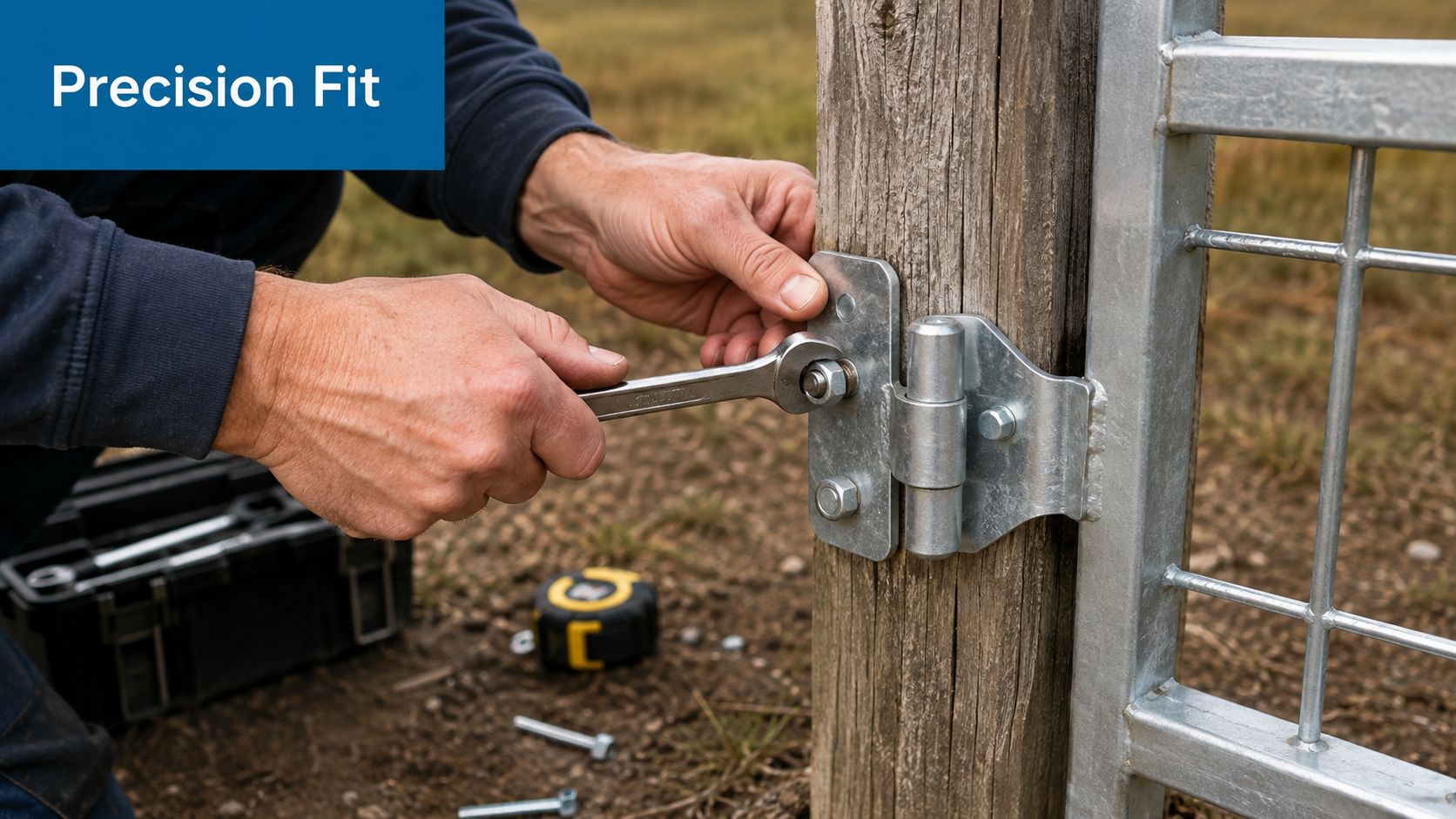
Fix hinge leaves and straps to sound timber, avoiding split edges and rotten end grain. Drill pilot holes suited to both the fixing and the timber. Softwood and hardwood require different pilot-hole treatment, so follow the coach-screw maker's guidance rather than driving a full-size screw into un-drilled timber. Match the fixings to the coating. Use galvanised or stainless fixings with galvanised hinges, because bare ferrous steel at the joint becomes a corrosion point and may stain or damage nearby zinc.
Cranked hinges need enough offset for the leaf to clear the post. Set roughly 5 to 10 mm clearance, then test the full swing before final tightening. Hook-and-band straps on uneven masonry may need packing. Use durable packers and stainless washers where the strap meets an irregular surface. This spreads the load and prevents tightening from twisting the hinge or crushing a high spot.
Use a hinge designed for a metal post. Depending on the section, that means bolting through suitable steel, welding compatible components or fitting rated brackets. A timber screw fixing is not a sound connection to hollow steelwork. The post must carry the hinge load and resist movement.
Follow this gate hinge installation guide for another practical view of the fitting process. A shim beneath the bottom hinge can correct minor gate drop without removing the leaf. It will not repair a leaning post or an undersized hinge.
Before final tightening, plumb the gate in both planes with a spirit level. Check the latch-side gap, top gap, bottom gap and complete opening arc. If the gate swings freely while loose but binds after tightening, the hinge line or packing is under strain. For fixing selection and pilot-hole guidance, read this advice on what size screws to use for door hinges, then apply the same principle to gate work: match screw diameter, length and coating to the material and load.
Galvanised hinges need maintenance. The coating slows corrosion, but mud, trapped water, livestock contamination and neglected pins can still damage the moving parts. Give the installation a proper visual check at least annually, and inspect sooner if the gate is exposed or heavily used.
Look for these six warning signs:
Lubricate the pin and moving knuckle every six months with marine-grade grease. A graphite or PTFE lubricant suits the moving knuckle where a cleaner, lighter application is preferred. Choose a dry weather window, clean away grit first and don't pack abrasive dirt into the joint with excess lubricant.
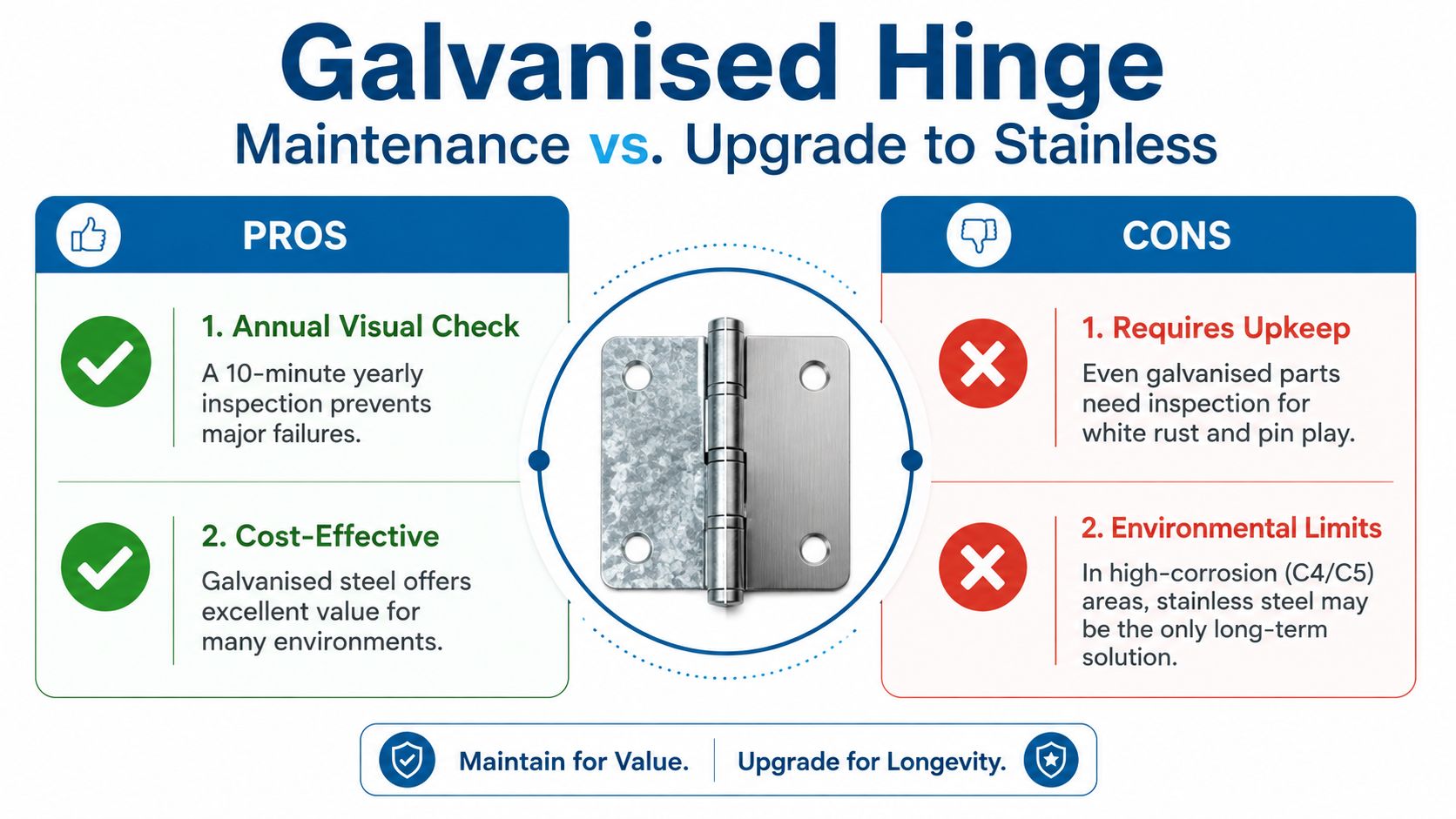
Galvanised steel is the right-value choice for many inland gates, especially where the hinge is accessible and the post is properly protected. Stainless steel A2 or A4 becomes the better buy within 1 km of breaking surf, on pool enclosures, in livestock housing with constant urine exposure, or where the gate forms part of critical security. These are aggressive conditions, and replacing a seized hinge can cost more in labour and disruption than choosing a more suitable material at the outset.
UK suppliers now separate galvanised, stainless steel, blue galvanised and black passivated ranges, which reflects the need to match protection to the application. Don't pay for stainless automatically, but don't specify ordinary galvanised hardware for a location that will attack it continuously. The guide to fixing squeaky door hinges also reinforces the practical point, lubrication and inspection should happen before movement becomes a failure.
Before ordering, write down the conditions that will decide whether the hinge lasts or fails.
Use two hinges only where the leaf and hinge capacity support that arrangement. A tall, heavy or frequently used gate may need a third hinge, as covered earlier.
Final trade rule: If the choice falls between sizes, step up one hinge size. A properly specified hinge gives useful margin, while an undersized hinge fails long before a sound galvanised coating does.
Neasden Hardware supplies hinges, fixings and related ironmongery for tradespeople and DIY projects, with online ordering and a Wembley showroom for practical product guidance. Visit Neasden Hardware before ordering the gate hardware.