
Order Online
- Straight to your door!
Straight to your door


You know that lock on your front door that clicks shut behind you, automatically securing the door without you needing to fumble for a key? That's a night latch. Think of it as a convenient, one-way security gate for your home; it’s designed for an easy exit while requiring a key to get back in.
A night latch is a type of lock that’s surface-mounted, which just means its main body sits on the inside face of your door rather than being tucked away inside it. Its key feature is a spring-loaded latchbolt that shoots into a keep on the door frame, securing the door the second it closes. This automatic locking is what really defines it and makes it so popular.
This clever mechanism gives you instant security without you having to remember to lock the door manually. Night latches, often just called 'Yale' locks here in the UK, have been a staple on external doors across British homes for well over a century. That spring action is what sets them apart from deadlocks, as it allows the door to latch shut on its own, cutting out the risk of accidentally leaving your home unlocked—a simple feature that has made them a huge hit with homeowners. If you want to get into the nitty-gritty of lock parts, you can check out our guide on what a Euro cylinder lock is.
A few core components work together to provide this simple but effective security. These are the main parts you'll deal with:
Once you get the hang of what a night latch is, you'll start noticing they come in a few different flavours, each offering its own level of security. Choosing the right one really comes down to what your property needs. This isn't a one-size-fits-all situation; the world of night latches ranges from standard models built for convenience to high-security versions designed to stop intruders in their tracks.
The most common type you'll see is the Standard Rim Night Latch. This is the classic "Yale lock" that’s on countless front doors across Britain. It’s convenient because it automatically locks the door when you pull it shut. Simple. However, its biggest weakness is that the latch can sometimes be "slipped" open from the outside by a burglar with nothing more than a thin piece of plastic.
For better protection, the Deadlocking Night Latch is a serious step up. This type lets you secure the latchbolt so it can't be pushed back from either side. You can usually engage the deadlock from the inside with an extra turn of the knob or by using the snib, and from the outside with a full turn of the key. This simple action stops the bolt from being slipped open, adding a vital layer of security.
A deadlocking function essentially turns your convenient, springy latch into a solid, unmoving bolt. This one feature makes it much harder for someone to force the latch back from the outside, giving you real peace of mind when you're away from home or sleeping.
Finally, for the best of both worlds—convenience and security—there’s the Auto-Deadlocking Night Latch. This model automatically deadlocks the bolt every single time the door closes, without you having to lift a finger. The mechanism prevents the bolt from being retracted once it's in the door frame, completely getting rid of the risk of slipping. This diagram shows the key parts that are common to all these types.
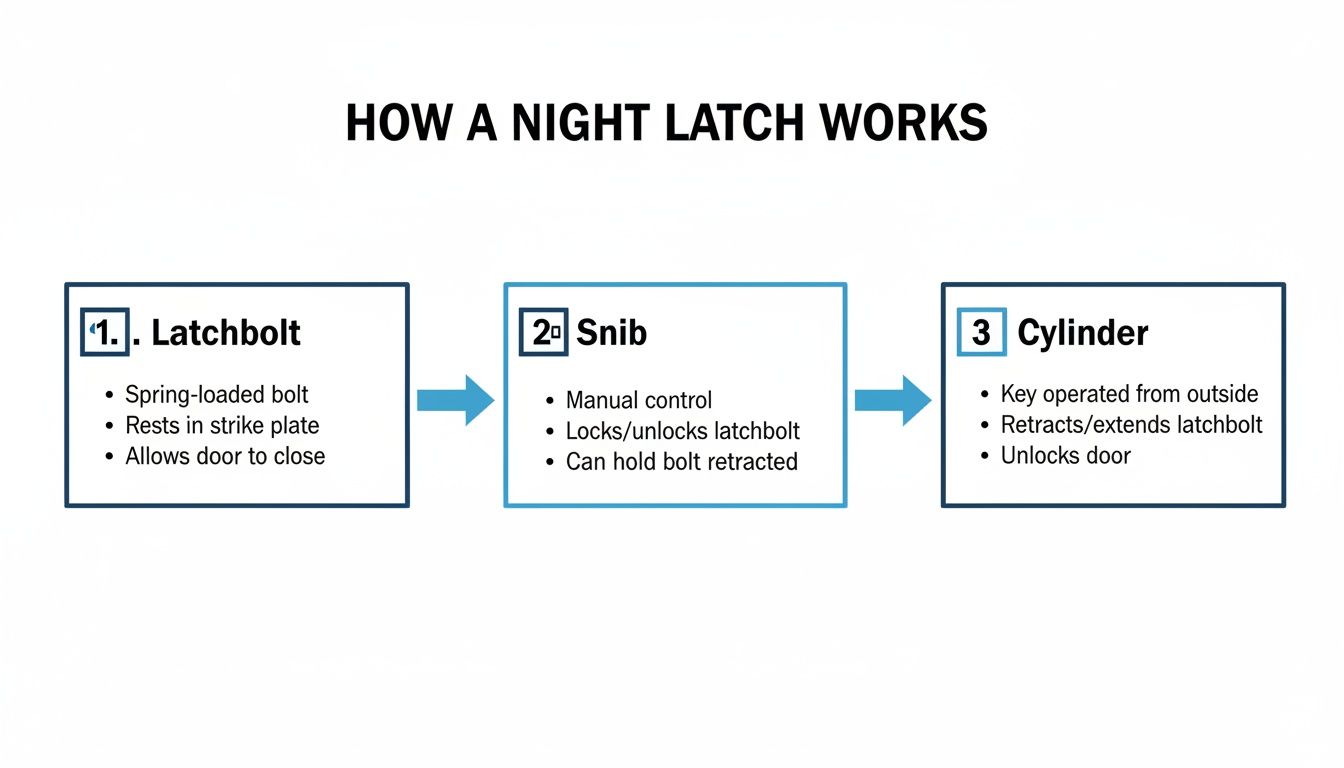
As you can see, the external cylinder, the internal snib, and the latchbolt itself all work together to keep your door secure. Each type of night latch uses these same core parts but builds on them with different security features to suit different needs.
To make sense of the options, here’s a quick comparison of the common night latch types you'll find in the UK. This table breaks down their features and typical security levels to help you decide which is the best fit for your door.
| Feature | Standard Rim Night Latch | Deadlocking Night Latch | Auto-Deadlocking Night Latch |
|---|---|---|---|
| Locking Action | Automatic latching when door closes | Automatic latching; manual deadlocking | Automatic latching and deadlocking |
| Security Level | Basic | Medium to High | High |
| Protection Against "Slipping" | Vulnerable | Protected when deadlocked | Always protected |
| User Action Required | None for basic locking | Turn key/snib to deadlock | None; locks and deadlocks automatically |
| Best For | Low-risk areas, internal doors | External doors, homes needing extra security | High-security needs, convenience |
Choosing the right lock is all about balancing convenience with the level of security you need. While a standard latch is fine for some situations, upgrading to a deadlocking or auto-deadlocking model provides a significant boost in protection that's well worth considering for any external door.
It's a common mistake to think that just having a locked door means you're covered by your insurance policy. The reality is that many UK home insurers have very specific rules about the locks you need, and a standard night latch on its own often won’t make the cut.
The gold standard for locks in the UK is British Standard BS 3621. Think of it as a badge of honour, proving a lock has been put through its paces against the common tricks of the trade used by burglars. Insurers almost always insist that your external doors have at least one BS 3621-compliant lock.
Because a basic night latch can be vulnerable to being 'slipped' open with a credit card or simply forced, it's nearly always a requirement to team it up with something tougher. This is where a proper 5-lever mortice deadlock enters the picture.
For proper security and to keep your insurer happy, the best setup for a front door is a night latch for day-to-day convenience, backed up by a BS 3621-approved 5-lever mortice deadlock. While the night latch handles the auto-locking, the deadlock provides the serious, heavy-duty security that policy documents demand.
A mortice deadlock is fitted into the door itself, not just onto the surface. When you turn the key, a solid bolt shoots deep into the door frame, making it incredibly tough to kick in or force open. This two-lock system really does give you the best of both worlds.
To get a clearer picture of how they work together, you can learn more about what mortice locks are in our detailed article.
When you're shopping for a night latch, especially a high-security model, keep an eye out for features that are specifically designed to stop common break-in methods. These are the details that separate a basic lock from one that’s truly insurance-rated.
Key defensive technologies include:
By pairing your night latch with a BS 3621 deadlock, you’re not just making your home more secure—you're also making sure it’s fully compliant with your insurance policy. It's a simple step that can prevent a lot of headaches if you ever need to make a claim.
It’s easy to forget, but before the night latch became a household staple, securing your home was a much more deliberate, clunky affair. Its arrival was a game-changer, bringing a new level of convenience and reliable security to ordinary homes across Britain. Gone were the days of having to manually throw a heavy bolt; the night latch did the work for you, every time you closed the door.
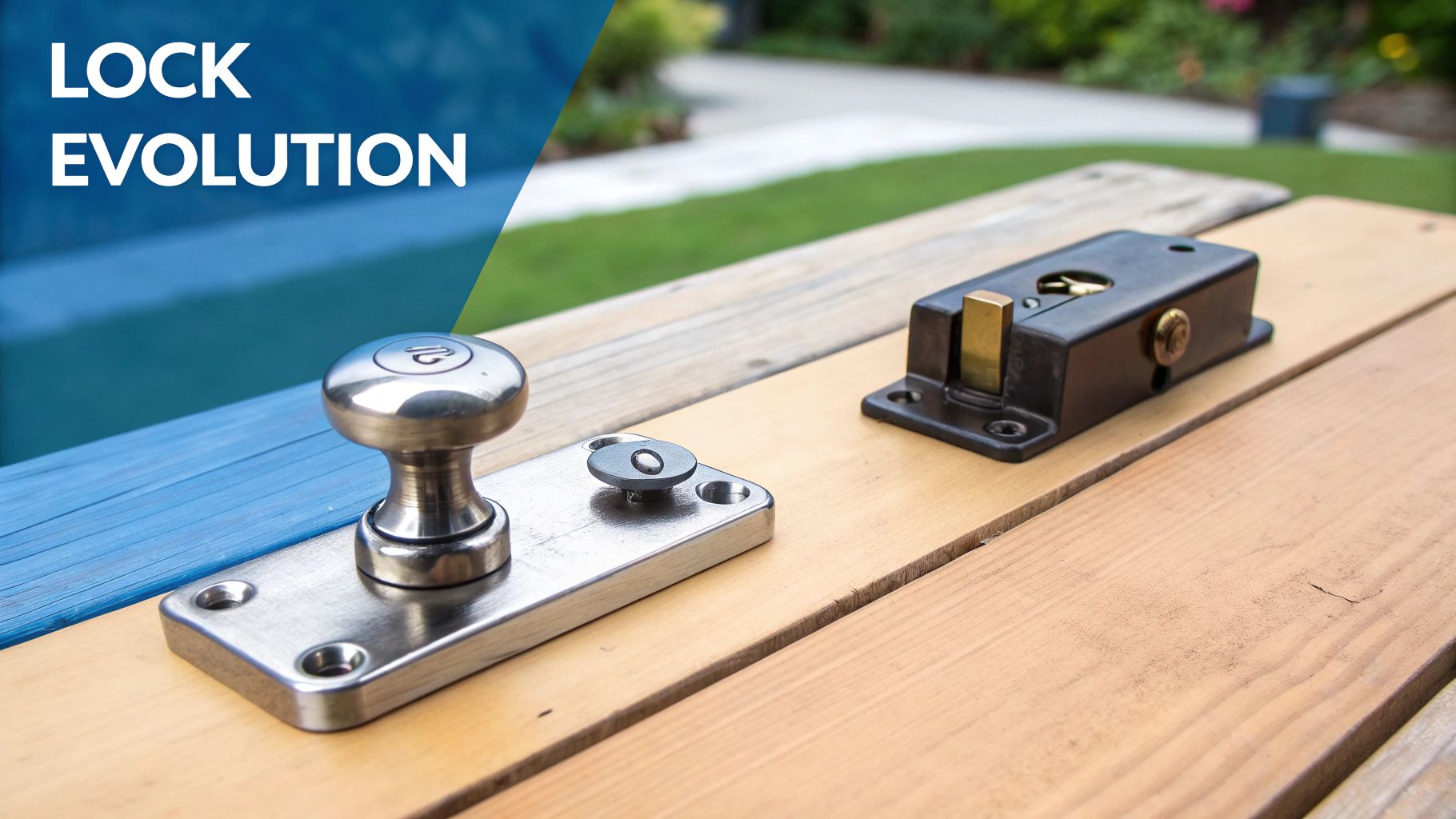
The real breakthrough that paved the way for the modern night latch was the invention of pin-tumbler technology—a design famously associated with the 'Yale' brand. This clever concept, which fundamentally changed how we secure our homes, was first patented by Abraham O. Stansbury, an American physician who was living in England at the time. It was a genuine leap forward in domestic security.
Of course, as decades passed, burglary techniques became more sophisticated. Locksmiths and engineers had to keep up, and the night latch evolved right alongside these new threats. This constant improvement led to some crucial security enhancements that are now standard.
Modern high-security night latches are a direct response to historical vulnerabilities. Features like drill-resistant plates, anti-pick cylinders, and anti-carding mechanisms were all developed to defeat common methods of forced entry, making today’s locks far more resilient than their predecessors.
This cycle of innovation is precisely why the night latch has remained such a trusted fixture on British front doors. Its proven reliability has cemented its reputation, and for those looking to build a wider security strategy, it often works alongside a complete home security system installation.
Before you even think about buying, grab a tape measure. There are a couple of key measurements you absolutely need to get right.
First up is door thickness. You need to know this to make sure the cylinder and fixings will actually fit. Most standard night latches are built for doors between 44mm and 60mm thick, but it’s always wise to measure yours to be certain.
Next, and just as important, is the backset. This is the distance from the very edge of your door to the centre of the keyhole. The two most common backsets are 40mm and 60mm. If you get this measurement wrong, the lock simply won’t fit the existing holes or line up properly with the frame.
This isn't a full-blown fitting manual, but understanding the basic process helps you know what the job involves. The steps are pretty logical but demand a bit of precision. For a more detailed walkthrough, check out our guide on how to install door locks in our dedicated article.
Generally, the installation process breaks down into these stages:
Getting the alignment spot on is the most critical part of the entire job. A misaligned lock and keep will cause the door to stick, stop it from latching securely, and lead to the mechanism wearing out far too quickly.
Once your night latch is fitted correctly, a little bit of maintenance will go a long way. Every now and then, check that all the screws are tight and give the moving parts a light spray with a graphite-based lubricant. This will keep it operating smoothly and reliably for years to come.
It's completely normal to have a few questions when you're wading through the world of door hardware. To make things a bit clearer, here are some straight-talking answers to the queries we hear most often about night latches and where they fit in your home security setup.
In short, no. For the vast majority of UK home insurance policies, a standalone night latch just won’t cut it. It needs to be paired with a BS 3621-compliant 5-lever mortice deadlock to meet security standards and give you proper protection against break-ins.
Think of it this way: the night latch is for day-to-day convenience, but the deadlock is the heavy-duty security that keeps your home safe and your insurer happy.
A night latch uses a spring-loaded, sloped bolt that automatically locks the door behind you when it closes. A deadbolt (or deadlock), on the other hand, is a completely manual lock. You have to use a key or a thumbturn to slide a solid, straight bolt across into the doorframe.
Deadbolts are far more secure because the bolt can't be pushed back without a key, meaning they can't be 'slipped' open like a basic night latch can.
The real difference comes down to convenience versus deliberate security. A night latch locks itself automatically, while a deadbolt needs you to actively lock it, creating a much tougher barrier.
If you're swapping an old night latch for a brand-new, identical model, it's usually a straightforward job for a confident DIYer. It mostly involves just unscrewing the old unit and screwing the new one in its place.
However, if you're fitting a different type of lock or installing one from scratch on a new door, things get trickier. The job requires precise drilling and careful alignment to make sure it works smoothly and is secure. If you're not 100% confident, it’s always best to call a locksmith or an experienced carpenter for a guaranteed professional finish.
For expert advice and a full range of high-security night latches and deadlocks, take a look through the catalogue at Neasden Hardware. Find the perfect solution for your project today at https://neasdenhardware.co.uk.